The Battle of Queenston Heights by William Thomas White

white
Queenston, Upper Canada on the Niagara. Looking from the village to the Heights. By Edward Walsh, c.1803-1807
Image courtesy of the Library of Congress


A Patriotic Poem Written on the Anniversary of that Great Victory

Ho ! ye who are  Canadians, and glory in your birth,
Who boast your land the fairest of all the lands on earth,

To-night go home with cheerful heart and lay all care aside,
And set aglow your brightest lamps and throw the shutters wide.

Heap high with coal the fire, till its merriest sparks you win,
And send out all your messengers to call the neighbors in.

Then when the evening well is spent with feast and mirthful sound,
In circle deep about the hearth range girls and boys around.

Bring forth the book of heroes’ deeds, and to your listening flock,
Read reverently of Queenston Heights and the death of Isaac Brock.

Oh, there are some amongst us who spurn the patriot’s name,
Who say our country has no past, no heroes known to fame.

They talk of bold Leonidas who held the pass of blood,
And how Horatius Cocles braved swollen Tiber’s flood.

They never tire of dark Cortez who spared nor blood nor tears,
Nor yet of Arnold Winkelreid, who broke the Austrian spears.

Their glory is of Waterloo, that crimson-memoried fight,
Of the “thin red line” of Inkerman and Alma’s bloody height.

For Canada their voice is mute, yet history’s pages tell
That braver blood was never spilt than where her heroes fell.

To-day o’er Queenston’s lofty heights the autumn sky is drear,
From drooping limbs the withering leaves hang bloodless, wan and sere.

From fertile sward the plough has gone, and from the field the wain,
In bursting barns the farmer views his wealth of garnered grain.

Those fields are sacred and that sward shall be Canadians’ boast,
The spot where valor’s few hurled back the dark invader’s host.

The tale shall live while grow the trees, while rippling water runs,
Of fame’s bright birth to Canada from the life-blood of her sons.

You know it well ! The invaders crossed with the first grey dawn of light,
And foot by foot their numbers told and gained the stubborn height.

The guns are ta’en ! on Dennis’ flank the reinforcements pour,
While from the battery on the hill the crashing round-shot tore.

And backward, surely backward, the patriot heroes move,
With death to left and death to right and death on high above.

But, hark ! When hope has almost fled, at the hour of sorest need,
Is heard the clatter of iron hoofs and the neigh of a coursing steed.

Now let the martial music breathe its most inspiring notes,
As bursts the shout of welcome from the faltering veterans’ throats !

What spell so much could nerve them in that losing battle’s shock,
“Courage, boys ! It is the General ! Onward comrades ! On with Brock !”

Now forward to the battery ! They lend a ready ear ;
There’s a hero’s form, to lead them and a hero’s voice to cheer.

And o’er the level plain they press, and up the sloping hill,
‘Mid hiss of shot and volleys’ smoke his cry is “Onward !” still.

And now they pass the low ravine, they clamber o’er the wall ;
The fatal death-shot strikes him ; they see their leader faIl.

“Push on, push on, York volunteers !” brave words—they were his last,
And like the vision of a dream the charging column passed.

He heard their cry of vengeance as they reached the mountain’s crest,
Then rushed in purpling tide the flood of life-blood from his breast.

You’ve read the rest ; their comrades came to stay their second flight,
Dashed on to meet the foe in blue and hurled them from the height.

Then, Canada, was seen thy might ! by equal ardour led,
Fought Indians like white men, and coloured men like red.

One spirit moved, one thought inspired that gallant little band ;
That foot of no invading foe should e’er pollute their land.

A thousand men laid down their arms to force inferior far ;
Blush, fickle land of commerce, for thy myrmidons of war.

Sleep, heroes ! Rest upon the hill where valor’s deed was done,
No flower shall ever wither in a crown so nobly won.

While Canada can rear her sons, the bravest of the brave,
From the tempests of Atlantic to the placid western wave,

So surely as shall come the day that tells your deathless fame,
Shall future patriots mourn you and festal rites proclaim.

And thou, whose sacred dust entombed on yonder summit lies,
Beneath that noble monument far-reaching toward the skies,

Thy name shall be a holy word, a trumpet-note to all,
When bravery’s arm is needed and they hear their country’s call.

And future sires, shall take their sons at evening on their knee,
And tell the old tale over, and thus shall speak of thee—

“His is the noblest name we have in all our bright array ;
He taught our youth to falter not tho’ death might bar the way ;

“He showed our might, he led our arms, he conquered, tho’ he fell ;
He gave up all he had—his life—for the land he loved so well.”


Source: Raise the Flag and Other Patriotic Canadian Songs and Poems. Toronto: Rose Publishing, 1891

About William Thomas White

Upon the Heights at Queenston by James L. Hughes

hughes
Brock’s Monument, Queenston Heights. Sketched by I.F. Bouchette.
Courtesy of Archives de Montréal

UPON the heights at Queenston,
‡‡One dark October day,
Invading foes were marshalled
‡‡In battle’s dread array ;
Brave Brock looked up the rugged steep,
‡‡And planned a bold attack,
“No foreign flag shall float” said he,
‡‡“Above the Union Jack !”

His loyal-hearted soldiers
‡‡Were ready, every one,
Their foes were thrice their number—
‡‡But duty must be done.
They started up the fire-swept hill
‡‡With loud resounding cheers,
While Brock’s inspiring voice rang out
‡‡“Push on York Volunteers !”

But soon a fatal bullet
‡‡Pierced through his manly breast,
And loving friends, to help him,
‡‡Around the hero pressed ;
“Push on,” he said, “do not mind me,”
‡‡And ere the setting sun,
Canadians held the Queenston Heights—
‡‡The victory was won.

Each true Canadian patriot
‡‡Laments the death of Brock.
Our country told its sorrow
‡‡In monumental rock ;
And if a foe should e’er invade
‡‡Our land in future years,
His dying words will guide us still—
‡‡“Push on brave volunteers !”


Source: Raise the Flag and Other Patriotic Canadian Songs and Poems. Toronto: Rose Publishing, 1891

About James L. Hughes

This poem by Hughes was also set to music by Alan Mills, and published under the title “The Battle of Queenston Heights” in Singing Our History: Canada’s Story in Song. by Edith Fowke and Alan Mills. Toronto: Doubleday, 1984

A Ballad For Brave Women by Charles Mair

mair
Monument and bust of Laura Secord, heroine of Battle of Beaver Dam, Beaver Dam, Ontario, Canada, stereograph, 1908
Image courtesy of the Library of Congress.

A STORY worth telling, our annals afford,
’Tis the wonderful journey of Laura Secord!
Her poor crippled spouse hobbled home
‡‡‡‡‡‡‡‡‡‡‡‡‡‡‡‡‡‡‡‡‡‡‡‡With the news
That Bœrstler was nigh ! “Not a minute to lose,
Not an instant,” said Laura, “for stoppage or pause—
I must hurry and warn our brave troops at Decaws.”
“What ! you !” said her husband “to famish and tire !”
“Yes, me !” said brave Laura, her bosom on fire.
“And how will you pass the gruff sentry ?” said he,
“Who is posted so near us ?”

‡‡‡‡‡‡‡‡‡‡‡‡‡‡‡‡‡‡‡‡‡‡‡‡“Just wait till you see ;
The foe is approaching, and means to surprise
Our troops, as you tell me. Oh, husband, there flies
No dove with a message so needful as this—
I’ll take it, I’ll bear it, good bye, with a kiss.”
Then a biscuit she ate, tucked her skirts well about,
And a bucket she slung on each arm, and went out

’Twas the bright blush of dawn, when the stars melt from sight,
Dissolved by its breath like a dream of the night ;
When heaven seems opening on man and his pain,
Ere the rude day strengthens, and shuts it again.
But Laura had eyes for her duty alone—
She marked not the glow and the gloom that were thrown
By the nurslings of morn, by the cloud-lands at rest,
By the spells of the East, and the weirds of the West.  
Behind was the foe, full of craft and of guile ;
Before her, a long day of travel and toil.
“No time this for gazing,” said Laura, as near
To the sentry she drew.

‡‡‡‡‡‡‡‡‡‡‡‡‡‡‡‡‡‡‡‡‡‡‡‡“Halt ! you cannot pass here.”
“I cannot pass here ! Why sirrah you drowse,
Are you blind ? Don’t you see I am off to my cows.”
“Well, well you can go.” So she wended her way
To the pasture’s lone side, where the farthest cow lay,
Got her up, caught a teat, and with pail at her knees,
Made her budge, inch by inch, till she drew by degrees
To the edge of the forest. “I’ve hoaxed, on my word,
Both you and the sentry,” said Laura Secord.

With a lingering look at her home, then away
She sped through the wild wood—a wilderness gray—
Nature’s privacy, haunt of a virgin sublime
And the mother who bore her, as ancient as Time ;
Where the linden had space for its fans and its flowers,
The balsam its tents, and the cedar its bowers ;
Where the lord of the forest, the oak, had its realm,
The ash its domain, and its kingdom the elm ;
Where the pine bowed its antlers in tempests, and gave
To the ocean of leaves the wild dash of the wave,
And the mystical hemlock—The forest’s high-priest—
Hung its weird, raking, top-gallant branch to the east.

And denser and deeper the solitude grew,
The underwood thickened, and drenched her with dew ;
She tripped over moss-covered logs, fell, arose,
Sped, and stumbled again by the hour, till her clothes
Were rent by the branches, and thorns, and her feet
Grew tender and way-worn and blistered with heat.
And on, ever on, through the forest she passed,
Her soul in her task, but each pulse beating fast,
For shadowy forms seemed to flit from the glades
And beckon her into their limitless shades :
And mystical sounds—in the forest alone,
Ah! who has not heard them ?—the voices, the moan,
Or the sigh of mute nature, which sinks on the ear,
And fills us with sadness or thrills us with fear ?
And who, lone and lost, in the wilderness deep,
Has not felt the strange fancies, the tremors which creep,
And assemble within, till the heart ’gins to fail,
The courage to flinch, and the cheeks to grow pale,
’Midst the shadows which mantle the spirit that broods
In the sombre, the deep haunted heart of the woods ?

She stopped—it was noonday. The wilds she espied
Seemed solitudes numberless. “Help me !” she cried ;
Her piteous lips parched with thirst, and her eyes
Strained with gazing. The sun in his infinite skies
Looked down on no creature more hapless than she,
For woman is woman where’er she may be.
For a moment she faltered, then came to her side
The heroine’s spirit—the Angel of Pride.
One moment she faltered. Beware ! What is this ?
The coil of the serpent ! the rattlesnake’s hiss !
One moment, then onward, What sounds far and near ?
The howl of the wolf, yet she turned not in fear
Nor bent from her course, till her eye caught a gleam
From the woods of a meadow through which flowed a stream,
Pure and sweet with the savour of leaf and of flower.
By the night dew distilled, and the soft forest shower ;
Pure and cold as its spring in the rock crystalline,
Whence it gurgled and gushed ’twixt the roots of the pine.

And blessed above bliss is the pleasure of thirst,
Where there’s water to quench it ; for pleasure is nursed
In the cradle of pain, and twin marvels are they
Whose inter-dependence is born with our clay.
Yes, blessed is water, and blessed is thirst,  
Where there’s water to quench it ; but this is the worst
Of this life, that we reck not the blessings God sends,
Till denied them. But Laura, who felt she had friends
In heaven as well as on earth, knew to thank
The giver of all things, and gratefully drank.

Once more on the pathway, through swamp and through mire,
Through covert and thicket, through bramble and brier,
She toiled to the highway, then over the hill,
And down the deep valley, and past the new mill,
And through the next woods, till, at sunset, she came
To the first British picket and murmured her name ;
Thence, guarded by Indians, footsore and pale
She was led to Fitzgibbon, and told him her tale.

For a moment her reason forsook her ; she raved,
She laughed, and she cried—“They are saved, they are saved !”
Then her senses returned, and with thanks loud and deep
Sounding sweetly around her she sank into sleep.
And Bœrstler came up, but his movements were known,
His force was surrounded, his scheme was o’erthrown
By a woman’s devotion—on stone be’t engraved—
The foeman was beaten and Burlington saved.

Ah ! faithful to death were our women of yore !
Have they fled with the past to be heard of no more ?
No, no ! Though this laurelled one sleeps in the grave,
We have maidens as true, we have matrons as brave ;
And should Canada ever be forced to the test—
To spend for our country the blood of her best !
When her sons lift the linstock and brandish the sword,
Her daughters will think of brave Laura Secord !


Source: Raise the Flag and Other Patriotic Canadian Songs and Poems. Toronto: Rose Publishing, 1891

Mair originally published this poem possibly in 1888 – the following was written in Grip, July 7, 1888:

The heroic conduct of Mrs. Laura Secord in apprising the British of the contemplated attack of Bœrstler’s forces in 1812, is once again made the subject of a poem, and this time the same hand that gave in Tecumseh, Vide the Week of June 21st. A first rate piece of work by a Canadian author is something uncommon enough to evoke enthusiasm, and the bard of Price Albert rarely fails to “do us proud.” After reading his latest we unanimously shout “Give us Mair, Charles, give us Mair!”

Read about Charles Mair


Of Sometime True Lovers by Doug Smith

sometime
Horseshoe Falls in Winter. Photo by Heather Rodman
Courtesy of Niagara Falls Public Library

In the yellow and blue dawn of winter
I will come for her
My misty apparition
who fogs my eyes and senses
and comforts me with her chilled
wet kiss

She knows my secret sins
She’s lived my life
“Come in,” says Niagara
“The water’s fine”
I know it’s not true, it’s freezing in December

Look up from the Horseshoe Falls
see the Rainbow Bridge, Goat Island, the gaudy signage
Home…

Look down upon the frigid rapids
My misty apparition
who fogs my eyes and senses
and I wonder how it will be
to know the caress 
of my sometime true lover
as I lapse gently inside her
and ponder my new address

Slipping into her grasp
suicide and marriage are one
no cold, no fear
just nostalgia


Source: The author, 2022. Of Sometime True Lovers was first published on All Poetry, 6/9/21, Written 10/31/98

Author’s note: While this appears to be about suicide in Niagara Falls, it’s really about what I owe to the city itself, the city that I grew up in and made me.

See Doug Smith ’s All Poetry site (Darknightofthesoul)

Doug Smith is a former Niagara Falls, NY resident


Another December Snow Day in Niagara Falls by Doug Smith

december
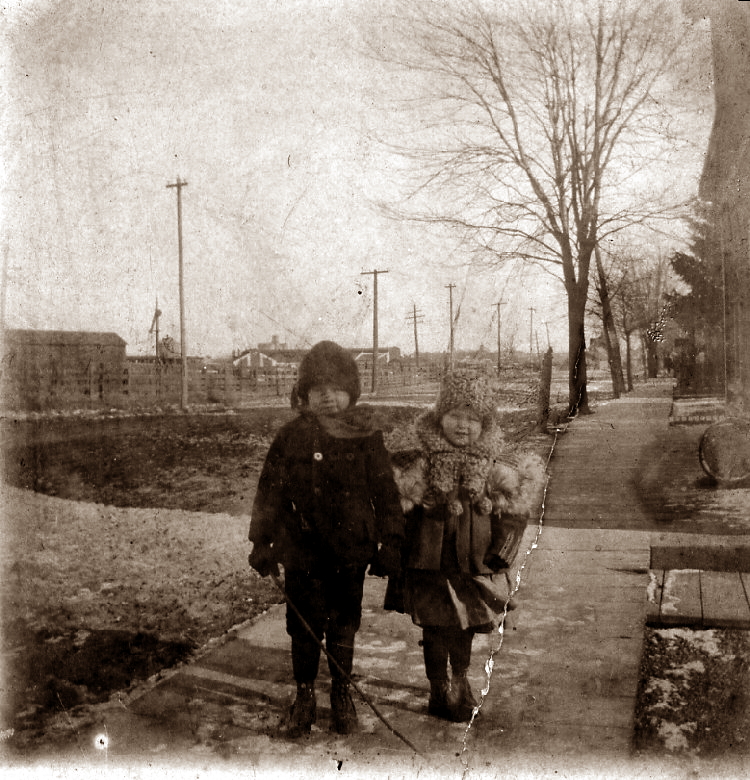
Children on Bridge St., Niagara Falls, looking East, circa 1900
Image courtesy of Niagara Falls Public Library

Lost in snowflakes

      children march 
            in jubilation
                warmed 
                      by ‘Let it Snow’ 
                          philosophies
                             and homemade 
                                 scarves and mittens.
                                     Another December snow day 

                                                    in Niagara Falls.  

Source: The Author, August 2022


See Doug Smith ’s All Poetry site (Darknightofthesoul)

See Another December Day in Niagara Falls on All Poetry, written 12/13/21

Doug Smith is a former Niagara Falls, NY resident