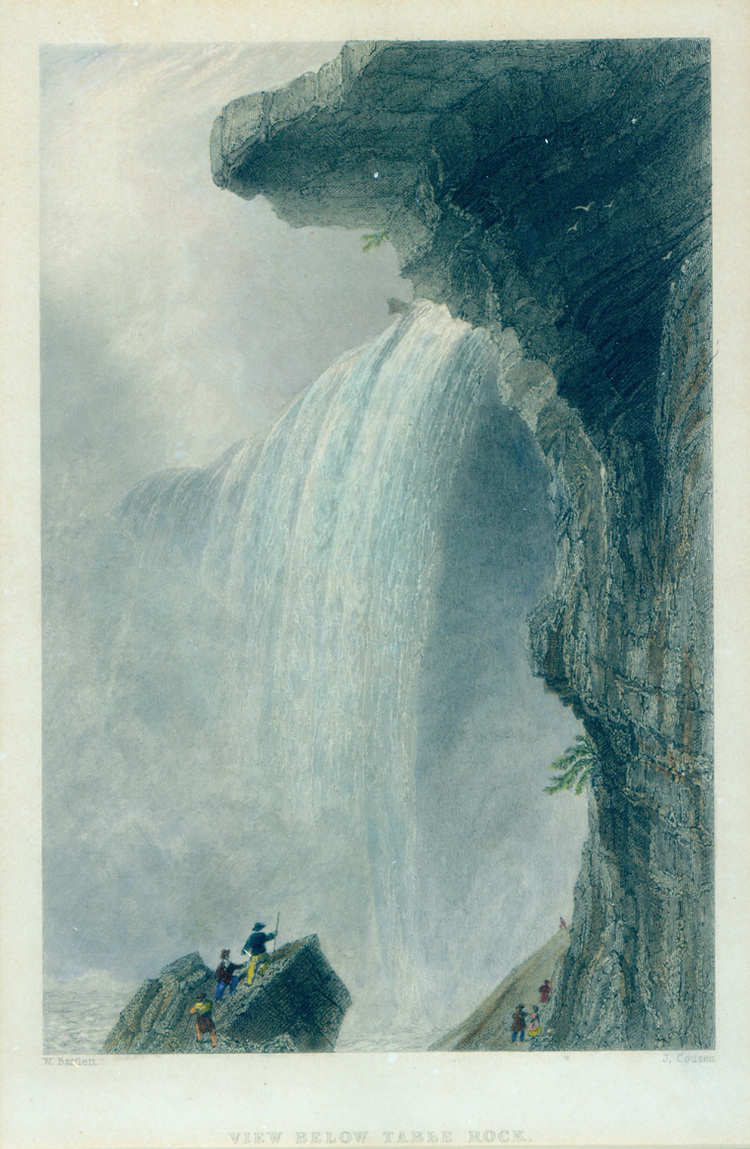
The Falls of Niagara by John Breakenridge

breakenridge
View Below Table Rock by John Cousen, c.1837. Image courtesy of Niagara Falls Public Library

Behold! again I view thee, in thy majesty and might,
Thy proud sheet flashing in the blaze of morning’s glorious light ;
I see thee maddened in thy fall, and pale with hoary rage,
And fretting in thy passion that hath boiled from age to age.

Like thunder on my startled ear, thine everlasting roar
Hath broken, and reverberates from shore to echoing shore,
Continuous and fearful—giant power in its tone,
That shakes the earth’s foundations, and rives the solid stone !
How tremulous beneath the shock the fearful earth hath grown ;
Reeling beneath the mighty plunge, it sighs with ceaseless moan.
Now rush thy waves with frenzy wild, in foam of dazzling white,
Now placidly they sweep along with ever changeful light.
O, wondrous power ! O, giant strength ! how fearful, to behold,
Outstretched on yon o’erhanging crag, thy mad waves downward rolled ;
To look adown the cavernous abyss that yawns beneath—
To see the feathery spray flash forth in many a glittering wreath !

Voluminous and ceaseless still, forever swift descend
Thy waters, in their headlong course—then, turning, heavenward wend ;
Now, disenthralled, their essence hath its spirit shape resumed,
Bright, bodiless, and pure, its flight to yon empyrean plumed !


Source: John Breakenridge.  The Crusades, and Other Poems.  Kingston: John Rowlands, 1846.

Niagara by Leonard Nathan

nathan
Leonard Nathan, courtesy of Wikipedia / Andrew Nathan

Looking into the Falls, I heard it sing:
Marriage, marriage, one life always,
Beginning to end in simple water music.
And I thought, by you, this isn’t music for men,
Who are always bespoken in two places at once,
Who partially stand in the middle of great music
Distracted by distance. I put myself in this poem
With you and with marrying waters, and look at me — still
A little apart, wishing for one whole life
But singing this far-off solo right
In the face of the music, as though it could solve me.


Source:  Leonard Nathan. Returning Your Call: Poems. Princeton: Princeton University Press, 1975.

Read about Leonard Nathan


Untitled by Claud H. Hultzén, Sr.

claud
One of the Old Lombardy Poplar Trees and the “Castle” at Old Fort Niagara

All of this historical fact from which we form our individual opinions and prejudices, is only the reflection of the lives and characters of those whose acts brought about the series of circumstances with which we have had to deal. Men of France, men of England, and men of America, each in turn, have served well under their respective flags at Old Fort Niagara. Each in his turn has contributed in one way or another to the happy state of affairs which we know today.

Perhaps the writer can best express his thoughts in this connection by the relation of a few lines of verse which came to him as he stopped beneath the old Lombardy poplar trees which have stood in the Old Fort for two hundred years:

To stand beneath these silent Lombardies,
The sentries of the passing centuries;
To gaze far out, across the azure deep
In quiet communion with them as they keep
Their endless vigil o’er this sacred soil;
To live with them again the tragedies,
The hopes, the fears, the gallant victories
That marked the tireless pace of those who sleep,
Who lived and fought and died — that we might reap
The harvest of their vision and their toil.


Source: Claud H. Hultzén, Sr.  Old Fort Niagara: The Story of an Ancient Gateway to the West.  Youngstown, NY: Old Fort Niagara Association, 1939.

N.B. An earlier version of this poem with an added first line: “I love” was presented in a paper to the 1936 annual meeting of the Old Fort Niagara Association. The paper, including the poem, was reproduced under the title Restoration of Old Fort Niagara in the journal New York History, vol. 18, no. 4 (October 1937)

Claud H. Hultzén was the executive vice-president of the Old Fort Niagara Association.

Niagara by R. W. Sanders

sanders
Terrapin Rock in Winter, Niagara Falls. Image courtesy of Niagara Falls Public Library

Mighty Niagara, the source of great power.
‡‡Seventh wonder of nature’s great toils,
Giving service to all, from God’s great dower;
‡‡Beauty sublime: as the river it coils
Through ravines, cut from the mighty rock bed.
‡‡Splendor superb, by its rainbows are made,
Grandiose scenes: as our willing ears are fed
‡‡By the musical roar of the mighty cascade.

Beautiful Niagara, a most wonderful sight,
‡‡Massive volume of waters, cascading ever;
Filling the vision and mind with delight.
‡‡Rushing headlong, obstruction ’twill sever
And hurl to destruction.  Naught can impede
‡‡Its progress, or hold the swirling turmoil,
Except nature’s deep rockbound gorge.  Indeed
‡‡With rising vapours, its waters seem to boil.

Ancient Niagara, aged work of unknown years
‡‡Patiently cut by the water’s great powers.
Its roaring noises, incite trembling fears,
‡‡Its wind whipped spray, make falling showers,
By moonlight, a weird fanciful elfin display,
‡‡With myriad light beams, mocking the stars.
Its loud roaring sounds, producing utter dismay
‡‡Like the ocean rollers, crossing the bars.

Wintery Niagara, most impressive white array
‡‡Mountains of ice, topped with covering snow,
Its immense power in near to stillness display
‡‡To the vision.  As if its great bulk to show.
Crystal reflections a kaleidoscope make,
‡‡Grotesque shapes form while one watching stands.
The terrible ceaseless roar of waters unseen
‡‡Tell their story, of the might of unseen hands.


Source:  R. W. Sanders. Up Into the Hills & Other Poems.  St. Catharines, Ont.: The Author, 1958

The Falls of Niagara by Giambattista Scandella

Translated from the Italian by Samuel L. Mitchell, 1796

scandella
Samuel Latham Mitchell courtesy of Wikipedia

BORNE to the rocky bed’s extremest brow,
‡‡The flood leaps headlong, nor a moment waits ; —
To join the whirlpool deep and vast below,
‡‡The saltless ocean hurries through the straits.

Hoarse roars the broken wave ; and upward driv’n,
‡‡Dashes in air ; —dissolving vapours press’d
Confound the troubled elements with heav’n : —
‡‡Earth quakes beneath ; — heart trembles in the breast. 

With steps uncertain, to a jutting rock,
‡‡To gaze upon the immense abyss I hie ;
And all my senses feel a horrid shock
‡‡As down the steep I turn my dizzy eye.

On cloudy steams I take a flight sublime,
‡‡Leaving the world and nature’s works behind ;
And as the pure empyreal heights I climb,
‡‡Reflect with rapture on the Immortal Mind.


Source: Hoffman, Charles Fenno (ed.) The New-York Book of Poetry.  New-York: George Dearborn, Publisher, 1837.

Also published in what appears to be an identical reprint, except for the beginning matter:  The Gems of American Poetry by Distinguished Authors.  New-York: A. & C. B. Edwards, 1840

“The above lines were translated by Dr. Mitchell, in October 1796, from the Italian of Dr. Gian Baptista   Scandella, an accomplished gentleman, who afterwards, in September 1798, fell a victim to the yellow fever in the city of New York,  just as he had finished his American tour, and was on the eve of embarking for Europe .”

N.B. The two books mentioned above has his forenames as “Gian Baptista,” other sources, including the Historical Society of Pennsylvania Archives which holds his papers, use “Giambattista.”

Read about Giambattista Scandella
Read about Samuel Latham Mitchell