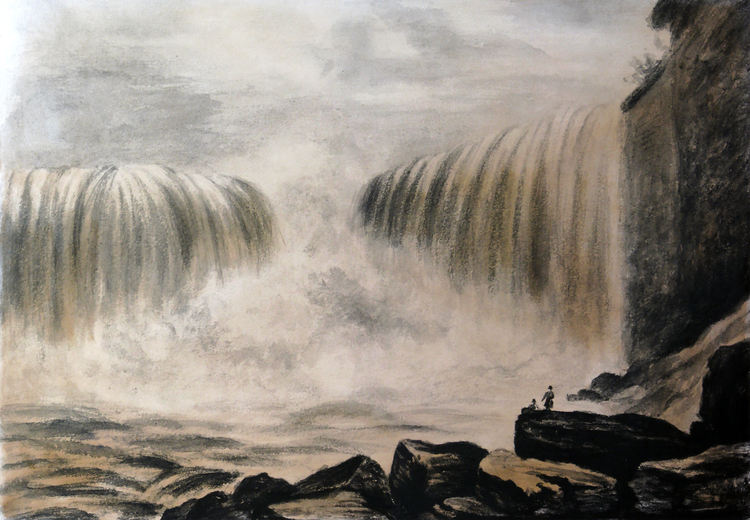
Niagara Falls by Ezekiel Bacon

“Labitur—labitur—et semper labetur.” 

bacon
Niagara Falls, 1845. Courtesy of the Library of Congress

WHEN from the realms of chaos dark
‡‡God chased the shades of night,
And on creation’s midnight void
‡‡Poured floods of living light;

Then o’er the darkness of the deep
‡‡The Almighty spirit stood,
Gave to the eternal hills their place,
‡‡Its bounds the unfathomed flood.

Long rolled that angry, sullen wave
‡‡In its imprisoned bed,
In Erie’s wild and watery waste,
‡‡By mighty torrents fed.

Till bursting from its ramparts high
‡‡Niagara’s current flowed,
And o’er the mountain and the glen
‡‡Its fearful surges rode.

Through long lost generations since
‡‡Thy ceaseless round hast run;
For generations yet to come
‡‡Thy race is but begun.

Roll on to thy deep ocean bed,
‡‡Thou wild, mysterious stream !
When ages yet unborn are passed
‡‡As fades a baseless dream.

Faint emblem of eternity !
‡‡Thy teaching sure is given
To point the enraptured wonderer through
‡‡Life’s narrow strait, to heaven !


Source: Ezekiel Bacon. Ægri Somnia: Recreations of a Sick Room.  New York : John Allen, 1843

Biography of Ezekiel Bacon

Psalm by Matt Donovan

Sam Patch, Daredevil, 1800–1829

donovan
Sam Patch Jumped to Fame and Death. Boston Sunday Globe, August 12, 1928

The trick was breathing in, you claimed, as if that was all
they gathered to watch as you milked the crowd in your matador sash,
rum-slurring some speech no one could hear above the river’s thunder,
quipping your catchphrase long worn threadbare: Some things
can be done as well as others. But most things don’t sputter back
even once, like that waterlogged schooner two autumns before,
lunging over Niagara as billed, loaded with its Strange Cargo
bison, two bears, a bonneted fox, raccoons, a wing-clipped eagle—
& disappearing into a wilderness of froth. Sam Patch, you dropped
arrow-straight, untethered from earth, for cash, for booze, a lay,
& yet here I am plundering your life for some path towards saying
in our water’s blind wrath, in the body from that roaring slosh
only a few times given back, despite nearly everything
we choose, somehow we are blessed. I might as well beg
for an ass-kick, I know. Scotch-soaked, fame-starved, cocksure,
you are long-dead, unbreakable until the river broke you too
& could stomach none of this. If it helps, forget the poem.
Forget I said anything before I turned to you—since today inexplicably
you’re all that will do—tottering sun-struck on the platform, preparing
to plummet into that luminous rage & whatever that might afford.


Niagara Falls by Rev. Charles Burroughs

Composed there, August 10, 1846.


burroughs
The Rev. Charles Burroughs, DD, painted by Gilbert Stuart, Princeton University Art Museum. 

HARK ! what sounds of mighty thunders !
O’er those cliffs an ocean pours !
Mark its foaming furious surges,
Booming on the rocky shores.

Why is all this awful tempest
Of Niagara’s flood so vast ?
Why these hurricanes of waters,
Seeming like destruction’s blast ?

Hear the story of these wonders ;
This decree did God proclaim :
‘Let the waters here be gather’d
To adore my glorious name.’

Lakes immense, and icebergs melted
From the stormy northern pole,
Babbling brooks, and countless rivers
To Niagara’s temple roll.

To that glorious altar move they
Not with slow reluctant pace,
But with eager speed and transport
Rush they to that sacred place.

All their garments beam with splendor ;
Some are whiter than the snow ;
These display a crimson lustre ;
Those, like brightest emeralds glow.

Some are graced with tints of azure ;
Those with amber ; these with green ;
Boundless wreaths of glittering diamonds
O’er Niagara’s robes are seen.

Thus the stream, all clothed with glory
To its God with rapture sings,
And the heavenly vaults re-echo
With its awful thunderings.

Then ascend thick clouds of incense,
Which is borne on angels’ wings,
And o’er earth the richest blessings
With unbounded mercy flings.

Then did Christ our blessed Saviour,
For those harmonies so loud,
Paint the rainbow’s radiant beauties
On the fleecy incense cloud.

There I saw the bow of promise
As it came from God’s right hand,
And it spread its arch transcendent
On our own and Britain’s land.

Here a Church has Christ erected,
All these sounds are praise to Him ;
All this stream ‘s a font baptismal,
And its drops are seraphim.

These grand cliffs are altars sacred
To that God who reigns above ;
All this rush and deafening roaring
Are but songs of holy love.

All these foaming crystal surges
Hath a Saviour’s mercy hurl’d
O’er those craggy heights, to christen
And redeem a fallen world.

It is wise that erring mortals
Should frequent these wondrous scenes,
Here to see the God of Nature,
And to learn what worship means.

‘T is not strange that red men always
View this spot, as God’s dread home,
And their pipes and beaded wampums
Humbly offer on the foam.

‘T is not strange that unbelievers
Here betray remorse and shame,
And confess our Lord’s dominion
Over cataract and flame.

‘Tis not strange that Christian pilgrims
Here the richest blessings know ;
Here ‘s the hem of Christ’s bright garment,
Which, when touch’d, will grace bestow.

These dread scenes portend the judgment,
When in triumph Christ shall come,
With a voice, like mighty waters,
To pronounce earth’s endless doom.

Then, O God, in mercy save me
From thine everlasting frown,
That in bliss my ears may hear Thee,
And my eyes behold thy crown.


Source: Burroughs, Charles, Rev.  The Poetry of Religion, and Other Poems. Boston, Ticknor, Reed & Fields, 1851.

NOTES [from the text by Charles Burroughs].

Note 1. — Allusion is made in the fourth verse to the waters which flow over Niagara Falls. They come from those mighty Lakes, or as they may be more rightly termed, inland Seas, Lakes Erie, St. Clair, Huron, Michigan, Superior, and many others. Lake Superior is four hundred and fifty miles long, one hundred wide, and nine hundred feet deep. It receives constant contributions from about forty rivers. The most distant source, that supplies Niagara, is probably the river St. Louis, which rises twelve hundred and fifiy miles north-west of the Lakes, and one hundred and fifty miles north-west of Lake Superior. Now these immense lakes, with their hundreds of rivers, great and small, all of which flow over Niagara Falls, cover a surface of one hundred and fifty thousand square miles, and contain nearly half the fresh water on the face of the globe. It is computed that one hundred millions of tons per hour, and thirty thousand tons per second, pass over the Falls. Hence old Father Hennapin, who visited the Falls in 1678, said, ‘I could not conceive how it came to pass, that such mighty lakes and numerous rivers should discharge themselves at Niagara Falls, and yet not drown a good part of America.

Note 2. — In verse seventh I speak of some of the robes of the Falls as covered with glittering diamonds.’ As you stand at a place, called the Platform, on the American shore, near the ferry-ways, the Falls at your side are thrown over the precipice for a long distance beyond you, in perpetual showers of huge drops, which continue as drops till they enter into the river below, and which, when seen about an hour before sunset, seem like a miraculous and perpetual shower of millions on millions of diamonds and other most brilliant gems.

Note 3.- In the 8th verse I speak of the ‘thunderings of the cataract. It is supposed that this circumstance led to its name. Niagara in the Iroquois dialect signifies the ‘thunder of waters.’ They produce not only a concussion of the air, but a constant trembling of all the adjacent country. So writes a beautiful Poet, —

‘Niagara, as thy dark waters pour,
An everlasting earthquake rocks thy lofty shore.’

Note 4.-In verse thirteen I have called the cliffs of Niagara “a sacred altar.’ Since writing that passage I have seen the same idea applied to the Falls by another writer. He calls them the everlasting altar, on whose cloud-capt base the elements pay homage to Omnipotence.’

Note 5. — The fourteenth verse associates the Falls with our redemption. So some other writer has well said,

“A Pavilion it seem’d, with a Deity grac’d,
And justice and mercy met there and embraced.’

Note 6. — The homage of Indians at the Falls is no fiction. Whenever they first see this wonder of our world, they offer at the cataract to the Great Spirit whatever they have valuable about them ; as mentioned in verse sixteenth.

Note 7.— I speak of God in the seventeenth verse as ‘over cataracts and flame.’ Beside the unsurpassed wonder of the Falls, there is near them a burning spring, an everlasting lamp of flame, which is kindled by the breath of Omnipotence.

Note from Charles Mason Dow’s Anthology and Bibliography of Niagara Falls

“Composed at Niagara August 10, 1846. To the clergyman author [ Burroughs ] the rush of water was a song of rapture to God, the clouds of spray were incense, the rainbow was a reminder of redemption by Christ, the cliffs were altars, and the whole Falls an inspiration to worship.”

The Traveller; or, A Prospect of Society by Oliver Goldsmith

Goldsmith
Oliver Goldsmith by Sir Joshua Reynolds, 1769-1770

[n.b. – this is an excerpt (lines 405-422) of the Niagara section of  the poem ]

Have we not seen, at pleasure’s lordly call,
The smiling long-frequented village fall I
Beheld the duteous son, the sire decay’d,
The modest matron, and the blushing maid,
Forc’d from their homes, a melancholy train,
To traverse climes beyond the western main—

Where wild Oswego spreads her swamps around,
And Niagara stuns with thundering sound?
Even now, perhaps, as there some pilgrim strays
Through tangled forests and through dang’rous ways,
Where beasts with man divided empire claim,
And the brown Indian marks with murderous aim—
There, while above the giddy tempest flies,
And all around distressful yells arise—
The pensive exile, bending with his woe,
To stop too fearful, and too faint to go,
Casts a long look where England’s glories shine,
And bids his bosom sympathize with mine.


Source: Oliver Goldsmith.  The Poetical Works of Oliver Goldsmith. London: Cundall & Addey, 1851. [Reprint of 1764 edition]

Biography of Oliver Goldsmith

Information about The Traveller

El Barril by James Thomas Stevens

barril
Annie Edson Taylor’s Tombstone in Oakwood Cemetery, Niagara Falls, New York. Image courtesy of James Thomas Stevens


In the one-time mecca of the hard-up honeymoon,
we were both born.

Yours, a life above the waterfall. Mine, below.

And Annie Taylor? We were all schooled in her story. How Miss
Michigan schoolteacher took on the cataract at sixty-three. In her
petticoats and lace-up boots, clutching her good-luck-heart-shaped satin
pillow, she stepped into the barrel where, two days earlier, she had
placed her cat to test pilot the way. Air pressured in by a bicycle pump,
bung in the hole, mattress wrapped. And the fall, fall, fall, emerging
twenty minutes later. Only head gashed and rib bruised to proclaim:
I would sooner walk up to the mouth of a cannon, knowing it was going
to blow me to pieces than make another trip over the Fall.

And in our two year, two year, two year fall. What was bruised if not
‡‡broken?

Your C-3 vertebra, out of whack.
Slack, from practice. Your tendons overwrought,
too taut from the bow, taught by the bow.

And my base pain, in the neck.
Now I know the days you play,
curse Bach and his concerto
for a doubled violin. 


Source:  El Barril was published in Prairie Schooner, vol 89, No. 4, Winter 2015

James Thomas Stevens, Aronhió:ta’s, (Akwesasne Mohawk) attended the Institute of American Indian Arts, Naropa University’s Jack Kerouac School of Disembodies Poetics, and Brown University’s graduate creative writing program. Stevens, originally from Youngstown, NY, is the author of eight books of poetry, including, Combing the Snakes from His Hair, Mohawk/Samoa: Transmigrations, A Bridge Dead in the Water, The Mutual Life, Bulle/Chimere, and DisOrient, and has recently finished a new manuscript, Ohwistanó:ron Niwahsohkò:ten (The Golden Book). He is a 2000 Whiting Award recipient and teaches in the Creative Writing Department at the Institute of American Indian Arts in Santa Fe, New Mexico.

View a far-reaching conversation between James Thomas Stevens and Prageeta Sharma in Bomb, issue 148, September 17, 2019, in which El Barril is discussed