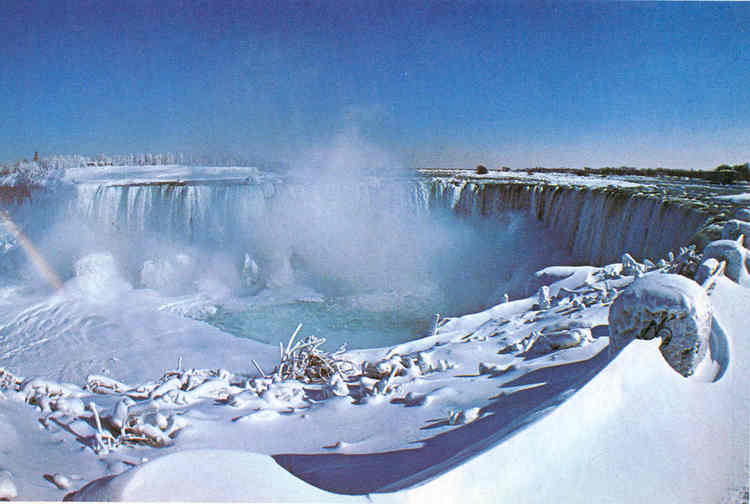
Niagara Falls by Consuelo Hernández (English language)

consuelo
Photo by Andrew Porteus ©2024

I too am a waterfall
with something stuck in my throat
the song that I saved
for the middle of my life.

There is no way out
everything tastes like a nightmare
and I cannot see clearly through so much debris…

Amongst so many fallen branches
I wish I could see farther
with no boundary to split up my happiness.

If everything is simple
why do you hide behind bubbles
that rise opaquely over
your true form, waterfall?
Or must I wait
for a steamboat to tear through
such webs woven with weariness?

We move in a dreamlike dimension
in a thick intensity we tame our fears
and we go somersaulting through debts incurred centuries ago
and now we finally settle
jumping off with you, waterfall
to the mist’s home
where no authority lurks
where there are no tickets for speeding
nor humiliation for having been born on different shores.

I’m struggling against the flower!


Source: Consuelo Hernández, 2025

See this poem in the original Spanish language version.

About  Consuelo Hernández


Seeking a St. Catharines Poet Laureate

laureate


Deadline for applications is January 5, 2026 for a one year term.

Get complete details here.

Niagara by Richard Emil Braun

braun
Niagara Falls From Just South of the Brink of the Horseshoe Falls  April 27, 2023
Photo by Andrew Porteus

    Mist-moist, past the rainbow, we make a small row
    at the low wall on the Canadian side:
you, and the other, who, as we approached the roar,
    often and oftener groped your shoulder,
and I, a stranger almost, along for the ride.

        Hundreds of soulful strangers, high
    on the speedy water in their bodies,
    lean on this rail, couples, eyes full or floating,
            and all of them narcotized
        unawares, by the falls, through the eye,
    as veritably as by the needle
            they despise and call sinful.

    Apart from you two by two yards, I scan
    the American side for the rapids
I already know; see them as a harum-scarum
    taffeta cancan seesawing in sunlight,
now higgledy-piggledy, the grey then white shreds

            shown then withdrawn in the sexy
        wingding; and parted from you two and from
        the hundreds by the absence of love in me
                (replaced by a drug), I hear
            that other’s chitchat you answer curtly
        often and oftener shrill over the falls’
                singsong, and hear in it pain

    which I can not respect. Inspecting the falls
    itself at its summit, I see a vein
of the river split on stone, then mend, now folding, next
    unfolding until both blend in the mist;
and to you, who have left the other to his pain

        momentarily, and his camera,
    and have come near me, I liken the white
    currents to a groin and she-thighs widening
            and clenching. You disagree.
        I watch further. I feel Niagara
    fill my head through the crown and through my eyes.
            Soon, spilling out my mouth

    with breath, it returns; encircles my mind;
    builds silence. Flowing glee impels me to fall.
To fall, I mount the rail. Suddenly, in unison
    with my own thought, you shout It liquefies me!
I come down. Yes, yes, I tell you. The other, cool,

        gripping your shoulder, leads you again
    past the rainbow, under sobering mist.
    I follow. Later I tell you both 
            my own story (how I
        am free of love through medicine)
    and theorize about the hundreds there
            high on love and water.

    Safe where Niagara is almost hidden
    and merely a moist whirr reveals its action,
we two juggle the topic literally.
    The third, unsure, shuffles picture postcards.
In the park, near the car in expectation

        of franker words in privacy,
    I ask again. I hear you, a blur, naming 
    a seminary where, at dawn, you would run
            in pairs or by fours, downwards,
        swung to a circular valley,
    hills of daisies, grey and white folds, low, up,
            lower, to swim secretly.


Source: Richard Emil Braun.  The Foreclosure: Poems. Urbana: University of Illinois Press, 1972.

Previously published in Fresco, [1964?]

Also published in Richard Elman & Robert O’Clair (eds.) The Norton Anthology of Modern Poetry. W. W. Norton, 1973

From acknowledgements in The Foreclosure:
The President’s Medal of the University of Western Ontario was awarded in 1965 for Niagara as the best poem to appear in a Canadian magazine during the previous year.

Falls of Niagara: A Sketch by Newton


sketch
Niagara Falls, c1845 July 22.
Image courtesy of the Library of Congress

    The sweep majestie of the river’s brow,
        Which far above extends from shore to shore—
    (It glows in memory’s magic mirror now,)
        Heaven’s bright blue arch rising behind and o’er—
    The Lakesprung torrents—as with ceaseless roar,
        Over the everlasting rocks they roll,
    Forever to the dizzy leap before—
        All rush at once upon the startled soul,
At the first transient glance your eye throws o’er the whole.

    But sight is mingled at the heart with sound—
        The loud, the deafening thunder of the fall,
    Which seems at first all feeling to confound,
        The brain to madden and the breast appal,
    And spread annihilation over all !—
        The dazzling whiteness of the sheeted foam,
    Which to the eye seems like a snowbuilt wall,
        On which is reared a bright Cerulean dome, 
That Poets well might take for fancy’s airy home ;—

    The clouds of rising and dissolving spray,
        Which wave and wanton in the gusty wind,
    On which the sunbeams hold their magic play,
        Painting gay rainbows of each glorious kind,
    That change their shape and colour, like the mind
        Of soft and ductile youth, with every scene,
    Of light and shade—now swelling unconfin’d,
        In matchless beauty with resplendent sheen—
Now bursting—leaving but the black abyss between ;—

    The dark and dripping cliffs which overhead,
        Rise like the warbuilt towers of ancient time,
    Breathing defiance, and inspiring dread,
        Which echo back with emphasis sublime,
    The cataract’s awful sounds, in measur’d chime,
        Rolling along the deep and distant pass,
    Until at length the bloodstain’d heights they climb,
        Where swell’d the roar of battle—when, alas !
Our country’s sons and foes fell in one mingled mass ;—

    And the still darker torrent at your feet,
        Whose greenwreath’d floods boil up from the abyss,
    To whose unfathom’d depths, in one broad sheet,
        They thundering fell—whose tides with horrid hiss,
    Like venom’d serpents vast, do seem, I wis,
        Writhing in pain, and madly rushing by,
    Towards far Ontario’s bed : —All—all, of this,
        Must have struck on the heart—the ear—the eye—
To wake the burning soul of its sublimity.

    O ! I have thought—and thought did well beseem
        A scene so fraught with wondrous majesty—
    If with such wonders His creation teem,
        What must the glory of the Author be !
    With what deep reverence and humility,
        Ought we to bow before His mighty hand !—
    Lord of Creation and Eternity !
        Shall human pride not quail at His command ?
The thunder of His power, O who can understand !


Source: The American Baptist Magazine,  vol. V, no. 12, December 1825

Falls of Niagara: A Sketch is simply signed “Newton.” Newton is probably John Newton Brown, ordained as a Baptist minister in 1824, and who later became the editor of the American Baptist Publication Society in 1848.  John Newton Brown wrote another poem about Niagara Falls, The Falls of Niagara 

See John Newton Brown’s entry in Wikipedia

Spike in Stats

spike
I enjoy looking at the stats for the Niagara Falls Poetry Project website. In addition to the number of hits on the site, they also show which pages are being looked at, how long each visitor is on the page, how many pages each visitor looks at, time of day, country that the visitor is from, and other stuff. One of these is the referrer, such as search engine, wikipedia pages, social media pages and the like. Lately I’ve been receiving a lot of visitors through the McMaster University portal. In the last few days there have been 144 visitors using the McMaster portal, and 100 of those were today between 2-4 pm, mostly viewing the same poem.

At other times that the site has been active (since 2001) I have noticed colleges and universities using the site through their portal, and I find it most gratifying to see it used by them. When I discovered a professor at a nearby university had been using the site in her course, I ended up giving a talk to her class about poetry in Niagara and its use in the social and historical record of the area.

So thanks, McMaster. If you’re a student there and have used the site, or if you’re the prof using the site as a teaching tool, please reach out (aporteus@niagarapoetry.ca) – I’d love to talk to you about how you are using it.

Many thanks,

Andrew