Life at Niagara: An Epistle From the Falls By James Thomas Fields

fields
James Thomas Fields


Dear N.
: While the rainbows are spanning the Falls,
And a lusty Scotch infant next door raises squalls, —
While the frantic young mother shouts madly for milk,
In tones not so soft, quite, as satin or silk, —
Your friend, grown poetic, has snatched up his pen,
To dash off a line to “the best of young men.”

You’ve been at the Falls, and they can’t be described,
Though Coleridge himself from the tomb should be bribed ;
Pile mountains of paper, and flood them with ink,
And Niagara is dry, though the reader should sink.
But there’s life here, my friend, — closely packed to be sure, —
For fashion condenses what man must endure :
Not a bed to be had, not a chair, or a block,
And the only spare table is old Table Rock.
How glorious a visit, were taverns and gongs
But banished a week to where Fashion belongs,
To tramp through the forest, with no charge of fares,
In a pair of brogans, such as Audubon wears;
To meet a lithe Indian, all stately and stark,
And “put up” a few days in his wigwam of bark; —
Gods! a walk through the woods, by the light of the stars,
Would outweigh all the lamps, and the Lewiston cars!

But here’s life at the Falls — from a year to fourscore —
(And I think by the sound there’s a day at next door ; )
Here are members of Congress, away from their seats,
Though sure to be there when the dinner-gong beats ;
Here are waiters, so eager your viands to snatch,
That they leap down the stairs like a multiplied Patch ;
To the sound of sweet music they nimbly appear,
And whisk off your corn while they tickle your ear.
Here are pensive young preachers, dressed quite comme il faut,
In coats black as night, and cravats pure as snow ;
Rich East India governors, heavy as gold,
Hanging round like weak sun-flowers, yellow and old ;
Artistical talent, with sketch-book displayed,
Drawing very bad water in very poor shade ;
Fat cockneys from Charing-Cross ; belles from Madrid,
Whose long jewelled fingers outrival Jamschid ;
Superb English maidens, with swan-swimming gait,
Who float round the Rapids like Junos in state ; —
But the brightest-eyed daughters, the best string of pearls,
Represent in their beauty our own Yankee Girls.

Here cluster the fair, and the plain, and the prim,
Round the gallant and gay, whiskered up to the brim ;
Here’s a biped in boots, a most exquisite ass,
Who looks at the Falls through a golden-rimmed glass ;
And to-day such a waist, N., I saw on the Rock,
That to furnish the brains seemed a slight waste of stock.
Here’s a lively old lady, all feathers and fans,
Who trots about peddling her Susans and Anns ;
And a drab-colored Quaker, I’ve seen more than twice
Take a sly glass of something in water and ice.
But brief let me be, while the dull curfew tolls ;
Niagara still lives! still it rushes, and rolls ; —
There is no spot on earth where I’d sooner meet you,
And the friends we both love, N., the choice and the true,
Though a Downeastern editor published the lie
That this glorious old cataract’s “all in my eye!”


Source:  James Thomas Fields. Poems by James T. Fields.  Boston: William D. Ticknor & Company, 1849
Read about Fields here

The Falls of Niagara by John Breakenridge

breakenridge
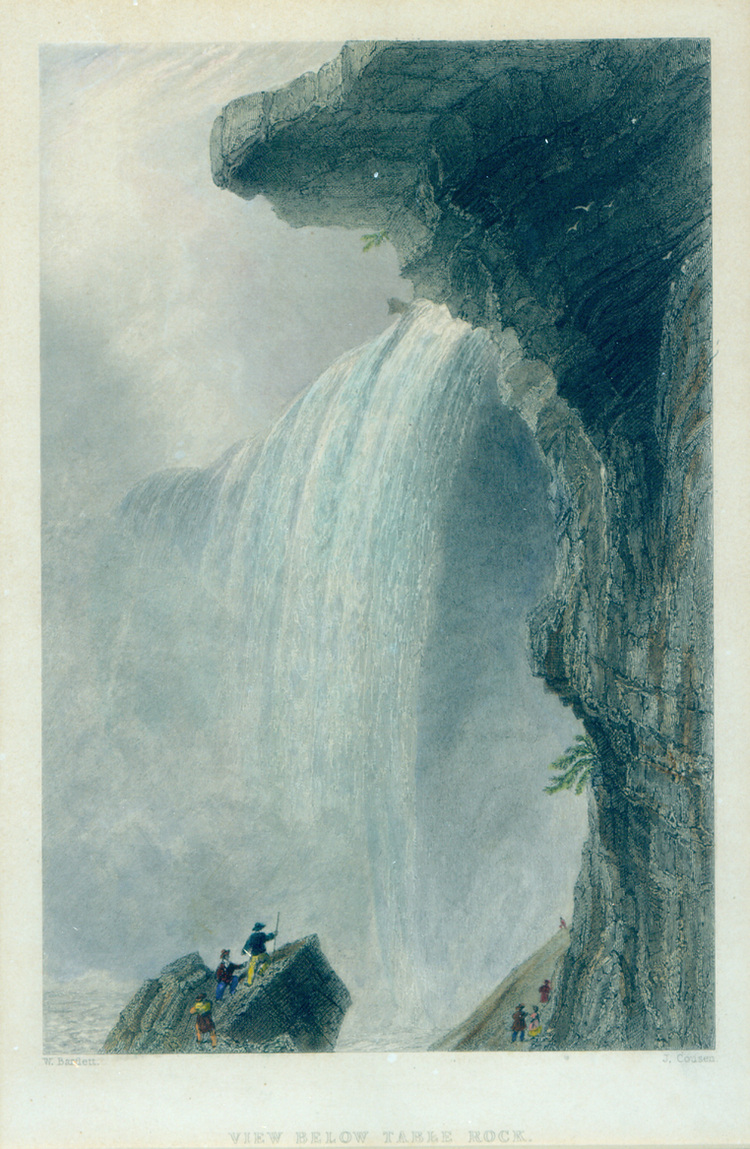
View Below Table Rock by John Cousen, c.1837. Image courtesy of Niagara Falls Public Library

Behold! again I view thee, in thy majesty and might,
Thy proud sheet flashing in the blaze of morning’s glorious light ;
I see thee maddened in thy fall, and pale with hoary rage,
And fretting in thy passion that hath boiled from age to age.

Like thunder on my startled ear, thine everlasting roar
Hath broken, and reverberates from shore to echoing shore,
Continuous and fearful—giant power in its tone,
That shakes the earth’s foundations, and rives the solid stone !
How tremulous beneath the shock the fearful earth hath grown ;
Reeling beneath the mighty plunge, it sighs with ceaseless moan.
Now rush thy waves with frenzy wild, in foam of dazzling white,
Now placidly they sweep along with ever changeful light.
O, wondrous power ! O, giant strength ! how fearful, to behold,
Outstretched on yon o’erhanging crag, thy mad waves downward rolled ;
To look adown the cavernous abyss that yawns beneath—
To see the feathery spray flash forth in many a glittering wreath !

Voluminous and ceaseless still, forever swift descend
Thy waters, in their headlong course—then, turning, heavenward wend ;
Now, disenthralled, their essence hath its spirit shape resumed,
Bright, bodiless, and pure, its flight to yon empyrean plumed !


Source: John Breakenridge.  The Crusades, and Other Poems.  Kingston: John Rowlands, 1846.

Niagara by Leonard Nathan

nathan
Leonard Nathan, courtesy of Wikipedia / Andrew Nathan

Looking into the Falls, I heard it sing:
Marriage, marriage, one life always,
Beginning to end in simple water music.
And I thought, by you, this isn’t music for men,
Who are always bespoken in two places at once,
Who partially stand in the middle of great music
Distracted by distance. I put myself in this poem
With you and with marrying waters, and look at me — still
A little apart, wishing for one whole life
But singing this far-off solo right
In the face of the music, as though it could solve me.


Source:  Leonard Nathan. Returning Your Call: Poems. Princeton: Princeton University Press, 1975.

Read about Leonard Nathan


Niagara by R. W. Sanders

sanders
Terrapin Rock in Winter, Niagara Falls. Image courtesy of Niagara Falls Public Library

Mighty Niagara, the source of great power.
‡‡Seventh wonder of nature’s great toils,
Giving service to all, from God’s great dower;
‡‡Beauty sublime: as the river it coils
Through ravines, cut from the mighty rock bed.
‡‡Splendor superb, by its rainbows are made,
Grandiose scenes: as our willing ears are fed
‡‡By the musical roar of the mighty cascade.

Beautiful Niagara, a most wonderful sight,
‡‡Massive volume of waters, cascading ever;
Filling the vision and mind with delight.
‡‡Rushing headlong, obstruction ’twill sever
And hurl to destruction.  Naught can impede
‡‡Its progress, or hold the swirling turmoil,
Except nature’s deep rockbound gorge.  Indeed
‡‡With rising vapours, its waters seem to boil.

Ancient Niagara, aged work of unknown years
‡‡Patiently cut by the water’s great powers.
Its roaring noises, incite trembling fears,
‡‡Its wind whipped spray, make falling showers,
By moonlight, a weird fanciful elfin display,
‡‡With myriad light beams, mocking the stars.
Its loud roaring sounds, producing utter dismay
‡‡Like the ocean rollers, crossing the bars.

Wintery Niagara, most impressive white array
‡‡Mountains of ice, topped with covering snow,
Its immense power in near to stillness display
‡‡To the vision.  As if its great bulk to show.
Crystal reflections a kaleidoscope make,
‡‡Grotesque shapes form while one watching stands.
The terrible ceaseless roar of waters unseen
‡‡Tell their story, of the might of unseen hands.


Source:  R. W. Sanders. Up Into the Hills & Other Poems.  St. Catharines, Ont.: The Author, 1958

The Falls of Niagara by Giambattista Scandella

Translated from the Italian by Samuel L. Mitchell, 1796

scandella
Samuel Latham Mitchell courtesy of Wikipedia

BORNE to the rocky bed’s extremest brow,
‡‡The flood leaps headlong, nor a moment waits ; —
To join the whirlpool deep and vast below,
‡‡The saltless ocean hurries through the straits.

Hoarse roars the broken wave ; and upward driv’n,
‡‡Dashes in air ; —dissolving vapours press’d
Confound the troubled elements with heav’n : —
‡‡Earth quakes beneath ; — heart trembles in the breast. 

With steps uncertain, to a jutting rock,
‡‡To gaze upon the immense abyss I hie ;
And all my senses feel a horrid shock
‡‡As down the steep I turn my dizzy eye.

On cloudy steams I take a flight sublime,
‡‡Leaving the world and nature’s works behind ;
And as the pure empyreal heights I climb,
‡‡Reflect with rapture on the Immortal Mind.


Source: Hoffman, Charles Fenno (ed.) The New-York Book of Poetry.  New-York: George Dearborn, Publisher, 1837.

Also published in what appears to be an identical reprint, except for the beginning matter:  The Gems of American Poetry by Distinguished Authors.  New-York: A. & C. B. Edwards, 1840

“The above lines were translated by Dr. Mitchell, in October 1796, from the Italian of Dr. Gian Baptista   Scandella, an accomplished gentleman, who afterwards, in September 1798, fell a victim to the yellow fever in the city of New York,  just as he had finished his American tour, and was on the eve of embarking for Europe .”

N.B. The two books mentioned above has his forenames as “Gian Baptista,” other sources, including the Historical Society of Pennsylvania Archives which holds his papers, use “Giambattista.”

Read about Giambattista Scandella
Read about Samuel Latham Mitchell