Niagara by Henry Howard Brownell

Henry Howard Brownell

Has aught like this descended, since the fountains
    Of the Great Deep broke up, in cataracts hurled
And climbing lofty hills, eternal mountains,
    Poured wave on wave above a buried world?

Yon tides are raging, as when storms have striven,
    And the vexed seas, awaking from their sleep,
Are rough with foam, and Neptune’s flocks are driven
    In myriads o’er the green and azure deep.

Ere yet they fall, mark (where that mighty current
    Comes like an army from its mountain home)
How fiercely yon wild steeds amid the torrent,
    With their dark flanks, and manes and crests of foam,

Speed to their doom – yet in the awful centre,
    Where the wild waves rush madliest to the steep,
Just ere that white unfathomed gulf they enter,
    Rear back in horror from the headlong leap;
Continue reading “Niagara by Henry Howard Brownell” →

Niagara Below the Cataract by Clara Jessup Moore

Moore
Clara Jessup Moore

Within a temple‘s towering walls I stand  ̶
A temple vast; the heaven is its dome.
No corniced crag was hewn by human hand
Nor by it wrought the tracery of foam;
The inlaid floor of emerald and pearl
Heaves at the hidden organ‘s thunderous peal,
While round and up the clouds of incense curl,
Shrouding the chancel where the billows kneel.
Ah! bow your heads. It is a fitting place
For solemn thought, for deep and earnest prayer;
For here the finger of our God I trace,
Beneath, above, around me, everywhere;
He hollowed out this grand and mighty nave,
And robed his altar with the ocean wave!

Source: Moore, Clara Jessup. Miscellaneous Poems; Stories for Children; The Warden’s Tale; and Three Eras in a Life.  2nd ed.  Porter & Coates, 1875

Note: Moore used a variety of pseudonyms. This poem has also been published under the name Mrs. C. J. Moreton

Niagara by Wilson MacDonald

portrait of Wilson Pugsley MacDonald
Wilson Pugsley MacDonald

Thy mother, Erie, loves each furious form:
The crash of water and the howl of wind
Are ever in her mind,
For she is called the sweetheart of the storm.
And thou, Niagara, art thy mother’s child —
And with thy restless spirit now I go
The world’s most tragic water-way, and lo!
Like thee to narrow ways unreconciled.

And yet thine early childhood was serene
And fraught with blackened quays and humble craft,
And often thou had’st glimpses of pure green
Where tourists sang and laughed;
But soon thy mother’s whisper bade thee rise
And hurl thy laggard body toward the skies —
And thou did’st then forget
All else save wildness and the haste of life,
And that far, roaring, curving parapet
That called thee to its strife
And then thy feet the maddest race began
That ever waters ran —
Madder than oceans in their wildest hour,
And moving without plan,
Even as chaos ere the worlds began.

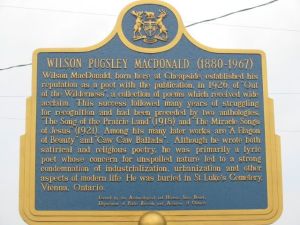
Plaque honouring Wilson Pugsley MacDonald

If all the mountain snows
Could melt into the beauty of one rose,
That ermine bloom would not more lovely be
Than this pale flower I see —
This curving verdure, crashing into white
More lovely than pure light
And colder than the spirit of the night.

Here all the fury since the world was young
Is chanted on one tongue.
Here all the beauty since the earth was born
Is beaten, bruised and torn.
Here all the passions of the stifled cries
Of sages, who were martyred, wildly rise.
Here is the protest in the daring art
Of all true poets of the rebel-heart.
Continue reading “Niagara by Wilson MacDonald” →

The Test of Cantilever by James Walton Jackson

Sketch of the testing of the cantilever bridge 1883
Sketch of the testing of the cantilever bridge 1883 Courtesy Niagara Falls Public Library

Lo! Cantilever stands the test,
See! see! it bears upon its breast
Fully twenty locomotives’ weight,
Nor bends beneath the heavy freight.
See! twenty engines safely ride
Across Niagara’s seething tide –
Across the mystic iron span –
Last product of the god-like man.
“The Cantilever bridge is strong!”
Exultant shout the wondering throng.
Lo! fifty locomotives screech,
Two nations’ praise blends each with each,
Resounds the East, resounds the West,
The matchless triumph each attest.
The loud applause – the palm each yields
To Cantilever and to Fields.

First published May 10, 1884 in …ridge Journal

Niagara by C. E. Whiton-Stone

Portrait of Cara Elizabeth Whiton-Stone
Gift inscription by Cara Elizabeth Whiton-Stone

What wild convulsion in the ages past
Shook thee to such immeasurable unrest,
Oh, mad Niagara?     Did the huge crest
Of some black mountain, splintered by a blast
From Heaven down-bolted, leave these fissures vast
Whence rush thy waters?     Or was ocean pressed
From its storm-beaten shores, to dash thy breast
And hurl out rage from thee, while Time shall last?
          Rage on, imperial mystery, that thou art;
          Chance, in the azoic age, with wonders rife,
          At mandate of the gods, from out earth’s heart,
          In embryo doomed to everlasting strife,
          Thou sprang’st defiant, thundering to thy part,
          Magnificent and terrible, as Life.

Rage on, for giant raging thou may’st show,
Through veins that interlace the land, thy power,
And with thy foaming passion, bring to flower
The genius of man; may’st writhing go
Like a colossal serpent, to and fro,
Winding through ribs of steel that massive tower,
And so imprisoned, strike the zenith hour
When science shall supremest secret know:
          I liken thee to soul wherein is pent
          Divinest madness, that song surging keeps,
          Till by unconquerable forces rent,
          To mighty music it majestic sweeps.
          As the great Odyssey blind Homer sent
          Crashing sublimely down eternal steeps.

Source: Myron T. Pritchard, comp. Poetry of Niagara. Boston: Lothrop Publishing Co., 1901.