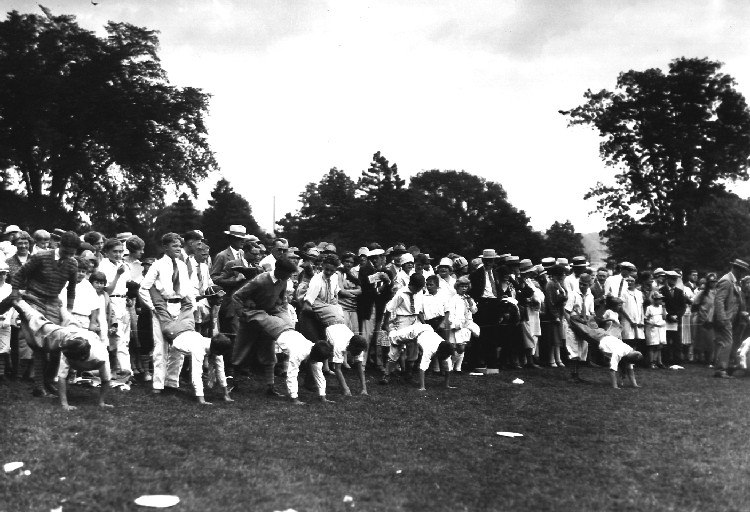
The Crowland Safe Guard Union and Port Robinson Presbyterian Sabbath Schools held a union picnic at the Falls on Aug. 15, and the occasion has been immortalized by the Crowland poet, as followeth : —
Wheelbarrow Race During Picnic in Queen Victoria Park, July 1927. Photo by Edwin Hodge Courtesy of the Niagara Parks Commission / Niagara Falls Public Library
Did you ever Pic-nic at the Falls ‡‡Upon a summer’s day ?
If not, I tell you, ’tis the place ‡‡To pass the time away.
Now first of all you name the day, ‡‡But then, if it should rain,
You fix upon another date, ‡‡And then perhaps again.
And next you must a chicken catch, ‡‡Be sure to take off its head,
Then fill it well with dressing ‡‡And roast it when it’s dead.
You fix a lot of other things ‡‡To fill the basket up ;
‘Tis well to take some dishes too, ‡‡A plate and spoon and cup.
The time comes round — you’re on the road, ‡‡Your best friend at your side,
And if you chose a pleasant day ‡‡You will enjoy the ride.
You can go by the Clifton hill, ‡‡Or down the old ravine,
No difference how you get there ‡‡Upon the park and green.
You meet your many neighbours there ‡‡Their friendship to renew,
Along perhaps with relatives ‡‡And strangers quite a few.
You’ll meet there Col. Gzowski ‡‡And he’ll not speak to you,
But gaze in blissful ignorance ‡‡Upon the sights to view.
And noon comes round, the tables spread ‡‡With pies and cakes and such
And some one at your elbow says, ‡‡“Take care, don’t eat too much.”
Now some drink water pure and bright, ‡‡But grannies have their tea,
For you can get hot water ‡‡Right at the park Q. V.
We sit along the bank awhile ‡‡And watch the Misty Maid ;
Some people will not ride on her ‡‡Because they are afraid.
The day is spent, we start for home ; ‡‡On two things we agree.
That we have had a pleasant time, ‡‡We’re tired as we can be.
Many thanks to Arden Phair for referring this poem to the Niagara Falls Poetry Project curator.
Source: Undated newspaper clipping (probably the Welland Tribune) found in The Diaries of Melvin Byron Misener, held at the Mayholme Foundation in St. Catharines. The clipping has the date “1900” handwritten in the margin of the previous page. Misener (1847-1936) was known as “The Crowland Poet.” Read more about Misener
Fairview Cemetery, Niagara Falls, Ontario Image courtesy of the City of Niagara Falls
I walk alone, eyes downcast
seeking paths of fallen leaves,
to disguise the sound
of breaking armour.
Cemeteries in the fall
are good places for disguise.
I can lie there,
surrounded by stone confessors,
and speak aloud
all that is in me.
Joy, sorrow,
goodness and sin.
There is no forgiveness,
or absolution offered.
They are not my pardoners.
They are just marks left for others,
who perhaps, like me,
spent troubled times there,
before making it their home.
Source: Shie Sirianni published this poem in Captured Essence: Niagara Poetry Anthology, vol. 11. St. Catharines: Canadian Authors Association, Niagara Branch, 1995
With thanks to Arden Phair who pointed out this poem by Shie Sirianni to the Niagara Falls Poetry Project curator.
Satellite View of the North-East Section of the Niagara Peninsula, Niagara Falls Center Left, Escarpment Running East to West, Parallel to the Lake Ontario Shoreline Courtesy of Canada Topo Maps
Crazy creeks break up grid patterns
Man has tried to impose.
Rattlesnake bogs, winding rivers,
Thundering world famous cataracts:
Water everywhere,
Natural courses and huge man-made ditches.
Roller coaster effects courtesy of the escarpment
Excite otherwise boring, like everywhere else, roads.
Weather splits there between Lincoln North and South
Cradling one, blasting the other in turn.
Home is the place you leave
But won’t leave you,
Having deftly intertwined your soul and mind.
From everywhere I’ve ever been
I can close my eyes and be in Niagara.
Source: Deborah Ranchuk published “Home to Niagara:” in Captured Essence: Niagara Poetry Anthology, vol. 11. St. Catharines: Canadian Authors Association, Niagara Branch, 1995
With thanks to Arden Phair who pointed out this poem by Deborah Ranchuk to the Niagara Falls Poetry Project curator.
‡‡‡‡‡‡‡‡‡‡‡‡‡‡‡There is a thorn — it looks so old ‡‡‡‡‡‡‡‡‡I‡‡‡‡‡In truth you’d find it hard to say ‡‡‡‡‡‡‡‡‡‡‡‡‡‡‡How it could ever have been young — ‡‡‡‡‡‡‡‡‡‡‡‡‡‡‡It looks so old and grey . ‡‡‡‡‡‡‡‡‡‡‡‡‡‡‡‡‡‡‡‡‡‡‡‡‡‡‡‡‡‡‡‡‡‡‡‡‡‡‡‡‡‡— WORDSWORTH .
The city walls of Avignon are built of stone, and high
The houses stand with balconies above the streets that lie
Around the old cathedral, whose sweet bells were ringing clear
A merry tune, one day in June
Of seventeen hundred year,
And half a hundred years beside, while crowding far and near,
Beneath the flags and tapestries, the people loudly cheer —
The regiment of Rousillon is ordered to the war,
A thousand strong, the pick among
The mountaineers of Var.
The great Church portals open wide, the crowd goes surging in,
The soldiers tramp with measured tread — the services begin,
A blessing is invoked upon the King’s Canadian war —
Beyond the seas there is no ease,
And all things are ajar —
The English in America do boldly break and mar
The peace they made ; but we will keep the treaties as they are !
And now the Royal Rousillon take up the route with joy,
And march away while bugles play —
Mid shouts of ‘Vive le Roi !’
There lives a lady beautiful as any Provence rose,
The chatelaine of Bois le Grand, who weepeth as she goes —
For sleep has left her eyelids on the banks of rapid Rhone —
‘But three months wed ! alas ! ‘ she said,
‘To live my life alone !
Pining for my dear husband in his old chateau of stone,
While he goes with his regiment, and I am left to moan ,
That his dear head so often laid at rest upon my knee,
No pillow kind but stones shall find —
No shelter but a tree ! ‘
‘Weep not, dear wife !’ replied the count, and took her in his arms,
And kissed her lovingly and smiled to quiet her alarms — They stood beneath the holy thorn of the old Celestine,
Pope Clement brought with blessings fraught
And planted it between
The wall and wall beside the cross, where he was daily seen
To kneel before it reverently. It came from Palestine,
A plant from that which cruelly the crown of thorns supplied,
Christ wore for me, when mocked was He
And scourged, and crucified.
‘I’ll take a branch of it,’ he said, ‘across the stormy sea
That roars between New France and Old, and plant it solemnly
In that far country where I go campaigning for the King.
It will remind and teach mankind
Of pains that blessing bring. ‘
Above his head he plucked a spray acute with many a sting,
And placed it on his plumed chapeau , in token of the thing
Alone can turn the sinful man — the piercing of the thorn —
The healing smart — the contrite heart —
Of penitence new born.
Despairingly she kissed his lips ; ‘O welcome, sharpest pain,
That cuts the heart to bleeding and bids hope revive again ! O Spina Christi! to my heart I press thee wet with tears —
If love outlast as in the past
Each parting that endears !
Our sky has been so bright and filled with music of the spheres,
So gloomy now in sad eclipse it suddenly appears !
For joy dies out in silence like sweet singing that is done,
If men forget their sacred debt
To women they have won.
‘But I will have no fear,’ she said, ‘although in our New France
They say the fairest women live, and eyes that brightest glance.
In all the King’s dominions else, are no such sunny smiles,
From beauty’s lips, such honey drips
In sweetness that beguiles —
There’s no escape forever from the witchery of their wiles —
They win all hearts and keep them from Quebec through all the isles,
And rivers, lakes and forests, to the setting of the sun —
And he is blest above the rest,
Whose heart is soonest won !
‘My husband dear ! last night I stood alone by Laura’s tomb,
Where Petrarch laid the laurel wreath that crowned his head in Rome,
The polished marble sweated cold in token of some ill,
Befalling me, befalling thee,
As I do fear it will ;
For out of it arose a mist that struck me with a chill ;
I could not move — I dare not speak — but prayed in silence, till
I heard a feeble voice within, that, disembodied, said :
‘His love was tried and magnified
While living — mine, when dead !’
‘ O, Laura never knew nor felt the might of love,’ said he —
And Petrarch sang away his life in vain — so cold was she.
Perfect in all proprieties of virtuous disguise,
The poet’s need — the poet’s greed
For woman’s love, to rise
On wings of immortality that bear him to the skies ;
She never knew the joy of it with him to sympathize ;
And all his glorious raptures did but minister to pride,
When he had done — ’twas all he won —
A smile — and nought beside.
‘O, care not for such omens, love ! for Laura’s words were naught
But echoes to the ear of what was fancy in thy thought — A soldier serves the King with life or death, without rebate,
And gaily goes to fight the foes
That dare assail the state,
And yet will melt when women crowd about the city gate,
With faces pale and wet with tears, embracing each her mate,
And kissing him as if for death — nor cares who sees or knows,
While far away the bugles play ;
“Farewell, my Provence rose !”
Adieu ! my wife and chatelaine ; keep safe my house and land,
Should God so will that I return no more to Bois le Grand.
My heart is thine forever, and so pierce this holy thorn,
And stab it through, if e’er untrue,
I leave my wife forlorn —
New France may boast the fairest and the sweetest women born ,
And the chateau of St. Louis laugh the continent to scorn —
I would not give these eyes of thine, and tresses falling down
Upon my breast — to be possessed
Of sceptre and of crown .’
Then beat the drums a gay rappel — the fifes and bugles ring —
As rank on rank the mountaineers march out with martial swing —
They pass the city gate and walls of old Avignon.
Mid parting cheers and women’s tears
The Royal Rousillon,
Commanded by brave Bois le Grand upon his prancing roan,
Are fairly on the march towards Bordeaux on the Garonne —
Where ships are waiting to transport them far from kith and kin,
Beyond the seas, where victories
Are ripening to win.
From fair Bordeaux they sailed , and soon with crowds upon the deck,
Cast anchor in St. Lawrence ‘neath the walls of old Quebec.
To welcome their debarking all the city seemed alive,
And thronged the quays as thick as bees,
When swarming from their hive.
With waving hats and handkerchiefs, both men and women strive
To greet the gallant Rousillon becomingly — while drive
The Governor and Intendant along in royal state
With halberdiers and musqueteers,
And those who on them wait.
‡‡‡‡‡‡‡‡‡‡‡‡‡‡‡‡‡‡‡‡SPINA CHRISTI.
‡‡‡‡‡‡‡‡‡‡‡‡‡‡‡‡‡‡‡‡‡‡‡‡PART II .
Atlantic gales come winged with clouds and voices of the sea,
The misty capes uncap to hear the ocean melody —
In broad St. Lawrence rise and fall the everlasting tides,
Which come and go with ebb and flow —
While every ship that rides
At anchor swings, and east or west the passing flood divides,
Or westward ho! mid seamen’s shouts still onward gently glides,
Tasting the waters sweet from lakes, of boundless solitude
Where thousand isles break into smiles
Of nature’s gladdest mood.
Where trees and waters clap their hands as sang the Hebrew King,
God’s voices in them thundering, that to the spirit bring
Deep thoughts – far deeper than the thoughts that seem, and are not so
Of men most wise in their own eyes,
Who vainly toil to know
The meaning of this universe — life’s panoply — a No !
To pride of godless intellect — a Yes ! to those that go
With lamp alit — the Word revealed — and see amid the gloom
And labyrinths — the mighty plinths
Of temples, grandly loom.
A hundred leagues and many more towards the glowing west —
Amid the forests’ silences, Ontario lay at rest —
Keel rarely ploughed or paddle dipped its wilderness of blue ;
Where day by day life passed away
In peace that irksome grew. In old Niagara fort, a cross stood loftily in view,
And Regnat. Vincit. Imperat. Christus, the words did shew
Carved on it, when the Rousillon came up in early spring
To close the port — and guard the fort,
And keep it for the King.
O ! fair in summer time it is, Niagara plain to see,
Half belted round with oaken woods and green as grass can be !
Its levels broad in sunshine lie, with flowerets gemmed and set,
With daisy stars, and red as Mars
The tiny sanguinet,
The trefoil with its drops of gold — white clover heads, and yet,
The sweet grass commonest of all God’s goodnesses we get !
The dent de lion’s downy globes a puff will blow away,
Which children pluck to try good luck,
Or tell the time of day.
Count Bois le Grand sought out a spot of loveliness, was full
Of sandworts silvered leaf and stem — with down of fairy wool,
Hard by the sheltering grove of oak he set the holy thorn ,
Where still it grows and ever shows
How sharp the crown of scorn
Christ wore for man , reminding him what pain for sin was borne,
And warning him he must repent before his sheaf is shorn ,
When comes the reaper, Death, and his last hour of life is scored,
Of all bereft, and only left
The mercy of the Lord.
The thorn was planted, leafed and bloomed as if its sap were blood
That stained its berries crimson which fell dropping where it stood,
And seeded others like it, as on Golgotha befell,
An awful sight, if seen aright, The trees that root in hell !
Contorted, twisted, writhing, as with human pain to tell
Of cruel spines and agonies that God alone can quell.
A cluster like them Dante saw, and never after smiled,
A grove of doom, amid whose gloom
Were wicked souls exiled.
‘Abandon hope all you who enter here !’ in words of dread
Glared luridly above the door that opened to the dead ;
The dead in trespasses and sins — the dead who chose the broad
And beaten way, that leads astray,
And not the narrow road —
The rugged, solitary path, beset with thorns that goad
The weary spirit as it bears the world’s oppressive load
Up Calvary— to lay it down upon the rock, and wait
In hope and trust — for God is just,
And pities our estate.
Niagara fort was bravely built with bulwarks strong and high,
A tower of stone and pallisades with ditches deep and dry,
And best of all behind them lay Guienne and Rousillon,
La Sarre and Bearn, ‘neath Pouchot stern-
A wall of men like stone De Villiers and Bois le Grand of old Avignon,
And over all the flag of France waved proudly in the sun.
Prepared for it — they met the war with gaiety and zest — And every day barred up the way
That opened to the west.
Discord was rampant now and hate, and peace lay like a yoke
That galled the necks of both of them, and French and English broke,
With mutual wrath and rivalry, the treaty they had made ;
Too proud to live and each one give
Sunshine as well as shade.
From Louisburg to Illinois, they stood as foes arrayed,
And east and west war’s thunder rolled — the soldier’s polished blade
Flashed ’mid the savage tomahawks that struck and never spared,
While fort and field alternate yield
The bloody laurels shared.
The clouds of war rolled redder from the north, and English pride
Was stung to desperation at the turning of the tide,
When Montcalm the heroic, wise in council — struck the blow
Won Chouaguen, and conquered then
At Carillon the foe.
But with his very victories his armies melted slow.
No help from France obtained he — and his heart sank very low,
He knew that England’s courage flames the fiercest in defeat,
And in the day she stands at bay
Most dangerous to meet.
Help us, O France ! to save thy fair dominion in the west
Which for thy sake we planted and have carved thy royal crest ,
Of golden lilies on the rocks beside the streams that flow
From mountain rills and past the hills
Of far off Ohio.
Then down leagues by the hundred where bayous meander slow
Through orange groves and sugar canes, and flowers that ever blow,
In fair Louisiana. We will take and hold the land
For Francia’s crown of old renown,
If she will by us stand. ‘
So spake Montcalm , and message sent — ‘My armies melt away
With victories — my beaten foes grow stronger every day —
In vain Monongahela and Carillon piled with slain ,
If France forget to pay the debt
Of honour without stain,
She owes her sons who willingly are bleeding every vein
For sake of her white flag and crown, on fortress and on plain .
If we can keep Niagara safe that guards the western door,
Then in the east Quebec may feast
In quiet, evermore.’
Vain were Montcalm’s appeals for aid, Voltaire’s cold spirit ruled
The Court — while noisy doctrinaires a gallant nation schooled
In selfishness, and unbelief, and cowardice — and ease,
Which manhood daunt, while women flaunt
Their idle hours to please.
Degenerately they drank the wine of life mixed with the lees,
The Spartan virtues that make nations free and famous – these
Were mocked — derided , set at nought, while fatuous statesmen stand,
Whose feeble will potent for ill
Yields where it should command.
‡‡‡‡‡‡‡‡‡‡‡‡‡‡‡‡‡‡‡‡SPINA CHRISTI.
‡‡‡‡‡‡‡‡‡‡‡‡‡‡‡‡‡‡‡‡‡‡‡‡PART III.
Remote amid the trackless woods and waters of the West,
No enemy had broken yet Niagara’s quiet rest.
The fifth year of the war came in — a change was nigh at hand ;
The order ran to raise the ban
And make a final stand.
Prideaux and Johnson honoured were with new and high command,
From Albany a hundred leagues to march across the land,
While Wolfe besieged Quebec, and its defences battered in ;
So they elate took bond of fate,
Niagara to win.
But not before June’s leafy days, when all the woods are green,
And skies are warm and waters clear, the English scouts were seen.
A lull before the tempest fell with weeks of steady calm,
Of golden hours when blooming flowers
Filled all the air with balm.
The garrison were now prepared to struggle for the palm
To win the wreath of victory or die without a qualm ;
So passed their time in jollity and ease, as if the day
Of bloody strife with life for life
Was continents away.
A fleet of swift canoes came up, all vocal with the song
Of voyageurs, whose cadences kept even time among
The dipping paddles, as they flashed along Ontario’s shore,
Past headlands high and coasts that lie
In mistiness — and bore
A bevy of fair wives who loved their husbands more and more,
Who could not bear their absence, and defiant of the roar
Of forests and of waters, came to comfort and caress,
As women may — and only they —
Man’s solitariness.
In those Capuan days they basked in pleasure’s sunny beams,
The Provence home of Bois le Grand was rarer in his dreams,
The Chatelaine of his chateau fast by the rapid Rhone,
A memory dim became to him —
Nor loved he her alone.
A dame of charms most radiant –the cynosure that shone
Amid the constellations of Quebec’s magnetic zone,
Drew him with force and held him fast, a captive with her eyes,
Which dark and bright as tropic night,
Loved him without disguise ;
And he remembered not the thorn he planted by the grove
Of Paradise, where he forgot in his forbidden love,
The Chatelaine of Bois le Grand, the purest wife and best.
Of womankind he left behind,
And ventured, like the rest,
To sport with woman’s loveliness — as for a passing jest.
His heart was very lonely, too, while all beside were blest,
Like Samson in Delilah’s lap, his lock of strength was shorn.
He loved again despite the pain
And stinging of the thorn.
One day when he a-hunting went in the Norman Marsh and she,
The dame he loved, rode with him , as Diana fair to see,
In green and silver habited — and silken bandoleer,
With dainty gun — by it undone !
And bugle horn so clear.
While riding gaily up and down to turn the timid deer
And meet the joyance of his glance, when she should re-appear,
She vanished in the thicket, where a pretty stag had flown —
Saw something stir – alas ! for her !
She shot her lover down !
Bleeding he fell — ‘O, Madelaine !’ his cry turned her to stone,
‘What have you done unwittingly ?’ he uttered with a groan,
As she knelt over him with shrieks sky-rending, such as rise
From women’s lips on sinking ships,
With death before their eyes.
She beat her breast despairingly ; her hair dishevelled flies ;
She kissed him madly, and in vain to stanch the blood she tries,
‘Till falling by him in a swoon they both lay as the dead —
A piteous sight ! love’s saddest plight !
With garments dabbled red.
Their servants ran and hunters pale, and raised them from the ground,
Restored the dame to consciousness, and searched his fatal wound.
They pitched for him a spacious tent the river bank above
With boundless care for ease and air
And tenderness of love.
She waited on him night and day ; plucked off her silken glove
With self-accusing grief and tears — lamenting as a dove
Bewails her wounded mate — so she — and in her bosom wore
A spike of thorn which every morn
She gathered — nothing more.
She cast her jewels off and dressed in robe of blackest hue,
Her face was pale as look the dead, and paler ever grew .
Smiles lit no more her rosy lips where sunbeams used to dance ;
A withering blight that kills outright
Fell on her like a trance ;
For Bois le Grand was dying, and it pierced her like a lance
To hear him vainly calling on his Chatelaine in France ;
And not for her who knelt by him, and lived but in his breath —
Remorse and grief without relief
Were hastening her death .
Far, far away in Avignon, beneath the holy thorn,
The Chatelaine of Bois le Grand knelt down at eve and morn ;
And prayed for him in hope and trust long witless of his fate ;
But never knew he was untrue
And had repented late
As caught between two seas his bark was in a rocky strait,
And with his life went down the lives of those two women. Fate
Bedrugged the love, betrayed them both — and one by Laura’s shrine
Took her last rest — the other best,
Drank death with him like wine.
Niagara’s doom long threatened came — the roll of English drums
Was heard deep in the forest as Prideaux’s stout army comes.
They sap and trench from day to day, the cannon fiercer roar,
The hot attack when beaten back
Again comes to the fore.
The pallisades are red with fire, the ramparts red with gore,
Its brave defenders on the wall die thickly more and more,
‘ Mid rack and ruin overwhelmed — no help above — below,
The few remain — not of the slain —
Surrender to the foe.
But not before all hope had fled, when gathered far and wide
From prairie, forest, fort and field — with every tribe allied
To France, throughout the West they came, the fatal siege to raise,
And marched along, a mingled throng,
Amid the forest maze.
They halted in the meadows where they stood like stags at gaze,
The English and the Iroquois confronting them for days,
Till Brant and Butler, wary chiefs, with stratagem of war
Broke up their host, and captured most,
While fled the rest afar.
The last day came, and Bois le Grand beheld with misty eyes
The flag of France run down the staff, and that of England rise.
It was the sharpest thorn of all that ’neath his pillow lay —
‘O, Madelaine !’ he cried ‘my men !
My Rousillon so gay !
Fill graves of honour, while I live to see this fatal day !
But not another ! No !’ he cried , and turned as cold as clay.
She kissed his mouth, the last long kiss the dying get alone —
‘ O, Spina !’ cried — fell by his side
And both lay dead as stone.
In the L’Envoi section of The Queen’s Birthday that follows Spina Christi, the narrator, Uncle Clifford, is asked for a sequel to this story by his niece, May. The relevant excerpt reads:
He glanced at her with understanding eyes
That read her thoughts ; but nothing said. He saw
A gentle turbulence of maiden dreams
And fancies in a heart no fowler yet
Had taken, like a bird of woodnotes free
And taught to sing one strain of love for him.
‘I know no sequel to it — lovely May !
But in my youth have heard, there was a grave
Made wide enough for two, beneath the thorn,
The oldest and the inmost of the group
With memories of evil sore accurst,
That stand so weirdly there, outlawed, apart
From other trees in ragged age forlorn.
It long was visible ; and even now,
An eye that searches may find out the spot,
With crimson sanguinets like drops of blood
Much dotted on the grass that greener grows —
Kind nature’s covering for all of us,
When our life’s work is done, and we lie down
And sleep our last on Earth, to wake in Heaven,
At sunrise of our new creation’s morn !’
Source: William Kirby. Canadian Idylls. 2nd ed. Welland, Ont.: [s.l.], 1894
Spina Christi is part of a longer poem, The Queen’s Birthday.