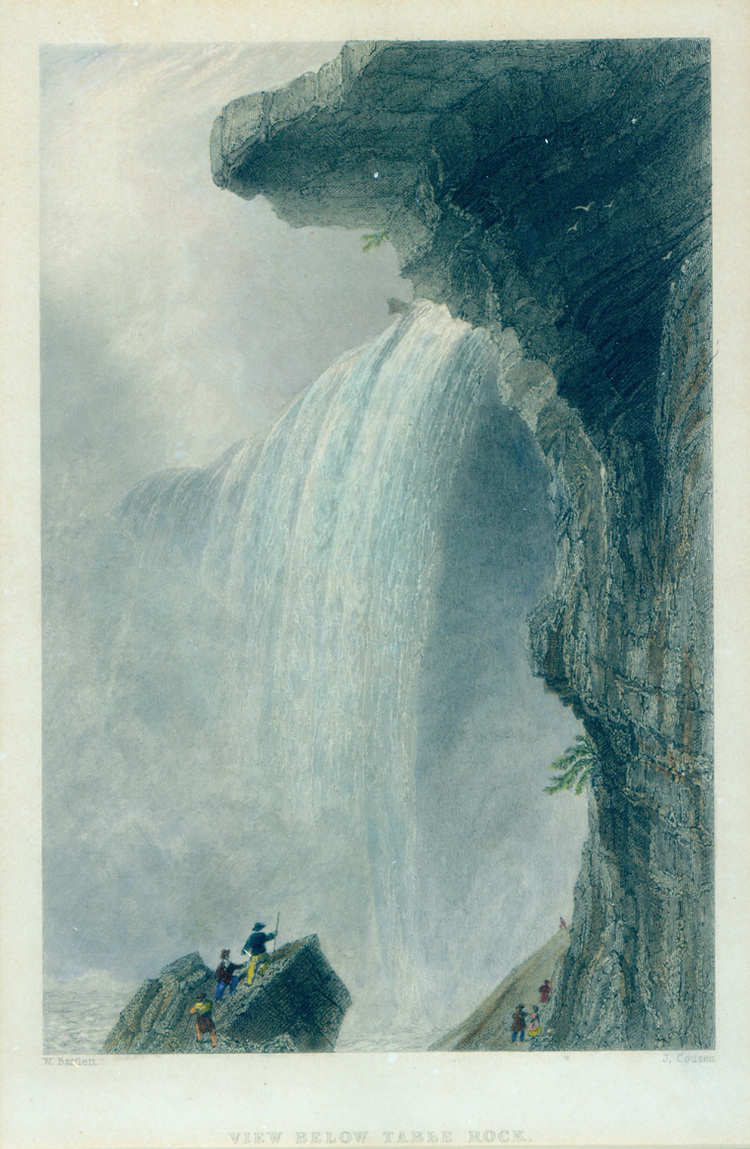
What I remember most is not the barrage,
the beating, the thunderous surge
in my plugged ears. Or the faces
drenched in rivulets of tears. Not the rubber
ducky shoes, or hooked yellow slickers and hats
lined up in a row like Gloucester ghosts
in the fog of the women’s undressing room.
But how, being shy and thirteen, I crouched
in a private cubby and slipping off my panties,
revived the child who once threw off her clothes
and ran through summer storms
open-mouthed in sheets of rain—
a bare-back rider with streaming hair
and tall grass between my toes
—wild and ecstatic.
Drowned in the deafening roar,
my parents’ incessant arguing dissolved to silence
as they held on for dear life to the railing.
Single file we climbed to The Cave of Winds
through the relentless crash of water.
An old man ahead of me stopped. Laughing,
I leapt around and raced up the winding steps, free
to look beyond their fear and shouting.
My uplifted face glowed with the stinging tattoo
and poured down my legs. Beyond belief,
on the top platform I looked through a quicksilver veil
hurling rainbows and spray into my eyes.
Though the scaffold rotted long ago
I’m still there, naked with the angel
behind the falls.
Dear N. : While the rainbows are spanning the Falls,
And a lusty Scotch infant next door raises squalls, —
While the frantic young mother shouts madly for milk,
In tones not so soft, quite, as satin or silk, —
Your friend, grown poetic, has snatched up his pen,
To dash off a line to “the best of young men.”
You’ve been at the Falls, and they can’t be described,
Though Coleridge himself from the tomb should be bribed ;
Pile mountains of paper, and flood them with ink,
And Niagara is dry, though the reader should sink.
But there’s life here, my friend, — closely packed to be sure, —
For fashion condenses what man must endure :
Not a bed to be had, not a chair, or a block,
And the only spare table is old Table Rock.
How glorious a visit, were taverns and gongs
But banished a week to where Fashion belongs,
To tramp through the forest, with no charge of fares,
In a pair of brogans, such as Audubon wears;
To meet a lithe Indian, all stately and stark,
And “put up” a few days in his wigwam of bark; —
Gods! a walk through the woods, by the light of the stars,
Would outweigh all the lamps, and the Lewiston cars!
But here’s life at the Falls — from a year to fourscore —
(And I think by the sound there’s a day at next door ; )
Here are members of Congress, away from their seats,
Though sure to be there when the dinner-gong beats ;
Here are waiters, so eager your viands to snatch,
That they leap down the stairs like a multiplied Patch ;
To the sound of sweet music they nimbly appear,
And whisk off your corn while they tickle your ear.
Here are pensive young preachers, dressed quite comme il faut,
In coats black as night, and cravats pure as snow ;
Rich East India governors, heavy as gold,
Hanging round like weak sun-flowers, yellow and old ;
Artistical talent, with sketch-book displayed,
Drawing very bad water in very poor shade ;
Fat cockneys from Charing-Cross ; belles from Madrid,
Whose long jewelled fingers outrival Jamschid ;
Superb English maidens, with swan-swimming gait,
Who float round the Rapids like Junos in state ; —
But the brightest-eyed daughters, the best string of pearls,
Represent in their beauty our own Yankee Girls.
Here cluster the fair, and the plain, and the prim,
Round the gallant and gay, whiskered up to the brim ;
Here’s a biped in boots, a most exquisite ass,
Who looks at the Falls through a golden-rimmed glass ;
And to-day such a waist, N., I saw on the Rock,
That to furnish the brains seemed a slight waste of stock.
Here’s a lively old lady, all feathers and fans,
Who trots about peddling her Susans and Anns ;
And a drab-colored Quaker, I’ve seen more than twice
Take a sly glass of something in water and ice.
But brief let me be, while the dull curfew tolls ; Niagara still lives! still it rushes, and rolls ; —
There is no spot on earth where I’d sooner meet you,
And the friends we both love, N., the choice and the true,
Though a Downeastern editor published the lie
That this glorious old cataract’s “all in my eye!”
Source: James Thomas Fields. Poems by James T. Fields. Boston: William D. Ticknor & Company, 1849
Behold! again I view thee, in thy majesty and might,
Thy proud sheet flashing in the blaze of morning’s glorious light ;
I see thee maddened in thy fall, and pale with hoary rage,
And fretting in thy passion that hath boiled from age to age.
Like thunder on my startled ear, thine everlasting roar
Hath broken, and reverberates from shore to echoing shore,
Continuous and fearful—giant power in its tone,
That shakes the earth’s foundations, and rives the solid stone !
How tremulous beneath the shock the fearful earth hath grown ;
Reeling beneath the mighty plunge, it sighs with ceaseless moan.
Now rush thy waves with frenzy wild, in foam of dazzling white,
Now placidly they sweep along with ever changeful light.
O, wondrous power ! O, giant strength ! how fearful, to behold,
Outstretched on yon o’erhanging crag, thy mad waves downward rolled ;
To look adown the cavernous abyss that yawns beneath—
To see the feathery spray flash forth in many a glittering wreath !
Voluminous and ceaseless still, forever swift descend
Thy waters, in their headlong course—then, turning, heavenward wend ;
Now, disenthralled, their essence hath its spirit shape resumed,
Bright, bodiless, and pure, its flight to yon empyrean plumed !
Source: John Breakenridge. The Crusades, and Other Poems. Kingston: John Rowlands, 1846.
Looking into the Falls, I heard it sing:
Marriage, marriage, one life always,
Beginning to end in simple water music.
And I thought, by you, this isn’t music for men,
Who are always bespoken in two places at once,
Who partially stand in the middle of great music
Distracted by distance. I put myself in this poem
With you and with marrying waters, and look at me — still
A little apart, wishing for one whole life
But singing this far-off solo right
In the face of the music, as though it could solve me.
Source: Leonard Nathan. Returning Your Call: Poems. Princeton: Princeton University Press, 1975.
One of the Old Lombardy Poplar Trees and the “Castle” at Old Fort Niagara
All of this historical fact from which we form our individual opinions and prejudices, is only the reflection of the lives and characters of those whose acts brought about the series of circumstances with which we have had to deal. Men of France, men of England, and men of America, each in turn, have served well under their respective flags at Old Fort Niagara. Each in his turn has contributed in one way or another to the happy state of affairs which we know today.
Perhaps the writer can best express his thoughts in this connection by the relation of a few lines of verse which came to him as he stopped beneath the old Lombardy poplar trees which have stood in the Old Fort for two hundred years:
To stand beneath these silent Lombardies,
The sentries of the passing centuries;
To gaze far out, across the azure deep
In quiet communion with them as they keep
Their endless vigil o’er this sacred soil;
To live with them again the tragedies,
The hopes, the fears, the gallant victories
That marked the tireless pace of those who sleep,
Who lived and fought and died — that we might reap
The harvest of their vision and their toil.
Source: Claud H. Hultzén, Sr. Old Fort Niagara: The Story of an Ancient Gateway to the West. Youngstown, NY: Old Fort Niagara Association, 1939.
N.B. An earlier version of this poem with an added first line: “I love” was presented in a paper to the 1936 annual meeting of the Old Fort Niagara Association. The paper, including the poem, was reproduced under the title Restoration of Old Fort Niagarain the journal New York History, vol. 18, no. 4 (October 1937)
Claud H. Hultzén was the executive vice-president of the Old Fort Niagara Association.