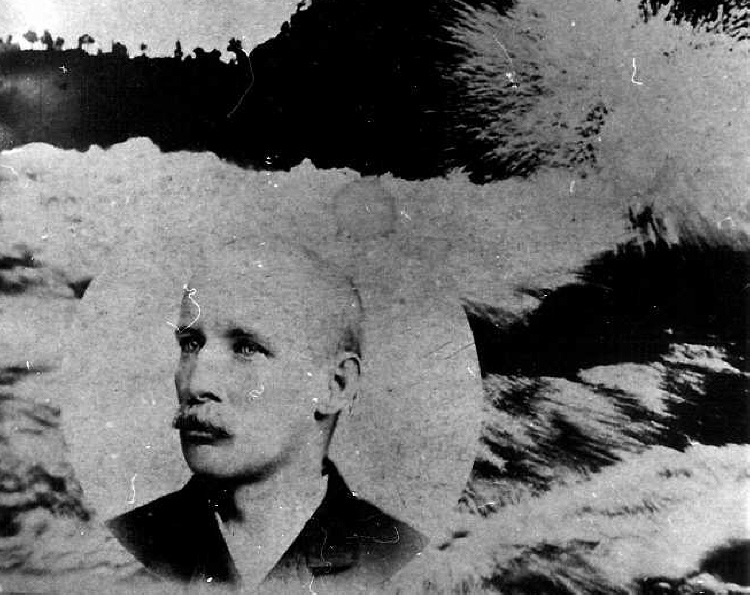
Source: Hoffman, Charles Fenno (ed.) The New-York Book of Poetry. New-York: George Dearborn, Publisher, 1837.
Also published in what appears to be an identical reprint, except for the beginning matter: The Gems of American Poetry by Distinguished Authors. New-York: A. & C. B. Edwards, 1840
N.B. The two books mentioned above has his forenames as “Gian Baptista,” other sources, including the Historical Society of Pennsylvania Archives which holds his papers, use “Giambattista.”
Table Rock, Niagara, 1867, by Edward Ruggles. Image courtesy of the Library of Congress
Here in great Nature’s gorgeous fane we stand,
Where grand libation endlessly is poured,
And incense soars aloft forevermore :
Th’ Almighty King the offering receives,
And on the rising cloud of homage hangs
His bow of promise and of grace.
How fair and gladdening ( as a dream of love
And of the pure, fond bliss of childhood’s hours
To the mind torn and tortured by stern grief
And vexed by sullen gusts of wild despair, )
Shines near the foaming, furious cataract,
This promise writ in rich-hued beams of light !
Here swells in Nature’s temple thro’ all years
Her hymn of praise, while sound the thunder-tones
Of her great organ builded not by man,
Shaking the bases and the rock-reared walls.
The rich, dark evergreens with icy fringe
Hang sparkling now beside the dread abyss.
They seem like a swarthy queen in jewel’d gear,
With divers prized and fond attendants by,
As Cleopatra decking for the step
Adown the fearful steeps of death to realms
Of mist and shades.
‡‡‡‡‡‡‡‡‡‡‡‡‡‡‡‡‡‡‡‡How beautiful yon grove
In all the wildness and the majesty
Of Nature’s primitive growth ! Rich mosses wrapt
Around the noble trunks are velvety
In colors brightened and bedewed with spray.
The tiny flower which blooms upon the sod,
Like it, is freshened in the flying mists
Which breathe their welcome day-dews thro’ these trees :
And hence, we, charmed with matchless beauty, learn
True greatness hath a ministry of love,
E’en for the humble and obscure, as for
The gorgeous and the stately in their hour
Of need and décadence.
‡‡‡‡‡‡‡‡‡‡‡‡‡‡‡‡‡‡‡‡Yon beetling cliffs
Which dark and dizzy, rise above the flood,
Adorned with crimson , pendent trees like vines,
Graceful and young , are types of strength,
The glorious architecture of a hand
Divine and infinite in power. And here,
Below the falling sheet, where foams the flood
With ceaseless roar and ever furious gusts
of rack and wind, — in this dim cave
The poet well might feign the genius fair
of this enchanting, gorgeous spot had shone
At twilight when no other eye beheld ;
As beamed the bright nymph thro’ the sparkling spray
Unto the eye of Manfred ’mid the wild, —
Th’ embodied, rich – hued glory of the scene.
If here the spirit of the Indian brave
Dwelleth amid the flying mists of the mad
And fearful cataract, ( its grander traits
Conspiring in his stern , etherial shape ; )
Forth from the poet’s imaged sprite doth glow
The light, the hues, the fresh , eternal charm
Of waters and of rocks and moss and flowers,
Of sun-bows and of foam-washed crystals clear,
The sparkle and the rich and bloomy grace
Which in the lovelier features of the scene
Adorn the spot as Nature’s glorious shrine.
This noble gem of scenic beauty set
Upon the swelling breast of Earth, hath, too ,
Its fair and delicate chasings as surroundings meet.
Source: Rev. Gurdon Huntington. The Shadowy Land, and Other Poems. New York: James Miller, 1861.
From Rev. E.B. Huntington. A Genealogical Memoir of the Huntington Family in This Country, Embracing All the Known Descendents of Simon and Margaret Huntington. Stamford, Conn.: The Author, 1863
GURDON, born Nov. 27, 1818, graduated at Hamilton College, 1838.
Ordained deacon of the Prot. Episcopal church, July 2, 1848, and presbyter, April 14, 1851. He was invited to Simmonsville, and Spraguesville, R. I., in 1848, from which post he went to Pottersville, N. Y., May, 1850. Called to Christ’s church, Sackett’s Harbor, N. Y., April 6, 1852, and to Sag Harbor, June 11, 1856, where he is now engaged. He has devoted much of his time to literature, and from early in his course, as student, has used a ready and skillful pen. His contributions to our poetic literature have been quite numerous, among which are the ” Shadowy Land,” now in press; “The Guests of Brazil;” ” The Romance of the Indian Country and its Tribes;” ” Washington at the Battle of Princeton;” “The Watery World;” ” The Mohawk River;” “Tuxedo Lake;” ” Genevieve ;” “Musings at Evening Hours ;” ” Child of Immortality;” “The Steamship.” Three of his poems, on public occasions, have also been printed: on ” Confidence and Affection,” &c. ; “Dignity and Triumphs of Mental and Moral Culture;” “Providence ;” and a prose essay on “The Conditions and Materials of Poetry.” His poem at the Huntington meeting, Sept. 3, 1857, appears in this book. He was married, Jan. 22, 1852, to Sarah Gold Sill, who died in Sag Harbor, Jan. 31, 1858. He married, the second time, Oct. 25, 1859, Miss Charlotte Marsh Sill, of Rome, N. Y.
Niagara Falls: From the Canada Side. Currier & Ives, 1856 (?). Image courtesy of the Library of Congress
I stood where swift Niagara pours its flood
Into the darksome caverns where it falls,
And heard its voice, as voice of God, proclaim
The power of Him, who let it on its course
Commence, with the green earth’s first creation ;
And I was where the atmosphere shed tears,
As giving back the drops the waters wept,
On reaching that great sepulchre of floods, —
Or bringing from above the bow of God,
To plant its beauties in the pearly spray.
And as I stood and heard, though seeing nought,
Sad thoughts took deep possession of my mind,
And rude imagination venturing forth,
Did toil to pencil, though in vain, that scene,
Which, in its every feature, spoke of God.
Oh, voice of nature ! full of strength and awe; —
Unceasing sermon, where Omnipotence
Is at once the theme and illustration.
O thou pervading sound ! o’erwhelming all
With vast conceptions of might infinite !
Hallow my inspirations, and subdue
Whatever in me jars with holy thought.
Let thy loud tones speak to my inmost soul,
And teach it ever to acknowledge God.
Full of thyself, great flood, how vain the task
To tell thy might, or adequately know
How vast thou art, — so very small are we !
If such the thoughts are which thy voice stirs up,
Then what the awe that would entrance the mind
At viewing thy dread strength, thy power sublime!
Or beauty that o’ertops the highest range
Of boldest fancy, whose most lofty flight
Would fall beneath thee far, and much abashed.
Oh place most sacred ! full of awe and God !
Where every sound, and all that’s seen, combine
To teach our minds to humbly trust in Him,
Whose fiat called, and who sustains the world.
O spot ! if any spot on earth can be
A temple, where Jehovah is felt most,
Raise my dejection, and enable me
To speak as may befit thee and myself ;
And teach me to address, in proper terms,
Him, for whose honor thou wast form’d to flow,
And talk forever of his power supreme.
O Thou, that givest all that we possess,
Whose might is infinite, and goodness, too,
Bend to my voice thy always ready ear,
And hearing grant, O grant my earnest prayer,
One which hypocrisy hath ne’er abused,
Nor has been by the drowsy formalist.
The verdant earth which thou hast made,
The sky through which the blazing sun doth ride,
And the moon with her large train make progress ;
These are thy works, which well assert thy might
And goodness, and addressing us, doth speak
Wherever culture rules or nature reigns.
Yet, sight of sky, of sea, or of the earth,
Of wild plant, or of cultivated flower,
Of quiet lake that sleeps in loveliness,
Wound in a belt of perfect solitude, —
Of streams that flow contented in their course,
And leave a legacy of flowers behind, — Is not to me vouchsafed, — nor may I look
Upon the cataract’s unfetter’d rage,
That wildly hurries it to the abyss,
Which, like a gap in nature, waits the flood
Which, ever rolling, leaves it waiting still.
Of this, imagination tells alone !
Is forced to copy, oh, how faint transcribe,
Where all its paintings must be in itself,
Nature’s designer, and her artist, too.
For me, the world is black, and filled with gloom ;
Huge darkness sits recumbent on the air,
Oppressing it with universal night,
And making melancholy joys supplant,
Till cheerfulness removes from where gloom reigns,
Leaving the mind a prey to thoughts unblest.
And here, where Thou art ever felt to be,
Where nature loudly owns Thee as her God,
Whose praise is sounded by the cataract,
Hearken to me, and my petition hear,
As from each recess of my struggling soul,
The sighs of sickly hope, assembling fast,
Meet in a perfect flood of fervent prayer, —
Which all express’d is this, — Lord, give me sight: — And that so long unheard, is unheard still.
Source: Artman, Wm. and Hall, L.V. Beauties and Achievements of the Blind. Dansville, N.Y. : Published for the Authors, 1854
From Frank Severance’s Old Trails on the Niagara Frontier:
That Niagara’s supreme appeal to the emotions is not through the eye but through the ear, finds a striking illustration in “Thoughts on Niagara,” a poem of about eighty lines written prior to 1854 by Michael McGuire, a blind man. Here was one whose only impressions of the cataract came through senses other than that of sight. As is usual with the blind, he uses phrases that imply consciousness of light; yet to him as to other poets whose devotional natures respond to this exhibition of natural laws, all the phenomena merge in “the voice of God.”
The poem, which as a whole is far above commonplace, develops a pathetic prayer for sight; and employs much exalted imagery attuned to the central idea that here Omnipotence speaks without ceasing; here is
“A temple, where Jehovah is felt most.”
The gas was on in the Institute,
The flare was up in the gym,
A man was running a mineral line,
A lass was singing a hymn,
When Captain Webb the Dawley man,
Captain Webb from Dawley,
Came swimming along the old canal
That carried the bricks to Lawley.
Swimming along –
Swimming along –
Swimming along from Severn,
And paying a call at Dawley Bank while swimming along to Heaven.
The sun shone low on the railway line
And over the bricks and stacks
And in at the upstairs windows
Of the Dawley houses’ backs
When we saw the ghost of Captain Webb,
Webb in a water sheeting,
Come dripping along in a bathing dress
To the Saturday evening meeting.
Dripping along –
Dripping along –
To the Congregational Hall;
Dripping and still he rose over the sill and faded away in a wall.
There wasn’t a man in Oakengates
That hadn’t got hold of the tale,
And over the valley in Ironbridge,
And round by Coalbrookdale,
How Captain Webb the Dawley man,
Captain Webb from Dawley,
Rose rigid and dead from the old canal
That carries the bricks to Lawley.
Rigid and dead –
Rigid and dead –
To the Saturday congregation,
Paying a call at Dawley Bank on the way to his destination.
Source: Betjeman’s Banana Blush: Sir John Betjeman the Poet Laureate Reads His Verse. Charisma Records, 1973.
Captain Matthew Webb was a world-renowned swimmer who attempted to swim the Whirlpool Rapids at Niagara Falls on July 24, 1883. He is buried in Oakwood Cemetery, Niagara Falls, New York. Read about Captain Webb here.
Horseshoe Falls From the American Side by James Hamilton, 1855. From the National Grid (Formerly Niagara Mohawk Power) Collection. Image courtesy of Niagara Falls Public Library
Hail ! Thou stumendous, trependous waterfall !
O waterfall thou art, and waterway thou seemest to fall !
Infinitudinous thou, infinitesimal I !
Yet do I hold thee in the minute circle of mine eye !
Of thee have other alleged poets sung and sung and sung,
Chanting wild doggerel with unlimbered tongue
And shrieking till they nearly ruptured their little left lung !
But it hath fatefully remained for insignificant me
To do the brown poetical thing, O Niagara by thee !
I’ve done up Highland Lake and Upper Woods and Gettysburg
And even busted quills on wild Van Fredenberg,
But ne’er till now did in me surge the sweet divine afflatus
To tune to minstrelsy my poetico-intellectual apparatus
How doth the misty thunder surge palpitatingly athwart my tympanum auricular
As up the emerald aqueous wall it climbs exactly perpendicular !
Jerusalem ! it would absorb a Webster’s dictionary unabridged
To paint in words yon rapids by the flossy billows ridged.
And now I faint e’en as a reformed toper who would pass
His dearest enemy imprisoned in a crystal glass.
These islands are as fair as Eden ere yet the serpent, Sin,
Had run the pickets and skedaddled in.
The Horseshoe Curve — Great Scott ! how doth the water tumble !
And jumble, and rumble, and everlastingly bumble !
One hundred five and sixty feet in sheer descent
The green flood simply flops h–l bent !
And over half a mile across the gruesome edge
Of that precipitous ledge
The endless water pours and pours and pours,
And unremittingly roars and roars and roars !
And what euphonious cognomenclature
Have thoughtless men bestowed on this crown-glory of the works of mighty nature!
Just think of Goat Island, Bath Island, Three Sisters Islands and Shipman Island
And even Luna Island applied to dainty bits of dry land
Amid the thunders of this glorious flood !
Is’t not enough to make a poet drink the blood
Of the inhuman, misguided creatures
Who thus have named Niagara’s salient features ?
The fall is terrific.
The sound is soporific.
The walks are sudorific.
The baths are frigorific.
The charges of the hacks are calorific.
Niagara is a rare old hieroglyphic.
But I will bottle now my musings in my breast
Till I have killed a guide, carved up a hackman and burned an Indian bazaar, when I can rest !
There, the guide is dead, the hackman rests in peace and the bazaar smoke is mixed with Niagara’s mist,
And they will not be missed !
Adieu, Niagara ! the poet goes, as poets do, forever,
But thy sublime and massive grandeur he’ll remember ever !