Durfboger-LaCasse Wedding at Niagara Falls James Photography Studio, September 19, 1959 Image courtesy of Niagara Falls Public Library
I’VE seen them come, I’ve seen them go, ‡‡Too numerous to mention,
And I put on a mighty show ‡‡To capture their attention.
I hurl me boldly down the cliff ‡‡And thrash myself to spray,
Yet none of them would notice if ‡‡I ran the other way.
I think it’s very rude to me ‡‡That any groom and bride
Should come this distance just to be ‡‡So darned preoccupied !
Source: Saturday Evening Post, May 22, 1948
Biographical sketch of Norman R. Jaffray. Saturday Evening Post, March 28, 1942:
Jaffray, Just Jaffray
NORMAN JAFFRAY first appeared in Post Scripts sixteen years ago and he’s been appearing there with regularity ever since. You’ll even find him there this week, with WHODUNIT? Acceding to a deluge of requests from four readers (Hansel, Ole, Sergi and Tong Lee Jaffray), we are this week shaking down the fruit of Mr. Jaffray’s persistence.
Here he is:
“Yes, here I am—but guess which? Not the one in uniform—no-o. Not the one in the middle — no-o, but you’re getting warmer. . . . The scene is Santa Barbara, where I live, the friends. Flying Officer Robert French, RAF, and Mrs. Shreve Ballard, and the background is the blue Pacific (advt.).
“Where to start? Born? Yes. In Brooklyn, N. Y., and came to this country as a small boy.That was in 1904. Roosevelt was President—he still is; horse and buggy were the popular mode of transportation—nothing has changed.
” I went to Yale and then to Trinity College, Cambridge, and in 1926 I came out West. The country was filling up, and men sought new lands where they could start life afresh. I picked on Los Angeles, and it was there that Ted Cook, of the Examiner, printed my first piece in Cook-Coos. I’ve been freelancing ever since. I’m not even married.
” The other day I went to Los Angeles again, this time for a rendezvous with some fellow contributors to Post Scripts. Local No. 138 of the Curtis chain gang, comprising Ethel Jacobson, Kay Hosking and your correspondent, met and passed several resolutions, which were quickly tabled. Just to give you an idea of what shop talk among writers is like:
ETHEL: I liked that Christmas poem of yours—the one with the bad scansion.
KAY: Done anything lately, yourself?
ETHEL: Yes, something for Easter.
NORMAN (apprehensively): Nothing long, I hope?
ETHEL: Whole column.
KAY: Don’t you ever get sick or anything?
ETHEL; Do you like Y?
KAY AND NORMAN; Like that. (Gesture of cutting throat)
KAY: How about Z?
ETHEL AND NORMAN: Well, Z’s stuff is pretty good. Of course, it doesn’t rhyme and . . .
NORMAN; Well, I’ve got to drive back to Santa Barbara. (Goes to door, feeling for knife in shoulder blades.) And please . . . please don’t talk about me when I’m gone! (He goes. They do.)”
Written on the Opening of the Eastern Section of the Great Western Railroad, 1st November, 1853
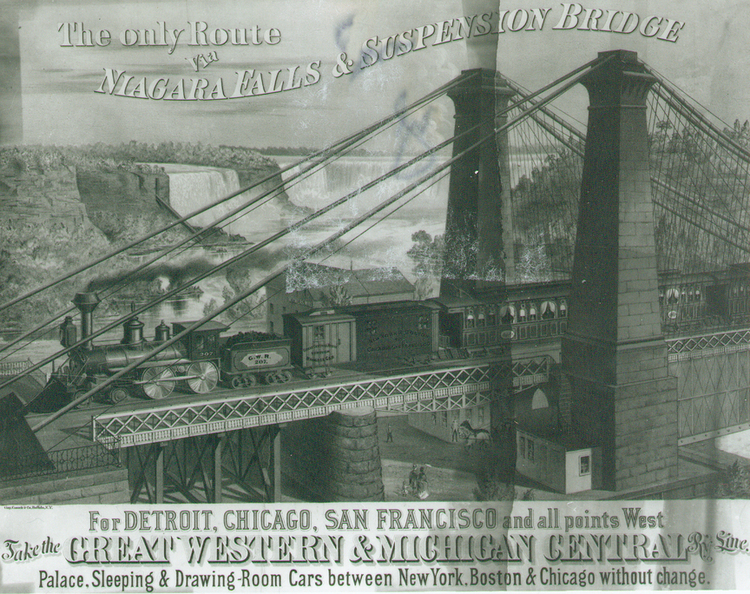
Advertising poster for the Great Western and Michigan Central Railroad, late 1850s Artistic licence places the bridge much closer to the Falls as is the case. Construction of the bridge was completed in 1855 Image courtesy of Niagara Falls Public Library
Hurrah, for the straight, hard iron road ! ‡‡For the fire-horse swift and strong !
Hurrah for the pond’rous chariot-train ‡‡That fleetly speeds along !
Through wood and wold—through hill and dale, ‡‡Past hamlet, hut, and hall,
The snorting fire-horse flys apace, ‡‡With a swift adieu to all.
Trees, rocks, and streams seem darting past ‡‡Like shadows on the wind—
The earth itself is rushing on, ‡‡To recede fast, fast, behind !
Away ! away bounds the mighty steed, ‡‡While wondering crowds admire
And, breathless, gaze on the fearful force ‡‡Of iron moved by fire.
The horse—the horse of our grandsire’s days, ‡‡With bones and muscles strong—
And the camel tall, and the elephant, ‡‡Could drag huge loads along ;
But the iron-horse, from the hand of man, ‡‡Impelled by mind and steam,
Whirls mountain chariots through the air ‡‡With the swiftness of a dream !
Speed on, strong horse ! with thy tidings glad, ‡‡Through wood and wild, speed on—
Thou bear’st abroad in triumphs now, ‡‡The conquest Mind has won ! —
The marvels, mysteries, magic, spells ‡‡Of a darker, bygone day,
Before the fact of the iron-horse ‡‡Must quickly pass away—
And fleet and far o’er the iron road ‡‡Strong thoughts shall soon be borne,
To burst the bondsman’s irksome chain, ‡‡And blast the tyrant’s scorn :
Intelligence, and power, and peace, ‡‡As the Maker, God, designed,
Like a rainbow wreath shall gird the earth, ‡‡As the heritage of Mind.
Land of the wood, and ocean lakes— ‡‡Of the wild beasts’ dark abodes !
Lands where the shirtless savage raved ‡‡Wild mummeries to his gods !—
Land of the savage now no more ! ‡‡Blest, peaceful, prosp’rous land !
Thy wealth and freedom are secured ‡‡By a massive iron band !
The red man’s rude and murderous bow— ‡‡His flimsy bark canoe—
His frantic worship—war-whoop wild— ‡‡And nostrums not a few—
From Art and Commerce fled away, ‡‡Yielded to mental force :
And Science now, on her iron road, ‡‡Sends forth her iron-horse.
Hail, Canada ! Thy fame, in part, ‡‡Is shadowed here to-day,
When sounds the steam-car’s whistle loud ‡‡Round our commercial Bay,
And hark ! the whistle sounds again ; ‡‡Crowds press, with keen desire,
To witness Mind’s stupendous power ‡‡In iron and in fire.
Source: St. Catharines Journal, November 17, 1853. p. 1
From Holt, William J. (ed) Niagara Falls, Canada: A History of the City and the World Famous Beauty Spot; an Anthology. Niagara Falls: Kiwanis Club of Stamford, 1967, p. 62 :
“The coming of the Great Western Railway in 1853 brought boom times to the village of Elgin, Canada West.* Hundreds of jobs were created in construction and railroading in Elgin, resulting in a startling population increase from 100 in 1853 to 2000 in 1857. The Great Western, in 1845, took over a charter granted in 1834 to the London and Gore Railroad, which gave it authority to build from any point on the Niagara River to the Detroit River. The construction of the Suspension Bridge at Elgin and its charter provision for a top deck for railroad traffic made Elgin the obvious choice.
Samuel Zimmerman had the contract to construct the portion of the line between Hamilton and Niagara Falls. Construction began in 1851 and the first run to Niagara Falls, with a steam engine and six passenger cars, took place in November, 1853. A gala party was planned at Zimmerman’s Clifton Hotel to mark the arrival of the first train and even though the last few miles of the trip were made by road, after the locomotive broke down, the party was held.”
It is possible that this poem was read at the gala.
*Elgin was a small village where the present day Via/Go railway station and the Niagara Falls bus terminal are located, a few blocks from Niagara Falls City Hall. It amalgamated with the village of Clifton in 1856, and in 1881 was renamed the Town of Niagara Falls. In 1904 the Town of Niagara Falls and the Village of Niagara Falls (formerly Drummondville) were amalgamated to form the City of Niagara Falls.
THE “Note” from Alexander’s Transatlantic Sketches,* which is appended to the following Poem, “FRANCIS ABBOTT,” will supply the particulars of “The Last Days” of that singularly unfortunate being. As so little is known of the earlier history of his life, I considered it no infringement of the licence universally allowed to the Poet, in giving him his original “local habitation” in a province, which is, from various causes, peculiarly dear to my recollections and feelings. And as the cause of the eccentric habits and singular alineation of mind of the Recluse still remains, and probably will remain, a mystery, I applied the same licence to the developement of it; and, as “brooks run to rivers, rivers run to seas,” I have attempted to show the result of an indulged morbid sensibility, which, from apparently slight original causes, has gradually acquired an influence, that has led some of the most refinedand delicately constituted minds to the very verge of
‡‡‡‡‡‡‡‡That dread gulph, where passion lies and frets ‡‡‡‡‡‡‡‡Till moody madness comes, and black despair!
In deviating slightly from the account given by Captain Alexander of the last scene in the life of Francis Abbott, I was actuated, not only by the consideration of making it less painful and repugnant to the feelings of the reader, but also from an idea, that the probable truth is in
favour of the description which I have given ; as it must, I apprehend, require a most unflinching determination, as well as great physical strength, to effect the purpose of self-destruction in the manner related by Captain Alexander, the correctness of which seems to rest entirely on the
testimony of the Ferryman at Niagara. It may be unnecessary to remark, that I have, in the
Poem, paid no respect to the modern and fashionable pronunciation of the word Niagara. Mr. M’Gregor, as I have before remarked, refutes the opinion that the accent should be placed on the second syllable.
J. Bird
* One of the best written and most interesting works that has
appeared relative to America.
The Hermit’s Cascade Located between Goat Island and First Sister’s Island, just above Niagara Falls. Francis Abbott’s favourite bathing spot. From Peter Porter’s Official Guide: Niagara Falls, 1901 Image courtesy of Niagara Falls Public Library
‡‡‡‡WHERE the clear GIPPING through the valley flows,
Where the green willow and the poplar grows,
So gently winds the stream, it seems at rest ;
The laden barge upon its peaceful breast
Would slumbering lie through many a tedious hour,
Did not the patient horse, with sluggish power,
Drag it from lock to lock, unwearied, slow,
From its snug mooring near the wharf at STOW,
To where the ORWELL, of the tribute vain,
Salutes the stream, and bears it to the main.
‡‡‡‡The River strays through verdant meads and fields,
Clad in the beauty which fair SUFFOLK yields :
Yes, SUFFOLK ! that poor county, which her best,
Her greatest Poet, in rough garb has drest ;
How has his genius touched her barren shore,
That, bleak and wild, lies trembling at the roar
Of angry waves !—her lone and sterile heath,
With gorse above, and useless roots beneath,
The dark and sedgy fen, the naked reeds,
The stinted corn o’er-run with noisome weeds,
The fetid poppy, and the charlock gay,
Amid the crops, as profitless as they,
Which noble CRABBE, with graphic hand, hath placed
On Time’s dark canvass, ne’er to be effaced !
‡‡‡‡Yet, SUFFOLK ! thou hast fairer scenes than these,
Which, if they raise no wonder, more than please ;
Health smiles around thy richly-wooded dales,
Luxuriant uplands, and refreshing vales,
Thy fields are like a fairy garden, wide,
Where art and nature are so close allied,
Their happy union has subdued the wild,
Their home is here, and beauty is their child !
Fair DISTRICT ! where I drew my natal breath,
Awoke to life, and hope to sleep in death—
Where I have seen, and loved to see, green nooks,
Have heard, and joyed to hear, thy murmuring brooks—
Where I beheld, and gladdened to behold,
Lime, elm, ash, beech, and towering oaks of old—
Where I have felt sink in my heart the beams
Of the bright sun, that glowed on hills and streams :
Feign would I hope, in honour of my theme,
This dream of loveliness no fictious dream ;
Well since thy scenes were ever dear to me,
SUFFOLK ! I dare begin this theme with thee !
‡‡‡‡The GIPPING slowly glided on its way,
As softly calm as was the close of day,
Few sounds arose—the partridge on the hill
Called to his mate, and, in the vale the mill
Ran whirring round—the stock-dove in the wood
Was heard to coo beside her tender brood,
O’er the closed lock the water gently fell,
Yet ‘woke not echo in her rural cell.
The sun, though sinking in the west, was bright,
And o’er the landscape threw redeeming light,
Illumed the grassy mead, the sloping ridge,
And faintly glittered on the narrow bridge
That lightly spanned the rippling stream between
The clustering fringes of the willow green,
While shone the water as a mirror clear,
And tree, wild shrub, sweet flower, and cottage near
Appeared reflected in the glossy stream
Soft as the shadows of a fairy dream.
‡‡‡‡Thou gentle RIVER !—though thou canst not vie
With nobler streams, whose fame may never die,
Well may’st thou brightly, proudly glide along
To join that lovelier stream, renowned in song,
In which, when thou art lost, though gone thy name,
Wed with the ORWELL thou’rt a part of fame !
What, if thou flowest through no rocky glades,
Spring’st not from mountains, fall’st not in cascades,
On thy green banks in childhood’s sunny day
Oft have I strayed, and felt it joy to stray ;
There have I watched the finny tribe, and there
Beheld the fisher with his treacherous snare,
Have seen the patient angler with his hook
And pliant line, sit with an anxious look
Fixed on his float, as though the doubtful fate
Of empires hung upon his tiny bait.
And here, a truant boy, the live-long day
I’ve loitered, strolled, and dreamed the hours away,
Till the old chapel-clock, perchance, struck nine,
And I awoke, nor marked the sun’s decline :—
And I was three lone miles from home—had two
Drear, dark church-yards through which I needs must go !
Then of my mother’s parting words I thought,
And thence new fears, and more vexation caught—
“Make haste !—and do your errand—go not nigh
The river’s brink, for there the mermaids lie—
Be home at five !”——Oh! how my heart sank now—
Speed in my heels, and fever in my brow,
I hurried home, and to my little bed
Stole, like a culprit, by a door that led
Within our old huge DEER-BOLTS Hall, apart
From the tired household—then, with fluttering heart
Crept to my couch, and soon forgot my cares,
Forgot my mother, and (I fear) my prayers.
‡‡‡‡And thou, old RIVER ! glidest on the same,
Thine aspect still as changeless as thy name,
The same green trees wave near thee as of yore,
And many now seem greener than before ;
Thou flowest still unruffled in thy course,
While life’s strong current, with resistless force,
Hath borne me onward, changed me since the hour
I strayed by thee, untried by passion’s power :
Yet, though time’s stream perchance has ruffled been,
By storms I saw not rise, but might have seen,
Yet, on its chequered banks thick scattered grew
Flowers of sweet fragrance, and of pleasing hue,
Planted by HIM who caused thine urn to flow,
Whose fount of love refreshes all below !
‡‡‡‡The sun-light lingered on the village green,
Where old and young, the grave and gay, were seen,
Now each discordant, jarring sound was mute,
Soft melting echoes of the warbling flute
And pipe and tabor gave their jocund tune,
While genial smiled the loveliest eve of June.
Two brothers gazed upon the lively train
That danced, exempt from care and vice, that reign
In courts, in camps, in cities, and in marts
Where gold and gain are cankering men’s hearts !
The elder, FRANCIS ABBOTT, with a smile
Spoke to his brother HERBERT, who, the while,
With sparkling eye looked on the dance with glee,
O’erjoyed, the joy of other hearts to see.
‡‡‡‡‡‡‡‡‡‡‡‡‡‡‡‡FRANCIS.
‡‡‡‡Mark, HERBERT! with what grace yon lovely girl,
Whose bright blue eyes, through many a glossy curl,
Beam like two stars of lucid light, that show
Through floating clouds, on dimmer things below—
See, how she moves !—with what light step she bounds,
As sweetly wild the village music sounds :
That sylph-like form, methinks, was aptly made
To grace the goddess of this sylvan shade ;
And that enchanting air!—her eye, her cheek,
So soft, yet bright—so beauteous, yet so meek !
‡‡‡‡‡‡‡‡‡‡‡‡‡‡‡‡HERBERT.
‡‡‡Brother ! thy words seem kindled in the heart
By passion’s warmth !—’tis said its fires impart
A glow so bright, that in its lustre lives
More than the mirror of stern truth ere gives !
The maid is fair—and, had I land and gold,
Domains unbounded, precious stores untold,
I would not prize what gauds like these confer,
Without sweet LUCY GRAHAM, or such as her !
FRANCIS ! one secret lives within my breast,
By none suspected, and to none confessed—
Long have I hoped on this fond theme to speak
To thee, my only brother !—I would seek
The heart, the hand of LUCY !—start not now,
Nor let a cloud thus gather on thy brow,
Full well I know my peace is dear to thee,
Kind hast thou been, as thou art still to me,
E’en when some error leads my thoughtless mind
Astray, disporting like the frolic-wind—
And, could I know fair LUCY’s love were mine,
Blessed would my fate be, and more glad be thine
To share my happiness !—to thee alone
I trust the secret of my soul—and soon
More joy, dear FRANCIS, may my words impart,
When LUCY crowns my rapture with her heart !
Oh! how it glads my bosom to possess
A friend who shares my transports, my distress,
A brother, from whose presence I ne’er kept
Smiles in my gladness, tears when I have wept ;
And now to hear me speak will yield delight
To him, who loves to see my hope most bright!
‡‡‡As HERBERT ceased, he saw his brother’s cheek
Flush with emotion, though he did not speak ;
His eye was troubled as he forced a smile,
And pressed the willing hand of HERBERT, while
He turned away abruptly from the spot,
As though he heard no voice, or heeded not :—
Yet FRANCIS loved his brother as his own
Undying soul, which suddenly was thrown
By HERBERT’s generous trust upon a wave
That dashed his aspirations to the grave !
Yes! he had felt the influence of the grace
Of LUCY’s mind, the beauty of her face :
He loved !—but knew not, till this trying hour,
The depth, the height, the might of passion’s power.
He had not dared to breathe to mortal ear,
The truth that Lucy to his soul was dear,
Though he had seen, and loved, and hoped to wear
Upon his heart a beauteous gem so rare.
But now !—the fountain of his lips was sealed
By HERBERT’s frank confession !—had it steeled
His breast against true loveliness and worth,
He still had known the happiness of earth :
But, like a torrent, when by rocks delayed,
Still rises, spreads, and will not long be stayed,
O’er the rough verge it breaks, and gains new force
E’en from those rocks that barred it in its course ;
So FRANCIS felt his bosom’s passion gain
New strength from checks that might awhile restrain.
With him had HERBERT played in childhood’s glee,
Lisped his first prayer beside their mother’s knee,
Together had they grown, and thought, and dwelt,
Together reasoned, and in union felt :
Could aught divide them ?—they who thus were joined
In love fraternal, one in heart and mind ?
The only children of their parents’ care,
Their youth’s horizon had been bright and fair ;
But now a little cloud was seen to rise,
Though but a speck, and distant from their eyes,
Yet, it might spread, and gather o’er life’s sky
In deeper darkness, threatening still more nigh,
Till every star of joy, and every ray
That yielded light to glad them on their way,
And e’en that sun, (the last from man to sever)
The sun of hope, be blotted out for ever !
‡‡‡The youths were noble in their minds and mien,
Both were the same, yet both how different seen !
Alike in moral worth, and in the aim
That leads us on to virtue, and to fame,
Alike their forms in manly grace were clad,
One was oft wild with joy, and one was sometimes sad.
‡‡‡The mind of FRANCIS, lofty and acute,
Reflected much, though oft his lips were mute,
A mild reserve was in his manners seen,
Oft from the world abstracted had he been
By bright imagination’s subtle power,
That wings the soul above the present hour ;
He loved to stray along the grassy vale,
To listen, lonely, to the wandering gale,
To hear the murmur of the swelling sea,
And o’er the heath-clad hill, or o’er the lea,
To watch the lark upon her airy wing,
Float ‘mid the fleecy clouds, and floating sing ;
To mark the watchful, melancholy moon
Glide through her sea of ether ; and alone
He oft was wont to ponder on man’s fate,
The change, the good, the evil of his state :
There was a pathos in his youthful heart,
Though rarely seen, it deeply dwelt apart
From all the showy world’s delight and boast,
And shunned the folly that inspires it most.
Yet, came there aught to call his feelings forth,
Triumphant virtue, or desponding worth,
Benignant wealth, or poverty in tears,
Youth’s restless hope, and manhood’s opening fears,
These, and the nobler energies of mind,
That raise, adorn, and dignify mankind—
These o’er his soul held sway, and, when their power
Threw gloom or lustre on the passing hour,
Self-love was dead, his warm, best feelings ‘woke,
And love for man, like sun-light o’er them broke !
‡‡‡And such was FRANCIS ABBOTT ; yet another
The humble pencil claims—his joyous brother !
In HERBERT’s soul there beamed a lamp, whose flame
Trimmed with the oil of gladness, burned the same,
Howe’er the rough external world might jar,
Or hostile factions sound the trump of war,
Howe’er old village scandal, in her ire,
Might move her tongue in scorn at dame or squire,
Whate’er the village gossipers might tell
Of this delinquent swain, that flirting belle,
If sunshine beamed, or gloomy fogs oppressed,
The wind blew north, or south, or east, or west,
If rain descended through the live-long day,
And spoilt his cricket, though he loved the play,
Howe’er the petty ills of life might give
A moral death to some, he still could live !
We start from shadows here !—How oft life brings
Trouble to common minds !—ignoble things
Not worth a rush, to them will evils seem,
As a light breeze disturbs a shallow stream.
But HERBERT rose above those ills—he saw
The bright side of life’s picture, and could draw
From barren scenes a solace, and impart
His own rich colouring to a dreary heart.
Where e’er he moved he was a welcome guest,
With him came sunshine to the icy breast,
Reserve before his generous warmth would melt,
And hearts would feel which had but rarely felt ;
His playful wit was like the moon’s bright ray,
Which, though it scorches not, illumes the way ;
And, in his laugh there lived that gladsome tone,
Which, when called forth, was never heard alone :
And, when the jocund villagers were seen
In social groups, or dancing on the green,
Or where the elder, graver folk, would sit,
And, while they talked of wisdom, laughed at wit,
All, when they met—for he to all was dear—
Would ask, with sparkling eyes—“Is HERBERT here ?”
‡‡‡Such were the brothers, and, though thus unlike,
As different notes make music when we strike
The chords harmonious, so their varied minds
Blended in that sweet harmony, which binds
Contrasted souls, and gives to life a power
And tone, to charm its ever changing hour,
As on it glides from varying day to day,
Then dies in richer melody away !
‡‡‡Could time ere bring one melancholy token
That these sweet chords would be for ever broken ?—
Two stars may brightly shed their mingled light,
Yet both be darkened by the clouds of night—
Two flowers together on one stem may grow,
Yet both be crushed by one untimely blow—
Two streams may spring from one untainted source,
And smoothly glide together in their course,
Yet rocks may rise, and part them as they run ;
Their waters troubled, and new strife begun,
Thenceforth they flow so far apart, no more
To glide unruffled to the distant shore,
But hoarsely murmur to the rugged coast,
Till both in ocean’s stormy caves be lost !
‡‡‡‡The merry dance was o’er—by HERBERT’s side
Sat LUCY GRAHAM—Oh ! had she been his bride,
He felt that then, howe’er old time might wend
His tortuous way to life’s brief journey’s end,
For him no storms would lower, no tempests rise,
But love’s glad sun beam over cloudless skies,
And never set, but, with unfading ray
Diffuse one changeless, one perennial day !
How joyous rose the heart of HERBERT now,
The light of rapture played upon his brow,
He smiled, and spoke of love, and then his breast
Swelled with its native mirth, which, unrepressed
Broke forth in sportive jest, and wit, that brought
A pungent relish to the feast of thought.
‡‡‡‡Near them stood FRANCIS, ‘neath a lofty oak
Whose green and pendent branches softly broke
The rising moon’s pale ray, as bright it fell
On the small brook that murmured through the dell.
His eye was fixed upon his brother’s face,
Then wandered slow to LUCY’s softer grace ;
He saw, or thought he saw, within her eye
Expressive light, that showed her sympathy
With HERBERT’s soul—she listened, while his tongue
Told merry tales, and laughing echoes rung :
They seemed the happiest, fairest, loveliest there :
And FRANCIS saw—then drooped his heart with care !
His love was yet untold—and now he deemed
His brother snatched the bliss of which he dreamed—
The vision fled, the present showed to him
A sad reality, whose shadows, dim,
Might gather round his life, and thus o’ercast
The hope for which he wished that life to last !
Yet—could he blame his HERBERT ? no ! he knew His heart was guileless, generous, and true—
And FRANCIS ne’er had whispered—ne’er confessed
The struggling passion of his ardent breast.—
Again he gazed upon the youthful pair,
One was so manly, one so passing fair ;
Oh ! now he felt as though his brother’s power
Were like a serpent in his Eden’s bower ;—
He looked again, and, as the rosy smile
Of LUCY beamed, devoid of care and guile,
From her sweet lips love’s angel seemed to start,
To mock the torturing demon in his heart !
‡‡‡‡Meantime how many a jocund heart that night
Beat with a pulse electric with delight :
Here was the village LAWYER, here his briefs
Were all forgotten, as were all his griefs :
He was a staid, yet merry man, who ne’er
Frowned at a dance, nor saddened at good cheer,
He loved the bright, the young, the gay, the free,
Yet, while he thought of these, forgot no fee ;
If asked to solve some hard and knotty point,
Where law and equity seemed out of joint,
Quick would he make obscurity appear
Like moonlight through a fog, not wholly clear,
Yet with enough of doubtful light to show
How much we asked, how little we might know !
Held as the country oracle, he knew
The law so well, that all he said was true ;
The lion of the place, his agile paws
Would sieze effects, though not without a cause ;
To guard his village greatness was his care,
His wife the first, his house the second there,
Next to the ‘Squire’s in grandeur, and in taste,
Above the level of the Vicar’s placed.
‡‡‡‡The good old Vicar! he had joined the throng,
He shunned not gladness where it brought no wrong,
His eye beamed mild on all—his placid age
Revealed how fair had been his pilgrimage ;
Though old in years his heart was youthful now,
‘Twas summer there, though winter on his brow.
The good old Vicar !—I have heard him oft
In friendly converse lift the soul aloft,
Yet, as he pointed to the sky, forgot
No hope, no trial of our common lot,
He breathed the spirit of contentment o’er
The path of life, which then seemed rough no more,
But, strewed with flowers, it led to Heaven at last,
Vice shrunk appalled—her thorny track was past !
‡‡‡‡And there was one most jocund in the train,
The well-known MARTIN of the Mill—his brain
Seemed in a whirl, like his own circling wheels,
And, though three score, the boy was in his heels,
He danced, if somewhat stately, yet as gay
In heart as younger men, more sure than they !
He was a man who earned his wealthy store
Like one who feels it needful, and no more :
Was money wanted—he had some to lend,
And, though no spendthrift, oft would freely spend ;
Robust of limb, and not inert of soul,
He took life’s chances as he took his toll,
Without a murmur, without much restraint !
In either case how useless were complaint ;
If forced from others, or himself it came,
The chance was taken—and the toll the same !—
When the day’s toil was past, beside his door
Beneath a porch, with woodbine clustered o’er,
There would he sit, and, with a neighbour drink
His nut-brown ale, too happy then to think ;—
He heeded not the world, its care, its toil,
Schemes that embarrass, vices that embroil :
He smiling heard the clacking mill go round,
Heard something pleasing in its very sound—
And, with his bustling wife, his busy mill,
Felt no alarm lest life should prove too still ;
Her thrifty gains from constant action sprung,
Her lasting care as ready as her tongue ;
Thus, if the changeful wind should cease to blow,
The summer stream in less profusion flow,
Though slept the water-wheel, the wind-mill sail,
Her own soft voice would never, never fail !
‡‡‡‡Sweet woman’s tongue! I love to hear its chime
That drowns the heavier iron tongue of time !
Rich in its tones, and varied in its power,
Its accents falling like an April shower
Upon the snow-drops of man’s heart, to cheer,
Warm, soften, cherish, animate, endear !
‡‡‡‡The Miller’s daughter too !—but, should my verse
Attempt in lengthened numbers to rehearse
The various merits of the nymphs so fair,
And swains who sought the green, the pastime there,
Our page would swell to many a ponderous quire,
The writer languish, and the reader tire.
Enough to tell that gladsome hearts were met,
The dance had ended, and the sun had set,
That peace and innocence were there combined
With joy, to throw a lustre o’er the mind.
‡‡‡‡The mellow music wafted slow on high,
The noiseless stars, all listening in the sky,
The summer moon that with her softened ray
Made night less glowing, yet more fair than day,
The social jest, the tale which gave delight,
And lit soft eyes with lustre more than bright,
The laugh that echoed from the heart at ease,
Sweet, happy faces, these, and more than these
Threw mirth’s inspiring mantle o’er the throng,
While rose the gladdening melody of song ;
And HERBERT’s voice in varied tones arose,
So glad, they broke the dullest heart’s repose,
That voice most welcome in the social hour,
Enriched with sweetness, and endued with power,
Was heard, while transport in each bosom sprang,
And hailed the charm of music while he sang :
‡‡‡‡‡‡‡‡Oh ! tell me not this life’s a toy ‡‡‡‡‡‡‡‡‡‡‡That yields us nought of pleasure ; ‡‡‡‡‡‡‡‡Its cup is nearly filled with joy, ‡‡‡‡‡‡‡‡‡‡‡And who shall stint its measure ?
‡‡‡‡‡‡‡‡Then, say not Time his scythe will wet ‡‡‡‡‡‡‡‡‡‡‡To crop our hopes while growing, ‡‡‡‡‡‡‡‡Let these in virtue’s soil be set, ‡‡‡‡‡‡‡‡‡‡‡And lightly heed his mowing !
‡‡‡‡‡‡‡‡There beams a fair bright world beneath, ‡‡‡‡‡‡‡‡‡‡‡A brighter world above us— ‡‡‡‡‡‡‡‡Why shade our brows with a cypress wreath, ‡‡‡‡‡‡‡‡‡‡‡While one true heart can love us ?
‡‡‡‡‡‡‡‡Then tell me not that love is sad, ‡‡‡‡‡‡‡‡‡‡‡That his light will fade in sorrow : ‡‡‡‡‡‡‡‡I feel his sun in my own heart glad, ‡‡‡‡‡‡‡‡‡‡‡And shall feel it there to-morrow !
‡‡‡‡Night reigned majestic o’er the earth—her throne
Was gemmed with stars, and the resplendent moon
Adorned her brow, that seemed a watch to keep
Solemn, and silent o’er man’s wonted sleep.
Yet FRANCIS sought the charm of sleep in vain,
Or, if he slept, dark visions in his brain
Came with their horror to distract his soul,
He saw the flash—he heard loud thunder roll—
Saw LUCY sit beneath her favourite oak,
While round her fast the vivid lightning broke,
Beheld it strike the rending tree, and cast
Its shattered fragments to the angry blast ;
Then saw he HERBERT rush, and snatch her form
With anxious haste in safety from the storm,
Perceived him fondly gaze upon her face,
As though his soul had mingled with its grace ;
He heard her sigh on HERBERT’s throbbing breast—
So wild his dream ! his sleep so void of rest !
He started from his couch, and strove to gain
A transient respite from that mental pain,
Reason and passion were at strife—one led
To placid fountains by clear waters fed,
The other pointed to a swelling sea,
Whose billows tempt us, stormy though they be !
‡‡‡‡He paced his lonely chamber—strove in vain
To banish LUCY’s image from his brain,
That image lived in every sense, and mixed
With every thought, however changed, or fixed !
His memory wandered to his boyish days
When kindness spoken was not specious praise,
When the swift hours on wings enchanted sped,
And gladness followed where his fancy led,
Ere passion kindled in his breast a flame
That scathed it with its lightning, when it came,
That now was burning in his brain and heart,
From which he felt it could no more depart,
Love in his soul omnipotent, its power
Could die, but only in his dying hour !
And, should he blame a brother, who had known
Affection’s impulse kindred with his own ?
And, could he marvel that the beauty’s light
Which charmed his eyes should dazzle HERBERT’S sight ?
That the same virtue, the same spotless soul,
Should bring both hearts beneath its sweet controul ?
That LUCY’s matchless worth and grace should bind
A spell o’er his, and o’er his brother’s mind ?
‡‡‡And, could he doubt that brother’s love had won
The fairest gem beneath the glowing sun ?
The thought was agony !—to him most dear
Was HERBERT’s peace, yet, must his own career
Hence from his brother’s be dissevered wide—
He could not live to see her HERBERT’s bride !
No!—he resolved in other lands to roam,
To seek the peace denied him now at home :
That home, in which his childhood had been passed,
Where every hour seemed happier than the last ;
That peaceful home, where parents, ever kind,
Had reared to virtue, and to truth his mind ;
That happy home, in which his youth had been
By care unharmed, by envy’s eye unseen ;
That cheerful home, where he the joy had known,
Which, like a seraph, round his heart had flown ;
That sacred home, where, in his youthful breast,
Grew life’s most hallowed feelings, and its best :
And could he now forsake it ?—now, that years
There passed in happiness, scarce dimmed by tears,
Had made the spot, as ’twere, a part of thought,
In every moment of existence wrought !
‡‡‡‡With quickened steps he paced his chamber o’er,
While each fresh impulse agonized him more ;
Then, as he knelt to pray, his fevered brain
So burned and throbbed, his holiest thoughts were vain—
He heard without his brother’s cheerful voice,
Whose every tone had made his heart rejoice :—
“Arise, my idle FRANCIS !—glad, the sun
His May-morn pilgrimage has just begun,
The dew shines on the flowers, and every bush
Is full of melody—the joyful thrush
Pours forth in extacy his matin song—
Attend me to the woodlands !—haste along !
How bright, how lovely is the morning’s smile,
And LUCY waits me by the upland stile—
Haste !—let us forth—and, as we wend our way,
With happy converse cheer the growing day !”
‡‡‡‡In these familiar tones sad FRANCIS heard
Sounds fraught with agony—nay, every word
That HERBERT spoke was as a dagger’s blade,
Which left no balm to soothe the wound it made !
His thrilling voice, so jocund at the time,
Struck on his brother’s ear as doth the chime,
Solemn, and mournful, passing for the dead,
Strike on the heart that feels its solace fled !
‡‡‡‡When love first touches with his kindling flame
The soul that thrills e’en but to hear his name,
When lavish hope, the sweet enchantress, builds
Her fairy palace, which affection gilds,
How sinks the heart if wavering doubt come nigh,
At whose cold frown extatic visions fly !
While fear, the dread magician, dark as night,
Sweeps with his wand that palace from the sight !
‡‡‡‡Time hurried on,—though swift as thought he sped,
He moved, with FRANCIS, on a wing of lead,
Dull, heavy, lingering in its toilsome flight,
While FRANCIS saw its shadow, missed its light ;
In vain the sun upon his cloudless way
Gladdened the world—to him it was not day ;
In vain his friends like stars around him shone,
Were they as countless, he had felt alone !
Now came the sad, the melancholy hour,
Which o’er the young heart holds its magic power,
In which it first forsakes the natal spot,
Dear to the soul, whate’er its chequered lot.—
He left his home to join a patriot band,
That strove for freedom in a distant land,
Where famed NAPOLEON led his gallic train,
And dyed with blood the mournful hills of SPAIN.
‡‡‡‡Strange ! that man e’er must strive, as he has striven,
To gain his birth-right, freedom ! gift of heaven !
That oft, when striving most, when most oppressed,
While victory hovers near his righteous crest,
When the rough strife is o’er, he finds his gains
Clench yet another rivet on his chains !
‡‡‡‡The parting morn arrived—a lovely morn,
The first, and fairest of sweet summer born,
And FRANCIS paused upon the path that led
Down from the upland, while the dew-drops, shed
From bush, and flower, were smiling in his way,
As though to greet the brighter smile of day.
His father’s last “Farewell”— his mother’s last
Fond kiss of love maternal, both were past—
And HERBERT grasped his hand, as with a smile,
Though tears were sparkling in his eyes the while,
He cried, “My Brother ! though the restless main
Will far divide us, we shall meet again,
And meet in happiness !”—He could no more,
His heart felt hope, yet sorrow at its core,
As FRANCIS turned, and with a bitter sigh
That rose to tell of struggling agony—
He shed no tear, the feelings of his soul
Were far above a common grief’s controul,
He felt as though the fountain of his tears
Were dried by passion’s fire—his earlier years
Passed in the bosom of his native vale,
And once so happy—now were as a tale
Told, and forgotten, and his present sorrow
Seemed all his yesterday—to-day—to-morrow !
‡‡‡‡Onward he passed—and, as each object dear,
Grown more familiar from glad year to year,
Now met his eye, he lingered, loth to part
From scenes that first won rapture from his heart.
The happy home that graced the wooded hill,
The open, winding vale, the busy mill,
Whose sails, seen whirling through the spreading trees,
Were ever sporting with the playful breeze,
The shady meadow, where the purling stream
Had lulled his soul in childhood’s peaceful dream,
The lofty trees, beside the little brook,
From whose high leafy tops the early rook
Oft roused him from his couch at rosy dawn,
To breathe the health, the fragrance of the morn,
The silent grove, from which his hand would bring
The first pale primrose of the welcome spring—
The hawthorn-tree, from whose new-blossomed spray
He plucked the earliest offering of sweet May,
And bore it to his mother, with that joy
Which marks the spirit of the happy boy—
The lowliest flower, nay, e’en the very weed
Which he, in happier moments, might not heed,
Gave, as beside his mournful path it grew,
A deeper sadness to his last adieu !
‡‡‡‡When the wide world, unknown, before us lies,
When first our home is fading from our eyes,
When in our youth we leave that spot, and hear
A father’s blessing, see a mother’s tear,
All that we love, and prize, and leave behind,
To seek a phantom, subtle as the wind,
All that was dearest, which we see no more,
We almost live to worship and adore ;
Loved objects lost, thus, in our changeful state
Seem, next to God, the guardians of our fate !
Oh ! may their influence o’er the heart be strong,
Nursed in our kindly bosoms, cherished long ;
Then, though the world, and worldly cares may press,
Its wiles deceive us, and its woes distress,
Yet, if our souls this genial influence hold,
Though full of years the heart will ne’er grow old !
‡‡‡‡Now FRANCIS reached the copse that crowned the glade,
And, as he paused a moment, from its shade
He heard a sweet, low voice—how deep its tone
Thrilled in his soul !—beside the brook, alone,
Beneath a willow, whose light fringes hung
O’er the clear stream, sat LUCY, while she sung.
Her bright blue eye was on the earth, her hair
Hung in soft ringlets o’er a cheek so fair
That, had it not been tinged by passion’s glow,
It might have seemed too fair for aught below :
Around her form there dwelt a fairy-charm—
The cottage-bonnet, slung upon her arm,
The small white ḥand that rested on her knee,
Her air, her voice, so rich with melody,
Her slightly heaving bosom, while the strain
Flowed from her lips, yet ‘woke not echo’s train,
Her sylph-like form—from these she well might seem
Some gentle Naiad of the peaceful stream :—
While, as his ear caught every tuneful word,
With strange emotion lingering FRANCIS heard.
‡‡‡‡‡‡‡‡The sea will soon between us roll, ‡‡‡‡‡‡‡‡‡‡‡And, like the troubled deep, ‡‡‡‡‡‡‡‡The restless passion of my soul ‡‡‡‡‡‡‡‡‡‡‡Can never calmly sleep !
‡‡‡‡‡‡‡‡For he who to my heart is dear, ‡‡‡‡‡‡‡‡‡‡‡Will wander far away, ‡‡‡‡‡‡‡‡And, though I wish his presence here, ‡‡‡‡‡‡‡‡‡‡‡I dare not ask his stay !
‡‡‡‡‡‡‡‡Oh, woman’s love, unsought, untold, ‡‡‡‡‡‡‡‡‡‡‡Must hide within its shrine, ‡‡‡‡‡‡‡‡Though precious as the secret gold, ‡‡‡‡‡‡‡‡‡‡‡Close hidden in its mine.
‡‡‡‡‡‡‡‡But what is sordid gold to love ? ‡‡‡‡‡‡‡‡‡‡‡The one of earth is part, ‡‡‡‡‡‡‡‡The other springs from Heaven above, ‡‡‡‡‡‡‡‡‡‡‡The Angel of the heart !
‡‡‡‡She ceased her song, and FRANCIS stood like one
Who feels within his struggling soul begun
A conflict of wild thoughts, and wilder fears,
To throw their shadows o’er his future years !
Scarce had these thoughts so strange, so undefined,
Mere lightning gleams of passion from his mind,
Scarce had they birth, when LUCY passed the brook
O’er the small rustic bridge :—the blood forsook
Her cheek, as, turning from the shaded dell,
Her eyes on FRANCIS at the moment fell :
But, with that grace which only woman can
Conceal her heart from less perceptive man,
She smiled, and spoke :—“Ha ! FRANCIS ! parting here
From all that long has made existence dear,
And did not deign to give me one farewell.—
Doubtless the tokens of thy friends will tell
Of changeless love, of their remembrance sweet,
Of hope’s fair promise soon again to meet :—
And I, at HERBERT’S earnest plea, have wrought
A little token of the pledge of thought,
That will not die, but comfort us, and be
A living link to join us still to thee
When far away !”—She said, and playful flung
A wreath around his neck, then gaily sprung
Light as a fawn, beside the winding stream,
And quickly vanished, like a lovely beam
Of summer-light, that flashes o’er our way,
And then departs, ere we can wish its stay !
‡‡‡‡With folded arms, and downcast eyes, and heart
That beat as though its very blood would start
From his hot swelling veins, to cool the flame
That spread insidious through his fevered frame,
Stood FRANCIS, ‘neath an old, yet stately tree,
Whose topmost branches, lightning-struck, might be
A mournful type of human hopes, like those
Which in his bosom to be blasted rose !
‡‡‡‡Long was the pause, ere his excited soul
With calmer reason could its storm controul,
And, when reflection came, it only brought
Distracting doubts, while thought succeeded thought
As do the waves, when first the winds arise,
The gale increasing, added strength supplies,
They roll in wilder tumult more and more,
To break, at last, upon a barren shore !
So flowed his thoughts.—The dubious song he heard
From LUCY’s lips—the token she conferred,
Blended with HERBERT’s name—the playful tone
With which she left him by the brook alone ;—
These thoughts but led him to a trackless waste,
In which hope’s steps were faint, if not effaced :
And, if hope lived—if through life’s vista dim
Might shine a ray of love, and joy for him,
If LUCY’s heart were even all his оwn ,
His bosom’s peace with HERBERT’s had so grown,
That, what o’er him might throw a saddening shade,
Would wrap them both within the gloom it made !
Then turned his thought (for who quick thought can bind)
To all the graces of his brother’s mind,
The lighter shades of feeling, and the sense
Of cheerful wit, his winning eloquence,
That filled the heart, as music does the ear,
To make us wish its tones were ever near ;
His sunny smile, which if a cloud came o’er,
But seemed to mark its influence the more,
As when aught dims the shrouded orb of day,
The less we see the more we prize his ray :
And thus comparing HERBERT’S with his own
Intenser mind, its deeper, graver tone,
And falsely judging woman’s soul as won
By the first dazzling light she gazes on,
He seemed to shrink before his brother’s beam
As doth a star, when, o’er the water’s gleam,
Aurora’s sapphire chariot, on its way
To bear abroad the victor-king of day !
He still believed fair LUCY was a flower
Which not his hand might plant in Hymen’s bower,
Her heart a pearl which he must never wear,
Her love a treasure which he must not share.
‡‡‡‡He mused no longer—for, the more his thought
Dwelt on that theme, the more despair it wrought ;
He left the spot—he reached the hill’s tall brow,
Turned—gazed once more upon the vale below—
His native vale !—The light smoke softly curled
From his own home—till now his only world—
The sun was sinking slow behind the trees,
He heard his brother’s voice upon the breeze,
Saw the kine wind the verdant mead along,
As home he lured them with a plaintive song.
That voice so sweet, so musical, so dear,
From childhood’s dawn, through every opening year
By FRANCIS deeply prized :—Oh ! now his youth
Flashed o’er his mind in all its happiest truth ;
He gazed no more :—his bosom swelled with pain,
Grief in his heart, and fever in his brain,
Quick from the spot he rushed, and mournful left
Kindred, and scenes beloved, and lost, and reft
Thus from his eyes, though in his heart to dwell,
E’en though for ever were this sad farewell !
‡‡‡‡Time fled-and HERBERT had perceived the breast
Of LUCY was not, like his own, at rest,
He soon believed that breast would never glow
With love for him alone—her all below—
He saw that oft a melancholy stole
Soft, and insidious o’er her pensive soul.
Enough—he saw her care—his heart despised
Inflicting pain on one so dearly prized.
Still would she listen to his kind discourse,
Gay by its freedom, striking by its force,
She seemed more happy when with him she talked,
And strayed in woodland paths, where FRANCIS walked
In hours for ever vanished !—still a charm
Lived in those scenes—the air to her was balm
Where he had breathed, yet might not breathe again,
FRANCIS—far off upon the battle plain !
Oft would she speak of him, while HERBERT’s heart
Swelled high, and joy’s delightful tear would start
Bright from his eye, to hear his brother’s name
Recalled by lips, whose breath was more than fame !
Yet HERBERT knew not, guessed not, that she spoke
Of one whose name within her bosom ’woke
A glow of feeling, whose extatic heat
Gave every pulse new rapture while it beat !
‡‡‡‡Time’s stream flowed on.—How fast, yet fair it flows !
How sweet life’s flower upon its margin grows !
And he who plucks its tender blossoms here,
Gathers with hope, yet touches them with fear,
Will find their fragrance and their bloom will last
When the far bounds of fading earth be past !
‡‡‡‡The past, though known, is dead—the present flies
Like a thin vapour, scarcely seen, and dies—
The future, dark, man’s longing eye escapes,
Though hope invests it with a thousand shapes ;
A few revolving suns our fate may change,
And what has been, be as a vision, strange,
And, what we deemed could never be, may form
A sun for life’s calm day, a rainbow for its storm !
‡‡‡‡Soon HERBERT felt this truth ;—his eye had seen
A village maiden of attractive mien,
Though LUCY’s virtues, and her beauty, first
Inspired his love, though born, it was not nurst
By her who gave it birth :—and HERBERT’S mind,
Though all unlike the ever-changing wind,
Was blest with that elastic spring of joy
Which yields new bliss, if time the old destroy :
The good we lose ʼtis useless to deplore,
And rapture gone can be recalled no more !
His heart was formed in life’s most social mould,
And, when he saw the human soul unfold
Its joys, its hopes, its energies, its power
To rise, to triumph o’er the passing hour,
E’en though some link be from the bosom torn,
Some object lost for which it can but mourn,
He held it meet with wisdom to caress
All that was left to captivate, to bless.
‡‡‡‡HERBERT had thus believed—believed it still,
And, when he saw fair ELLEN of the mill,
Mild as the stream that glided by her home,
Sweet as the flower that shed its summer bloom
Beside its banks, and lovely as the scene
Around the mill, which when the eye had been
Long gazing on its beauty, loth to part,
Would drop, like balm into the melting heart !
Yes—HERBERT saw the maiden, saw, and told
His tender tale—will e’er such tales grow old ?
He breathed his passion, that ensured the bliss
Of love retumed—has earth a joy like this ?
‡‡‡When woman’s love is first confessed for one
To whom she shineth like a quickening sun,
The centre of his gladness, while her ray
Brings all of light that then illumes his day,
That thrilling moment of new life can give
A joy for which alone ‘t were worth to live !
LUCY and ELLEN had been friends since time
First ‘woke the dawning of their reason’s prime,
Affection’s bond seemed now yet closer tied,
Since ELLEN’s fate with HERBERT’S was allied,
Plighted in truth :—yes ! Lucy’s generous breast
Could swell with joy to see another blest,
Though frequent sank her bosom, when she saw
The tender spell of fond endearment draw
The trusting lovers into converse sweet,
Dear to young hearts that all enchanted meet :
Then came a cloud o’er Lucy’s soul—to none
She breathed the truth, that, far away dwelt one
Whose image lived in every secret thought
That moved her breast, while deep emotion wrought
Its hectic on her cheek, which sometimes glowed
With hope’s warm flush, then chilling fear bestowed
A tender shade of sorrow, stealing pale,
As though to tell its melancholy tale.
‡‡‡Meanwhile had FRANCIS to the battle sped,
Rushed to the fields where patriots fought and bled ;
Heard the last sigh of gallant MOORE, the groan
From hearts that left him in his grave alone ;
Saw havoc reeling from Corunna‘s fight,
Viewed slaughter’s feast on Pampeluna‘s height ;
Beheld the war-fiend as he yelled aloud,
And gloomed o’er Europe like a thunder-cloud ;
Marked the fierce struggle in devoted SPAIN :
Some warred for freedom, others fought for gain.
Oh ! gain has oft the readiest heroes made,
In war they traffic, and in glory trade ;
And oft-times he, the chieftain of the game,
Who shouts “To Glory !”—“Liberty !”—“and Fame !”
Who gains the first “Huzza !” and all the praise
Won by ten thousand hands, ten thousand ways,
Who shares the greatest plunder, smallest toil,
Finds the true patriot buried in the spoil !
‡‡‡State wars with state, but not in history’s page
We always find a reason for their rage ;
Why are men foes together placed so near
That, from one strand the other’s cliffs appear ?
Though like two brothers lie their neighbouring lands,
From either shore they might, as ‘t were, shake hands,
A different language, or a different creed
Have proved enough to make the million bleed ;
While narrow jealousies, and petty scorn,
Nursed long by prejudice, of folly born,
Spread o’er the British and the Gallic realm
Griefs that o’ershadow, terrors that o’erwhelm,
Then flowed a deluge of hot tears and blood,
And mercy’s ark ne’er rested on its flood !
‡‡‡FRANCIS had fought in many a gallant field,
And, though to none in valour would he yield,
Though to his standard rank and honours came,
Though spotless glory marked his path to fame,
Yet, his heart sickened at the battle strife,
That sports with peace, and liberty, and life :
He saw the trivial fire that lit the brand
Of vengeance, oft, from echoing land to land ;
He saw that discord’s most triumphant reign
Brings certain woe to slayers and to slain,
That e’en proud victory’s continued tread
Will crush the living as it has the dead—
That where the stream of human gladness flows
The laurel withers, and the olive grows.
And, when his home to memory came, his heart
Was still of that endearing spot a part—
How dwelt his soul on cherished joys long past !
From earliest thought to that despairing, last
Farewell, he breathed, when, from his home he went
Contentless—still a stranger to content !
Then would he muse on LUCY, and behold
As in a dream, her happy home unfold,
In which his brother, HERBERT, smiled in bliss,
Where LUCY’s love, and where a cherub-kiss
From her sweet child impressed his brother’s lips—
Then, o’er his heart would steal a dark eclipse,
Whose shade, in spite of reason’s stern controul,
Would veil hope’s sunshine from his struggling soul !
‡‡‡Rarely had FRANCIS, ʼmid the nations’ strife,
Heard from his home, and friends more loved than life,
Though HERBERT’s hand had written oft, to tell
The village news, and what at home befel.
His letters breathed a spirit that could see
Nought in the world but grace and harmony,
He spoke of all that to his heart were bound,
Joy yet to find, and bliss already found.—
And, had the eye of FRANCIS, haply, seen
The lines so traced, his future fate had been
Less marked by sorrow, whose dark shadow now
Would sometimes steal across his thoughtful brow.
Yet, had he read of HERBERT’s peace, and known
His heart most happy—LUCY’s all his own,
Then would his soul, on passion’s ocean tost,
Her compass shattered, and her pole-star lost,
Have rested tranquil, like a bark that braves
A thousand storms, yet triumphs o’er the waves.
But HERBERT’s letter came not ʼmid the jar
Of hostile factions and the clang of war,
The social spirit of the time had fled
And order’s self was banished, or was dead—
Was love’s or friendship’s token sent—the heart
Might long in vain for all it could impart :
Were greetings sent to sooth the warrior’s lot—
The mail was plundered—the courier was shot.
These were war’s minor curses—I would fain
Its blessings tell—for these I search in vain
Its long and gloomy annals, where appears
A wreck of glory on a sea of tears !
‡‡‡At length stern war relaxed his brow, and smiled
O’er peace, as doth a murderer o’er a child
Which he hath slaughtered.—Now the time drew near,
When FRANCIS hoped to view the scenes most dear—
Scenes, where his earlier moments happy sped,
When youth by hope in flowery paths was led ;
He longed for home as doth a bird, whose rest
Returns no more while absent from its nest :
He soon might leave the crimsoned fields of SPAIN,
And seek his long-loved native vale again.
‡‡‡The morn arose—the welcome morn, whose light
To HERBERT’s gladdened eyes was more than bright—
The happy morn, in which he hoped to call
ELLEN his own—her changeless heart his all
Of earthly gladness !—Time himself seemed dead
That morn to him, till gentle LUCY led
The promised bride, whose blush was like the rose,
That fair and freshly in the morning blows,
With a bright dew-drop on its cheek, just one
Not yet kissed off by the approaching sun !
Fair was the timid bride, and passing fair
Her friend and bride-maid, LUCY, to whose care
Fell that endearing office of the heart
To witness ties which nought but death might part.
Gay was the village in that hour, and gay
The fragrant blossoms of inspiring May.
The happy mother smiled, of ELLEN vain,
Her father vowed his heart felt young again,
And sixty chequered years that marked his brow
Revealed but little of their winter now,
They seemed to bring him, in their mild controul,
One lasting midsummer to cheer his soul !
The stream seemed merrier by his mill to flow,
The circling wheels with readier gear to go,
While youths and maidens, a delighted throng,
Strewed flowers, as passed the nuptial group along
The winding path, that ’neath the lime-trees lay,
Smooth, soft, and glittering in the dancing ray,
To where the modest village church was seen,
Amid the shading foliage, brightly green.
‡‡‡A lonely traveller on the church-way stile
Was seen to linger, and to muse awhile—
He gazed around on every object near,
As though he knew them all, and all were dear—
There dwelt a pensive sorrow on his face,
Which, through that shade, still beamed with manly grace ;
Way-worn he rested—soon that beauteous spot
Dispelled his languor—now he felt it not ;
The breath of nature o’er his faint heart came,
Like a kind breeze that fans a sinking flame—
Each tree, each shrub, each daisy as it grew
On the green-sward, from feeling’s fountain drew
Soft tears of joy, that from his dark eyes fell,
While to his soul clung that enchanting spell,
The witching memory of departed years,
When FRANCIS felt no sorrows, shed no tears !
And he, the wanderer, now beheld again
Scenes loved in absence, danger, joy, and pain—
White glittering through the trees once more he saw
His father’s homestead :—he could scarcely draw
His fluttering breath, as busy fancy wove
Around that hallowed spot new charms of love.
‡‡‡Amid the bowers, where we in childhood played,
In calm and storm, in sunshine and in shade,
Live joys undying—and time’s dusky wings,
That shade the memory of most fleeting things,
Seem, as they onward sweep, to scatter rays
Of livelier lustre o’er our earliest days,
And lengthening years but leave a clearer track
For thought, sweet pilgrim, to go sighing back !
‡‡‡On FRANCIS moved, for he could muse no more—
He passed the gothic porch, the chancel door
Stood wide—he heard a solemn voice—his eye
Beheld the Priest before the altar nigh ;
He slowly entered—started in dismay,
Like one who sees a serpent in his way—
He saw his brother HERBERT kneeling there,
And LUCY by his side !—at once despair
Gloomed o’er his soul !—he dared not, could not speak—
He saw no more, nor could he strive to seek
The welcome truth, that might have soothed his blood,
That now ran boiling like a lava flood
Through his hot veins, while in his giddy brain
A fire was burning :—like a victim slain
By the red thunder-bolt, when tempests swell,
So FRANCIS reeled, and on the pavement fell !
He fell near Lucy’s feet :—she heard the sound,
And, starting from the stone, in grief profound,
Beheld the face, which in her dreams oft seen,
Her star of night, her hope through day had been !
Then blanched her beauteous cheek—a faintness came
O’er her deep-heaving heart—her trembling frame
Gave way, and, swooning, fell, with fear oppressed,
Cold as a snow-wreath on his heedless breast !
‡‡‡Silent and pale, unconscious lay the pair,
Still as the dead beneath them sleeping there !
Had one lone grave contained them till the death
Of fading time—had not their vital breath
Again returned, a world of woe and grief,
Of shuddering dread, and yet of fond belief,
Despair, delusion, and that rooted woe, .
Which throws dark shadows over all below,
Feelings, too strange, too subtile to define,
And madness, FRANCIS ! these had ne’er been thine !
‡‡‡Lucy had wept, and watched, and prayed in vain
Beside the couch where FRANCIS long had lain—
A frenzy o’er his wandering senses stole,
While strange mysterious phantoms of the soul
Depressed his waking hours, and, in his sleep,
Through his distempered brain would thickly creep
The frightful reptiles from black horror’s den,
Whence madness mocks the stricken minds of men ;
Oft were his eyes on LUCY fixed—his look
Had much of tenderness, and no rebuke—
While his lips trembled with the mental strife,
I must not love thee now—my Brother’s Wife !”
‡‡‡And when at last, the sufferer’s strength returned,
The sleepless fever in his brain still burned :—
One morn, when HERBERT through the lonely night
Had watched his slumbers, with the early light
He rose, and wandered in the blooming fields ;
Then beamed the season, when the spring-tide yields,
Sweet wreaths of fragrant flowers ;—at distance seen,
Observed by HERBERT, o’er the meadows green
He strayed awhile, until he reached the nook
Where he from LUCY parted, and forsook
His home to join the battle strife :—the scene
Around him spread its soft and quiet mien,
Beauty in silence, nature’s mute appeal
To happy hearts, and to the hearts that feel
Impressive sorrow, and yet turn to her,
As to the sun the Paynim worshipper :
And FRANCIS felt her loveliness—the hour
În which he last beheld that scene—the power
Of passion o’er his soul retouched the strings
Of memory’s harp, whose music often brings
Back to the bosom feelings of past years,
And opes the long-sealed fountain of our tears.
And FRANCIS wept—few were the drops that fell ;
Sudden he heard the voice of LUCY swell
From the green copse—the very voice and tone,
Which on that well-known spot he heard alone,
When last he viewed the scene, and parted there
From all he loved—the young, the good, the fair.
Now, as he listened to that voice once more,
His mind awakened, and a light flashed o’er
Its wilderness, as LUCY’s tender song
Recalled emotions that had slumbered long.
‡‡‡‡‡‡‡‡Why left the brave his blooming plains ‡‡‡‡‡‡‡‡‡‡‡To seek a foreign shore ? ‡‡‡‡‡‡‡‡The blighted flower of youth remains, ‡‡‡‡‡‡‡‡‡‡‡Its blossoms are no more !
‡‡‡‡‡‡‡‡Had he not wandered from his home, ‡‡‡‡‡‡‡‡‡‡‡And grief’s dark tempest known ? ‡‡‡‡‡‡‡‡Oh ! brighter then had been his doom, ‡‡‡‡‡‡‡‡‡‡‡And brighter still mine own !
‡‡‡‡‡‡‡‡One solace to my heart is left, ‡‡‡‡‡‡‡‡‡‡‡Nor other hope I crave; ‡‡‡‡‡‡‡‡The bolt by which his peace was reft, ‡‡‡‡‡‡‡‡‡‡‡Will strike me to the grave.
‡‡‡He heard that voice—its tone came o’er his soul
Like moonlight o’er the billows, when they roll
In stormy tumult, till the clouds pass by,
And the calm light beams softly from the sky.
He heard that voice—and, springing in the shade,
Stood, in a moment, near the trembling maid,
Who drooped her head on ELLEN, by her side,
Pale on the neck of HERBERT’s lovely bride ;
Then FRANCIS gazed upon the gentle pair,
Took LUCY’s hand with melancholy care,
Like one who fears his least intrusive touch
Might mean too little, or might claim too much.
‡‡‡“Mock me not, Lucy ! in my wandering mind
Strange thoughts have brooded, fearful in their kind ;
I dare not name the phantasies, the dreams,
The mental whirlwind, and the scorching gleams
Of lightning that have blasted me !—a light
Breaks partial o’er my sense, though still the night
Is dim around me !—HERBERT told me all
The truth, long hidden !—I can scarce recall
Distracting doubts, and moody fears, that drew
My mind astray, till fallacy seemed true.
I only know that thus to gaze on thee
Is rapture, LUCY !—bliss, how new to me !
Joy long departed !—Oh ! thou should’st have known
That thou wast dearer to me than mine own
Once happy life !— And now, by thee to linger
Is the new morn of being :—Ha ! thy finger
Wears not the bridal ring !—then I have breathed
A dreamer—and a madman !—I have wreathed
The deadly night-shade round my heart and brain !
Thus self-deluded, tortured, I remain
Like a seared stalk upon a wintry shore,
On which the fragrant hand of spring no more
May hang one blossom !—Lucy !—dearest !—still
That smile of gentleness allays the ill
That weighs upon my spirit.—Thus bereft,
O ! were my blighted passions, feelings, left
Worthy thy goodness, I would gladly rest
For ever near thee, hoping, loving, blest !”
‡‡‡The maiden raised her drooping head—her cheek
Flushed, and then paled, as now she strove to speak :
“ FRANCIS ! ‘t were heartless folly to conceal
All I have felt for thee, and all I feel ;
The past is nothing, since I live to hear
Words from thy lips, to be for ever dear :
Oh ! had I heard them ere affliction’s gust
Had strewn hope’s sweetest blossoms in the dust !
But now—though one in life and love the same,
The seeds of death are scattered through my frame ;
I feel the wasting canker in my heart
That can with death, and death alone depart !
Could I have lived—and lived with thee !—but this,
Denied below, I hope for purer bliss
In a far brighter world—to meet again !
Support me to my home—a torpid pain
Swims o’er my sense—I have not long to stay—
And, I would die while yet the flush of May
Garlands the fields, and have its flowers above me
Strewn by the hands of those who loved, and love me.
Yes, I would pass from every earthly strife,
While all around is freshening into life,
That, dying, I may deem the chill of death
A winter only to congeal my breath,
Till spring awaken every bud that sleeps,
And, yielding nature, from her lowest deeps,
Give back to life the blighted of the past,
And one eternal summer smile at last !
Perhaps, dear FRANCIS ! when we die, the thought
Of the freed spirit, may be kindly wrought
Into some subtle energy, to know,
Watch o’er, and pray for those it loved below—
If this be given, from some fair star of light
I yet may watch thee with immortal sight,
Till I behold thy spirit soar, to dwell
Where meet the happy, where no long farewell
Falls from the lips, as doth a blight, to perish
The fondest hope we love on earth to cherish !”
‡‡‡She ceased—and FRANCIS saw upon her cheek
Consumption’s banner spread—a hectic streak
Marked its pale surface, like a tint that lies
On a cold cloud, before the twilight dies !
He saw, and silent stood, as one bereft
Of sense and motion—for, to him seemed left
That dark, lone waste, from which his soul begun
To see a light, precursor of a sun
To rise unclouded.—He was stricken now,
Like a scathed oak that had but one green bough
Left, for the lightning’s ready flash to blast,
And that one severed by its bolt at last !
‡‡‡He saw her fade, as slowly day by day
Death stole some lingering bloom of life away ;
Still, as she drooped, and paler grew, a light
Beamed from her eye more tender, yet more bright,
As FRANCIS, ever anxious, by her side
Watched, while he mourned to see life’s wasting tide
Untimely ebbing to that boundless sea,
Whose breadth is space—whose length eternity!
‡‡‡And soon, too soon ! beside her couch he knelt
When LUCY died : —Oh ! then the mourner felt
In the wide hopeless world alone—alone !
A change came o’er his heart, as though to stone
Its very core were turned—he saw her lie
Cold in her shroud, with glazed and tearless eye ;
He saw the sweet flowers fading in her hand,
And o’er her coffin tearless still would stand,
But, when the dark and melancholy lid
Her form for ever from his vision hid,
When slow they bore her from the sable bier,
And “Dust to dust” struck on his thrilling ear,
While the dull mould upon her coffin fell,
The warning of decay, of hope the knell,
Oh ! then he wept o’er the unconscious dead
The last sad tears that he was seen to shed.
‡‡‡What is the human mind ?—We see its power,
Know, feel, and use it in each passing hour,
But, can we tell its essence ?—can we say
To-morrow’s course will find it as to-day,
The same in reason, feeling, truth, belief,
With less of gladness, or with less of grief ?
Can all the wisdom of great men of old,
All wit achieved, or genius could unfold,
Can sage philosophy, which long has wrought
Through lapsing ages in the mines of thought,
Can each, or any with their spells reveal,
How man’s free mind can act, or think, or feel ?
Or bare the secret springs by which the will
Is forced in tumult, or in peace lies still ?
Or tell why reason on her throne prevails
With one triumphant, with another fails,
E’en when the self-same causes are combined
To shed unequal influence on the mind ?
While, ‘mid the tempest’s wrath, one only shakes,
Another sinks when scarce a gale awakes !
Yet, through life’s dim, mysterious veil, appear
Directing lights to animate, to cheer,
Enough to draw our eyes on Heaven, to see
Man’s weakness lost in God’s immensity !
‡‡‡The mourner left his home:—one wintry morn
His father missed him—hearts were then forlorn
That long had loved him ;—now his mother’s age
Had less of light to cheer its pilgrimage ;
His brother HERBERT, he, whose path had borne
A thousand flowers to one afflicting thorn,
Felt the sharp blast of grief thus made more keen
To him, who rarely in its track had been ;
He sought, and long he sought, and fruitless still,
To trace the wanderer :—the lonely hill,
The tangled dell, the city, and the plain
By HERBERT searched, were only searched in vain.
FRANCIS was gone—for ever gone !—his worth
Remained, like fragrance from a flower of earth
Crushed by a passing footstep.—Still, his name
Oft dwelt on lips that loved to breathe his fame—
Friends who had known him longest, earliest, best,
With lofty mind, and loftier virtues blest,
Now mourned him lost, and bitter tears were shed,
Sad as the hopeless drops wept o’er the honoured dead!
‡‡‡The sun was sinking on his westward way,
While gorgeous hues illumed the close of day ;
Bright beams fell softly, glittering on the tall
Dark forest pines, and on that Waterfall
Which stuns the world with wonder, as it leaps
From NIAGARA’s rock to whirling deeps,
That rage infuriate, while the deafening roar
Eternal sweeps along ONTARIO’s shore.
While the rocks tremble, and the woods around
Shake, as they moaning echo back the sound :
Where oft, at midnight, on his lonely prowl,
The wolf sends forth his melancholy howl,
As though his fierce, yet feeble voice, could mock
The thunder of the waters, and the shock,
Which, when it first strikes man’s astonished ear,
Stuns with its power, and bows his heart with fear !
‡‡‡The sun had set—and, at the Hostel gate
The Master stood, his heart with hope elate,
That yet another, and another guest
Might reach his Inn before the hour of rest ;
And, as he looked upon the wooded hill,
He saw a man’s dark figure, mutely still,
Stand gazing on the FALLS, and, when his eye
Was glazed with wonder at their majesty,
When he had looked till he could look no more,
Awed by the grandeur, startled by the roar,
He raised his sight to Heaven :—how soon it sought
The earth abashed—he felt himself as nought !
He gained the Hostel where OʻKELLEY stood,
Who smiling, bowed, and spoke in pleasant mood ;
“Welcome to NIAGARA !”—but no sound
Escaped the Stranger’s lips—in thought profound
He fixed, once more, upon the falling flood,
His rapt, astonished sight :—the truant blood
Fled from his lips, as with a contrite sigh
He whispered—“Here will FRANCIS ABBOTT die!”
‡‡‡The host beheld the stranger’s pallid brow,
His dark, bright eye, that wandered wildly now,
His streaming hair that o’er his shoulders fell,
His pale, sad cheek, that looked a chronicle
Of blasted hopes, of feelings scathed, of pain,
That wrings the heart, and fires the tortured brain.
He sought his couch, but, on his lids the dew
Of sleep fell not—before his mental view
Still flushed the mighty Cataract, though night
Hid the wild thundering waters from his sight :
He felt that, having once beheld them sweep
In solemn grandeur from their awful steep,
The scene would form a portion of his thought,
Its power, its majesty, its glory wrought
Deep in his brain, and in his beating heart,
From which that picture could no more depart !
And, in that restless flood he well might see
A troubled emblem of his destiny—
Calm at its source, and flowing onward still,
By many a placid vale, and flowery hill,
Till, hurried, swoln, it can no longer glide,
But rushes fast, with rocks on either side,
And, with a troubled grandeur on its breast,
Sweeps to the gulph where never more is rest !
Remote from man, upon the IRIS-ISLE,
Where, through the sombre pines, the glimmering smile
Of day, fell faintly, the RECLUSE had reared
His lonely hut—where, through the trees, appeared
The roaring Waterfall, whose thunder fell
On his quick ear like music, while the swell
Of that eternal, wildly-rushing flood
Stirred a congenial spirit in his blood
Oft in the moonlight, o’er the waters dim,
Would FRANCIS stand—their awful plunge in him
Awoke a kindred tumult :—o’er their shock
He frequent leaned from the Terapin rock,
Poised on his foot above the gulph beneath,
One slippery step between himself and death !
While on the coldly-moaning midnight air
Would float the locks of his long raven hair,
And then a strange light in his wandering eye,
Too wild for earth, too restless for the sky,
Told of the ruin passion’s storm had brought,
The serpent in the Eden of his thought !
Oft on the frail and narrow plank that lay
Far o’er the Cataract, amid the spray
That rose from the vast deep, would FRANCIS stand,
And then, slight holding by his nervous hand,
Hang o’er the fearful gulph !—while at the sight
The distant boatman, starting with affright,
Would shuddering turn, and, ere his fear was gone,
Sigh from his soul—“God help thee, lonely one !”
‡‡‡Thus lived the sad RECLUSE, and rarely saw
His fellow-man, though he would sometimes draw
Forth from his bosom feelings, that will rise
In all whose hearts o’erflow with sympathies
That melt and mix with other souls, and share
Their summer joyousness, their wintry care ;
Feelings he long had known, so richly deep,
The marvel was that these could ever sleep,
E’en for a moment : but, he more and more
Shunned the o’er-busy world—the ceaseless roar
Of the wild waters, and the lonely wood,
And his own thoughts seemed now his only good.
Yet, when the years gone by came o’er his mind,
Like the soft whisperings of a gentle wind,
That breathes upon the morning’s opening way,
Though not so stormless ends the gathering day—
When dwelt his thoughts on joys and sorrows past,
His father, mother, brother, and that last
More tender tie, that bound him like a spell
To earth, till LUCY died :—his heart would swell,
And beat with anguish in his struggling breast,
While burned his brain with thoughts too dark for rest,
Till prayer, and better thoughts, his angels, came,
And resignation cooled his mental flame :
Then, to subdue the doubting mind, o’er wrought,
And find oblivion for his saddest thought,
He held communion with that dearest friend,
Whose love could never know nor change, nor end,
His gentle brother ! who had been to him
A cheering light, if life were fair or dim,
And oft to HERBERT he would thus impart
His free, confiding journal of the heart.
‡‡‡‡‡‡‡‡‡‡‡‡‡‡‡‡‡‡LETTER I.
‡‡‡‡‡‡‡‡‡‡‡‡‡‡‡TO HERBERT.
‡‡‡Forgive me, Brother ! that I left my home,
Lonely and sad, o’er trackless seas to roam :—
Could I have spared my mother’s heart one grief,
My father’s breast and thine one pang, my brief
And wasted life I would have gladly lain
Low in the grave, that refuge from all pain :
But, in my mind arose a power that sped
My restless steps to banishment, and led
My spirit onwards, till I paused at last,
Where, in her greatness nature’s hand has cast
Her matchless wonders, where the awful throws
A stern grace o’er the beautiful, and grows
A portion of my vision, till I see
The form, and hear the voice of Deity !
‡‡‡Here rolls the mighty CATARACT :—but, more
Of this when passion’s stormy gust be o’er,
If that can ever for a moment cease :—
While sweeps the whirlwind, can we hope for peace ?
Home of my childhood ! and, yet dearer thou,
Who taught my infant knees in prayer to bow,
My gentle mother !—weep not for thy son,
The wayward, restless, lone, self-exiled one !
My mind is troubled—yet, how oft it dwells
On thy past care, and patient love, the spells
Which closed around my heart, and ever keep
Emotions there, which but in death can sleep—
To thee I owe what I can ne’er repay,
Though both on earth a thousand years might stay !—
Thou in my heart did’st sow the early seeds,
Which, now, though checked and overgrown with weeds,
Will still put forth a blade of green, that shows
All is not blighted where a mother sows !
Oh ! I have caused thee grief !—I know thine eye
Has wept the burning tears of agony,
Which, had they fallen o’er my grave, had left
Thy heart less stricken, and not more bereft !
‡‡‡Home of my childhood !—like a star that gleams
Through gloomy clouds of lowering night it seems !
Darkness is o’er me—but, to memory dear,
The constellations of my heart appear !
My Father ! Friend ! Protector ! I forsook
Thy tender care, and wandered as a brook
Bursts from the peaceful lake, and leaves the source
That gave it birth, and, in its wilful course
Goes murmuring on, obstructions ever near,
Its way more ruffled, and its stream less clear.
Time was, my father ! jocund on thy knee,
I listened to thy tales of chivalry,
Of belted knight, and palmer with his staff,
Minstrel and page, that made me weep and laugh ;—
Oft in our fields, while sauntering by thy side,
Thy voice my music, and thy words my guide,
Thou read’st to me from nature’s book, her page
So kindly opened, that it might engage
My young affections, that, when manhood came,
My heart unchanged, might worship her the same.
It came—and still I loved her soothing grace,
Long saw a constant sunshine on her face ;
It soon was dimmed, and I must surely pay
The bitter penalty, and, far away,
From parents, brother, home, and LUCY’s grave,
Drag on awhile the chain of time, a slave,
Though, as a bird amid the forest, free
My passing out, my coming in may be !
‡‡‡Dear Lucy’s grave ! and, have I named the spot
Where she has rest, and FRANCIS finds it not !
HERBERT ! I can no more—No !—Now stern thought
Deep in my soul her adder-sting has wrought !
Beauty departed !—virtue dead !—love sleeping
Dark in the dust !—Oh ! that mine eyes with weeping
Would quench their light, and death at once would close
Their burning orbs in one long, deep repose !
‡‡‡More would I tell, my brother, but, I stay
Till the dark dream that haunts me pass away—
The chord is touched, and, like the harp, whose tone
Sighs to the melancholy wind alone,
My soul vibrates to every trembling breath
Of feeling, mournful as the wail of death !
No more, dear HERBERT ; let thy thought oft dwell
On him who bids thee lovingly farewell !
‡‡‡‡‡‡‡‡‡‡‡‡‡‡‡‡‡‡‡‡‡LETTER II.‡
‡‡‡‡‡‡‡‡‡‡‡‡‡‡‡‡‡‡THE CATARACT.
‡‡‡The river rolls on in its ceaseless might,
Unchanged by the changes of day and night,
It comes like a spirit, whose voice, when heard,
Thrills for ever the bosom it once has stirred :—
It steals from the lake, and it creeps awhile,
In its noiseless course with a placid smile,
It flows by the forest, it runs by the hill,
Like a creature that moves by the impulse of will,
Till at length it breaks forth in a murmuring sound,
And starts, like a steed that flies off in a bound ;
It leaps o’er the rocks that rise up in its way,
And exults in the strength that but laughs at delay,
Till it springs from the height whence it falls, to be
The theme of a world to eternity !
‡‡‡I have leaned o’er the roaring, fearful brink,
Where the gaunt wild-beast never dared to drink—
I have poised on my heel on the trembling spar
That hangs over the boiling waters far ;
I have swung by my hands o’er the deep abyss,
While the whirling blast, like the maddening hiss
Of a thousand serpents, mixed with the roar
Of the flood, till I heard and saw no more,
Till the strength had fled from each quivering limb,
When my heart grew faint, and my senses dim :—
I have stood on the rough Terapin rock
And heard the thundering waters shock,
While the cold and shuddering earth around,
Trembled to hear the ceaseless sound,
That rose from the rolling deep, and spoke
In the voice of God, till the hills awoke,
And the forest shade, and the lonely dell,
Flung back the reply from echo’s shell,
And I listened, and gazed, till I felt that all
Earth’s glory was seen in the Waterfall !
‡‡‡I have seen the bear of the wild-wood swim,
Where vain was the strength of his iron limb,
I have seen him caught by the roaring eddy,
When he fancied his course was safe and steady—
I heard his growl when he found the wave
Was dashing him on to a fathomless grave,
And I saw the last desperate struggle he made,
As he swept o’er the edge of the rushing cascade,
When his dying wail was heard no more,
Drowned in the din of the torrent’s roar,
As it flung him down, in its gushing might,
To the gulph of everlasting night.
‡‡‡Thou Lord of universal being !
In all things seen, thyself all-seeing :
We trace thy hand in the gems on high,
As they roll, or rest, in the trackless sky;
We see thy might in the lightning’s flash,
In the stormy billow’s awful dash ;
We hear thy voice in the wind that sings
To the rosy morn, when she opes her wings,
And flies abroad in sun-beams clad,
While the valleys laugh, and the hills are glad.
But here, where the falling waters roar,
We trace thy great hand more and more—
Where the gushing flood obeys thy will,
We behold thy might more wond’rous still,
Where the strength of NIAGARA leaps,
The voice of thy greatness never sleeps :
How the bosom heaves, and the full heart swells,
As that voice of thine endless glory tells,
While the shuddering earth, and the echoing sky,
Proclaim thee, LORD of all Being ! nigh !
‡‡‡HERBERT ! my only brother !—thou !
In vain I long for thy converse now !—
Thou sitt’st at home by thine own fireside,
With thy laughing boy, and thy smiling bride ;
Thou sitt’st by the sweet domestic hearth,
Where dawned the light of my childish mirth,
Till that was dimmed by the fruitless tears
That fell in the storms of after years !
I look on the river rolling past,
And I deem I have found my home at last,
Where the lone and the measureless woods resound
In their pathless depths, to the CATARACT’s sound—
While the fretting flood, and its ceaseless din,
Stun the voice of the fiends that I bear within,
That would tempt me to plunge from the torrent-steep,
When I think of my love’s untimely sleep,
And the morbid folly that led astray
My mind, as a child that had lost its way !
‡‡‡Departed LUCY !— Dearest Brother !
The thought is despair !—and now another
Fraught with the woe which this can bring,
Were as a death-blast, withering
The lonely flower of hope that grows
On my barren heart, like a sickly rose,
That hangs in the cleft of a rifted rock,
Shattered, and bowed by the lightning’s shock !—
Farewell ! my Brother !—the dews of the night,
Fall around my head—and the stars, once bright,
Glide away from the sky, as darkness flings
O’er the shrinking earth her gloomy wings :
I will lay me beneath the forest-tree—
O Heav’n ! may I dream of thine and thee !
‡‡‡‡‡‡‡‡‡‡‡‡‡‡‡‡‡‡‡‡LETTER III.‡
‡‡‡‡‡‡‡‡‡‡‡‡‡‡‡‡‡‡THE DREAM.
‡‡‡I lay beneath the forest-pine, and slept,
Hot were mine eye-lids—I have seldom wept
Since last we parted, HERBERT ! time can bring
My grief no solace, my despair no sting.
I had a dream, dear brother, in the night,
When all was still—and when the moon’s pale light
Looked through the pine-tree boughs upon my slumber—
When flitting thoughts, and fancies, without number
O’er my racked brain were crowding thick and fast,
Each wildered thought more torturing than the last !
‡‡‡I dreamt that near my father’s home I stood,
So true it seemed, that, in our upland wood,
I heard the stock-dove wail, I smelt the flowers
Which, long ago, I cultured in our bowers :
I heard my mother’s voice, I saw her tear
Of joy, that sprang, because her son was near,
The lost-one found !—I felt thy welcome hand,
Dear HERBERT, greet me to my native land—
I lived a boy with thee again, and played
Our old loved games beneath the beechen shade ;
And vanished scenes, that blessed my cloudless youth
Burst on my sense with all the force of truth,
Till heavier hours spread forth their wings of gloom,
And dark thoughts hovered o’er my LUCY’s tomb !
Now my strange dream was torture, that still burns
Within my brain, when lonely night returns:—
Methought I stood by LUCY’s grave :—the moon
In sickly sorrow o’er the church-yard shone
Through the white mist, that like a shroud was spread
O’er the deep solemn slumber of the dead.
I saw within the dim church-porch a spade
The sexton’s hand had left within its shade ;—
A strange and sudden thought flashed on my brain—
Might I not see my Lucy’s face again ?—
Should the cold dreary earth for ever keep
The form I loved in its decaying sleep ?
I grasped the spade, and, with the strength of one
Whose purpose fails not till his task be done,
The grass-green turf from LUCY’s grave I threw ;
E’en now I start as though that dream were true!—
Deep in the grave I dug, and deeper still,
Then o’er my heart crept horror’s icy thrill,
While, through the crumbling mould, no longer hid,
I struck the spade upon her coffin lid :
Mournful and hollow came the sound, my breath
At once seemed stopped by the chill hand of death ;
I gasped in agony—cold drops fell fast
From my faint clammy brow—a moment past,
Again my arm pursued its task ; I cleared
The loosened earth, when, to my sight appeared
The dimmed inscription—“LUCY GRAHAM—DIED”—
I paused in anguish—sudden opened wide
The creaking lid—when slowly, cold, and pale
Uprose the shuddering corse—death’s pallid veil
Fell from its face, while, in her living charms,
I snatched the lost one to my trembling arms.
I felt an awful transport in my heart,
And fondly deemed we never more should part,
When from my wild embrace the fleshless bones
Dropped in the yawning grave !—and hollow groans
Burst from the tombs, as though the dead expressed
Shame for my desecration of their rest !
I fled in terror, while a hideous yell
Rang in mine ear, as though the lowest hell
Had sent its blackest fiend to hunt me thence,
A spoiler of the grave !—A fear intense,
Awful, and deep, and shuddering, siezed mу brain—
One moment more of that distracting pain
Had killed—not maddenied me !—from that strange dream
Convulsed I started, and my frenzied scream
Rang through the forest, while the wild-beast there
Heard it, and sprang in terror from his lair !
‡‡‡HERBERT ! the dream is past !—but, in my thought
It lives accurst—is there so deeply wrought,
That, were I spared a thousand years, its power
Would haunt my soul through every mournful hour !
I hold one hope, dear brother !—throned on high
Dwells endless Mercy—this will let me die,
And sleep, as Lucy sleeps, in hallowed rest:—
Farewell !—my hour draws near—’tis wisest, best
To wait the time that God ordains—yet now
Burns the destroying fever in my brow,
And death were welcome !—all will soon be past—
I would not this, which scarce is life, should last,
Yet, while it lasts, dear HERBERT ! it will be
A life of prayer, and hope, and love for thee !
‡‡‡‡‡‡‡‡‡‡‡‡‡‡‡‡‡‡‡‡LETTER IV.‡
‡‡‡‡‡‡‡‡‡‡‡‡‡‡‡‡‡‡A FRAGMENT.
‡‡‡The dream is past !—and still I drag the chain
Of life alone !—while all its links remain
Cankered with fretting rust !—how frail !—how weak !—
A few more moments, HERBERT !—and ’twill break !
‡‡‡The sun is up, the breeze comes sporting light,
The heaven is cloudless, all the world is bright,
The bee sings cheerily, the birds soar high,
The forest glows beneath the blushing sky—
All wake to mirth but me !—I pass away
From earth too slowly—why this long delay ?
The summer-rose is dead—the leaves have died,
The ripened corn has fallen in its pride,
The grass is withered ‘neath cold autumn’s breath,
And many a flower is gone !—Ungracious Death !
Why strik’st thou not at me !—a poor wretch !—blighted !
With heart all crushed—mind wandering—lost—benighted !
I saw a happy bird this morn lie dead,
Close by my path—then wherefore is my head
Above the dust, while all my joys are gone,
With God’s worst curse upon me—“Be Alone !”
‡‡‡God of all wisdom !—let me not arraign
Thy dispensations !—man’s best hopes are vain,
If fixed on aught but thy unerring power,
That rules his gladsome, and his sorrowing hour !
Yes !—yes !—’tis well !—dear HERBERT ! I must bear
All my lone destiny !—life’s load of care
Will soon fall off !—and, could I linger long,
Turn to the world, and join again its throng,
I would abjure—contemn it !—I have seen
The single-hearted crushed to earth—the mean
And cringing spirit with the wreath of fame
Around his brow, a mockery of his name !
The good aspersed, the hypocrite caressed,
The rich rewarded, and the poor oppressed, The heartless fostered, the most abject praised, The modest trampled on, the bully raised
E’en by the hand he cringed to, yet despised !
Ah !— were the world’s huge heart anatomized !—
Its thoughts dissected, and its hidden springs
Laid bare, with all its strange imaginings !
To see that heart with plague-spots overgrown,
Would it not break the bold dissector’s own ?
‡‡‡The world!—’tis naught !—nay, worse than naught to me !
Swift from mine eyes its shadowy vapours flee—
Go !—let it fret !—the slumber of the grave
Is all I sigh for—hope for—long for—crave !
Yet, HERBERT !—there is virtue in mankind !
Yes ! I have seen—known—loved it !—but, my mind
Dwells on the darkest points—itself is dark !
Its fever comes again !—There, brother !—hark !
I heard a voice !—it sighed upon the breeze,
And whispered, like a spirit, ‘mid the trees—
It was a voice I knew—a gentle one—
Did LUCY speak ?—No ! No !—that voice is gone !
‡‡‡Again it calls !—or I am grown more mad !
I heard it !—Sweetly soft, and calmly sad,
It came upon mine ear !—’t were sin to stay !
My brain is seething in sharp flames !—away !
Away !—my throat is parched—my hot lips burn !
My dry tongue blisters !—whither shall I turn ?
Water !—I feel the suffocating heat
Rise from my heart ;—and, in my temples beat
The death-notes audibly !—away !—the flood
Hath sometimes cooled the fever of my blood,
And I will seek once more its rushing wave,
The health-restoring Jordan ! or—a grave !
The quenchless fire consumes me !—haste, for life !
The river !—haste !—O, HERBERT !—nature’s strife
Is passed !—dear brother ! cherish while on earth
My hopeless memory, and poor LUCY’s worth !—
Lost !—lost !—for ever !—no !—farewell !—farewell !
God !—in thy mercy, save me! * * *
‡‡‡He rushed to NIAGARA’s flood !—awhile
Seemed from his brain the Demon to recoil,
As with the cooling stream his brow he laved,
Till weakness came, and all that could have saved
Sank in a trembling faintness, and each limb
Convulsive shook, his weary sight grew dim,
As o’er his changing brow, and quivering eye,
Death drew his icy hand !—The stream gushed by,
And whirled him in its waters, till it swept
A mournful corse !—And FRANCIS ABBOTT slept
The dreamless sleep on Death’s oblivious shore,
To wait God’s Angel-shout—“AWAKE ! TO SLEEP NO MORE !”
Source: James Bird. Francis Abbott, the Recluse of Niagara; and, Metropolitan Sketches; second series. London: Baldwin and Cradock, 1837.
NOTE.
On the 18th of June, 1829, the anniversary of the evermemorable battle of Waterloo, a tall and handsome young man, habited in a long sad-coloured cloak or gown, passed through the village at Niagara. Under his left arm he bore a roll of blankets, as if for bivouacking, a portfolio, a flute, and a large book; in his right hand was a cane. In passing the Eagle Hotel he attracted the gaze of the visitors by his eccentric appearance ; but regardless of the idle and gay crowd, he passed on, and sought out the unpretending inn of Mr. O’Kelley. There he immediately entered into stipulations with the host for the entire use of a room, where he could eat and sleep alone, and that certain parts of his cooking should be done by Mr. O’Kelley. He then made the usual inquiries as to the localities about the Falls, and wished to know if there was a library or reading-room in the village. On being informed that there was, he repaired to it, deposited three dollars, took out a book, purchased a violin and some music-books, and informed the librarian that his name was Francis Abbott, and that he should remain a few days at the Falls. He then conversed on various subjects, and showed by his language that he was a man of cultivated mind.
Next day he returned to the library, and expatiated enthusiastically upon the beautiful scenery round the Falls, and upon that most sublime and magnificent spectacle the great cataract itself. “ In all my wanderings,” he said, “I have never met with anything in nature that equals it in sublimity, except perhaps Mount Etna during an eruption. I shall remain here at least a week, for as well might a traveller in two days expect to examine in detail all the museums and sights of Paris, as to become acquainted with Niagara, and duly to appreciate it in the same space of time. You tell me that many visitors remain here only one day, and I am quite astonished that any one, who has a few days to spare, could think of only devoting one to this, perhaps the grandest of Nature’s works.”
In a few days he called again, and again spoke in raptures of the glorious scene. He said he had now determined on remaining a month, or perhaps six months, and wished to fix his abode on Goat or Iris – Island, and was desirous of erecting a rustic hut, where he might abstract himself from all society, and lead a hermit’s life of seclusion, But the proprietors of the island refused him the permission he sought, so he occupied a small room in the only house on the island—a log-hut of one story, and in front a vegetable garden, washed by the rapid above the American falls. The family with whom he lived furnished him occasionally with bread and milk; but he often dispensed with these, providing himself with other articles from a store, and performed his own cooking. · He thus lived for twenty months, until the family removed ; and then, to those few persons with whom he held communication, he expressed his great satisfaction at having it now in his power to live entirely alone. But after a time another family occupied the hut, whose manners he did not like ; so he set about building for himself, and erected on the opposite bank a dwelling of plain exterior, which yet stands, about thirty roods from the American fall, and embowered in trees; here he lived for two months.
Many spots on Iris Island are consecrated to the memory of Francis Abbott. · At the upper end of the island he had established his promenade ; and in one place it was hard trodden, like the short walk of a sentry at his post. Between Iris and Moss Island there is, in shade and seclusion, a small but interesting cascade ; this was his favourite retreat for bathing. Here he resorted at all seasons of the year. In the coldest weather, even when there was snow on the ground and ice on the river, he continued to bathe in the Niagara.
At the lower extremity of the island is the bridge leading to the Terapin rocks, between which the troubled water roars and rushes immediately before it is precipitated over the ledge—
‡‡‡‡‡‡‡‡‡‡‡‡‡‡‡‡‡‡” Towards the verge ‡‡‡‡‡‡‡‡‡‡‡‡‡‡‡‡‡‡Sweeps the wide torrent; waves innumerable ‡‡‡‡‡‡‡‡‡‡‡‡‡‡‡‡‡‡Meet here and madden; waves innumerable ‡‡‡‡‡‡‡‡‡‡‡‡‡‡‡‡‡‡Urge on and overtakc the waves before, ‡‡‡‡‡‡‡‡‡‡‡‡‡‡‡‡‡‡And disappear in thunder and in foam.”
From the end of the bridge there extended a single piece of timber, some twelve or fifteen feet over the cataract. On the bridge it was the daily practice of the hermit to walk, either when alone, or when there were visitors there, whom he often alarmed by his strange appearance, in his dark gown, hair streaming in the wind, and bare feet. With a quick step he would pass along the bridge, advance on the timber to the extreme point, turn quickly but steadily on his heel, and walk back, and continue thus to walk to and fro for hours together. Sometimes he would stand on one leg, and pirouette with the other round the end of the log; then he would go down on his knees, and gaze in seeming ecstasy on the bright green and snow-white water of the cataract. “ But the worst of all, Sir,” said the ferryman to me, was when he would let himself down by the hands, and hang over the Fall. Lord! Sir, my flesh used to creep, and my hair stand on end, when I saw him do that.” Truly, he must have had nerves of iron, thus to suspend himself over such a fearful abyss, the vapour rising in clouds round him, the appalling roar of the mighty waters stunning him, as the heavy sound rose from the bottom of the mighty cauldron, perhaps five hundred feet deep.
To the inquiry, why he would thus expose himself? he would reply, that in crossing the ocean he had frequently seen the sea-boy “on the high and giddy mast” perform far more perilous acts; and as he should probably again soon pass the sea himself, he wished to inure himself to such danger : if the nerves of others were disturbed, his were not. The ferryman said, that he suspected he wished to slip from the bridge some day by accident. At the midnight hour he was often found walking, alone and unfearing, in the most dangerous places near the Falls, and at such times he would shun approach, as if he had a dread of man.
He had a deep and abiding sense of his moral duties, was mild in his behaviour, and inoffensive in his conduct. Religion was a subject he well understood and highly appreciated :—“ The charity he asked from others he extended to all mankind.”
The ferryman informed me that, some weeks before I arrived at Niagara, he observed Francis Abbott bathe twice in one day, below the boat-landing; a third time he came down, and the ferryman remarked him holding his head under water for a considerable time, and thought to himself he should not like to
be so situated. He turned his boat to convey a passenger across, and on looking again to the spot where he had last observed the hermit, he was no more to be seen – his clothes only lay on a rock. Search was immediately made for the body, but it was not discovered till ten days afterwards, many miles below the Falls, at Fort Niagara. When picked up, it was slightly bruised, doubtless in passing through a terrific whirlpool with drift tiniber in it, three miles below the great Falls. The corpse was removed to the burial-ground at Niagara, and decently interred.
Thus terminated the career of the unfortunate Francis Abbott, so little known to those among whom he spent his last two years, that only a few gleanings of his life can be given. He was an English officer, on half pay, and of a respectable family ; his manners were excellent, and his mind highly cultivated.
While at the Falls, if business brought him in contact with any of the inhabitants, with a few of them he would sometimes be sociable, to all others distant and reserved. When he chose to converse, his subjects were always interesting, and his descriptions of people and countries were glowing and animated ; but at most times he would hold no conversation with any one, communicating his wishes on a slate, and requesting that nothing might be said to him. Sometimes, for three or four months together, he would go unshaved, often with no covering on his head, his body enveloped in a blanket, shunning all, and seeking the deepest solitudes of Iris Island. He composed much, but destroyed his writings as fast almost as he produced them. When his cottage was examined, hopes were entertained that some manuscript or memorial might be found of his composition ; but he had left nothing of the kind. His faithful dog guarded the door, and was with difficulty persuaded aside while it was opened. A simple cot stood in one corner, and his guitar, violin, flute, and music-books, were scattered about confusedly! a portfolio lay on a rude table, and many leaves of a large book ; but not a word, not even his name, was written on any of them.
“What, it will be asked,” said an intelligent American, “could have broken up and destroyed such a mind as seemed to have been that of Francis Abbott ? What could have driven him from the society he was so well qualified to adorn ; and what transform him, noble in person and intellect, into an isolated anchorite, avoiding the society of his fellows? The history of his misfortunes is unknown, and the cause of his unhappiness and seclusion is still a mystery.”
—Alexander’s Transatlantic Sketches, vol. 2, pp. 147—155.
Lydia Huntley Sigourney 1791-1865 by Augustus Washington, 1855
Flow on for ever, in thy glorious robe
Of terror and of beauty ! God hath set
His rainbow on thy forehead, and the cloud
Mantled around thy feet. And he doth give
The voice of thunder power to speak of Him
Eternally — bidding the lip of man
Keep silence, and upon thy rocky altar pour
Incense of awe-struck praise.
‡‡‡‡‡‡‡‡‡‡‡And who can dare
To lift the insect trump of earthly Hope,
Or Love, or Sorrow, — ‘mid the peal sublime
Of thy tremendous hymn? — E’en Ocean shrinks
Back from thy brotherhood, and his wild waves
Retire abashed. — For he doth sometimes seem
To sleep like a spent laborer, and recall
His wearied billows from their vexing play,
And lull them in a cradle calm : — but thou,
With everlasting, undecaying tide,
Dost rest not, night or day.
‡‡‡‡‡‡‡‡‡‡‡The morning stars,
When first they sang o‘er young Creation‘s birth,
Heard thy deep anthem — and those wrecking fires
That wait th’ Archangel‘s signal to dissolve
The solid Earth, shall find Jehovah‘s name
Graven, as with a thousand diamond spears,
On thine unfathomed page. Each leafy bough,
That lifts itself within thy proud domain,
Doth gather greenness from thy living spray,
And tremble at the baptism. Lo! yon birds
Do venture boldly near, bathing their wing
Amid thy foam and mist. — ‘Tis meet for them
To touch thy garment‘s hem, — or lightly stir
The snowy leaflets of thy vapour wreath, —
Who sport unharmed upon the fleecy cloud,
And listen at the echoing gate of Heaven,
Without reproof. But, as for us, — it seems
Scarce lawful with our broken tones, to speak
Familiarly of thee. Methinks, to tint
Thy glorious features with our pencil‘s point,
Or woo thee to the tablet of a song,
Were profanation.
‡‡‡‡‡‡‡‡‡Thou dost make the soul
A wandering witness of thy majesty ;
And while it rushes with delirious joy
To tread thy vestibule, dost chain its step,
And check its rapture, with the humbling view
Of its own nothingness — bidding it stand
In the dread presence of th’ Invisible,
As if to answer to its God through thee.
Signed L.H.S., Hartford, Conn.
Source: Parsons, Horatio A. A Guide to Travelers Visiting the Falls of Niagara. 2nd ed., greatly enlarged. Buffalo: O.G. Steele, 1835
Page from Sangster’s “Our Land Illustrated in Art & Song”
Also published in Tunis’s Topographical and Pictorial Guide to Niagara. Niagara Falls. W.E. Tunis, Publisher, 1855 under the title Apostrophe to Niagara
The first stanza was also published in Sangster, Charles, ed. Our Land Illustrated in Art & Song. Toronto: Toronto Willard Tract Depository, 1887.
Also published in: Holley, George W., ed. The Falls of Niagara. Baltimore: A.C. Armstrong & Son, 1883
Also published in Johnson, Richard L. (ed). Niagara: Its History, Incidents and Poetry. Washington: Walter Neale General Book Publisher, 1898
Source: Tunis, W.E. Tunis’s Topographical and Pictorial Guide to Niagara. Niagara Falls, NY: W.E. Tunis, Publisher, 1855
The Pagoda that Almira refers to was at Point View, which “is a sudden elevation of the bank a few rods below the ferry-house Until five or six years ago, the adjacent grounds were tastefully arranged into a pleasure-garden and bowling-green. Upon this spot stood a Chinese Pagoda, surmounted by a camera-obscura. A few rods to the east of this stood the cabin of Francis Abbott. Apropos of the place, we subjoin Stanzas….”
From George Drought Warburton’s Hochelaga; or. England in the New World, 1846 edition, p 129-130:
Now, the neighborhood of this great wonder is overrun with every species of abominable fungus — the growth of rank bad taste; with equal luxuriance on the English and American sides, Chinese pagoda, menagerie, camera obscura, museum, watch-tower, wooden monument, sea gardens, “old curiosity shops.” A boy handed me a slip of paper, on which were printed some stanzas of astounding magnificence signed ” Almira, ” much in the favorite style of the poet laureate to ” Moses and Son. ” I cannot refrain from giving a short quotation:
Note that the lines Andfromtheunfinishedstructuregazeabroad, / AndwonderatthepowerofGod; before the line To the Pagoda’s utmost height ascend, in the original poem by Almira, have been omitted.