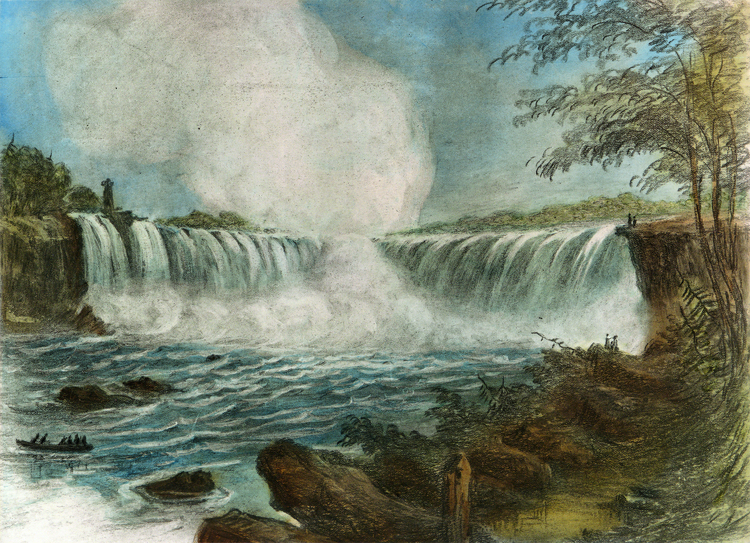
Source: Kelsey, Richard. Niagara, Jephthah : Remarks Upon the Defence of Wessex by Alfred the Great, With Other Compositions in Verse and Prose. London: Brewster and West, 1848
I cannot vote for Thompson—
Just hear the reason why—
Because this new Dominion
Wants men who will not lie.
We want no two-faced member,
When treason lurks around ;
We want a true Canadian
That’s honest, upright, sound.
I cannot vote for Thompson,
His loyalty aint clean :
He forswore his allegiance
To England’s noble Queen.
I will not vote for Currie,
He’s nothing but a tool,
And gets his education
In the Globe’s disloyal school.
He’s helping Brown’s convention,
To organize new strife,
To aid the agitator
To start in public life.
I will not vote for Currie,
His eyes are set behind,
And he cannot look before him,
To see what’s in the wind !
I will not vote for Thompson,
He’s crazy as a loon,
He’d make a splendid member
To represent the moon !
His stomach is enormous,
It never can be filled,
He eat Niagara Common,
Our railroad he has grilled.
He leased up all the farmers,
And still holds out his dish,
He swallowed half the river,
And he wanted all the fish !
I cannot vote for Currie,
He serves Dictator Brown,
Who sides with Reds and traitors,
Who hate the Queen and Crown.
I cannot vote his ticket,
He’s in the boat with Howe,
The foe of Federation
Who wants to raise a row.
His road is not a right one—
The Currie Road you see
He goes for Yankee Thompson,
And that’s enough tor me !
I’ll never vote for Thompson,
He wants to cut and carve,
He built himself a palace,
And let his workmen starve.
We’ll raise the British colours
And never turn our coat.
We’ll put in Angus Morrison
By every loyal vote !
We will not go for Thompson,
His promise never sticks.
We will not eat his pancakes,
Nor take his dirty bricks !
We will not vote for Currie,
He’s only fit to bark,
We’ll choose an honest farmer
Who is a man of mark.
He ploughs the Heights of Queenston,
He glories in their fame,
A loyal British Farmer,
And Robertson’s his name !
We’ll never vote for Thompson,
He took the Yankee oath,
We will not vote for Currie,
For HE seems nothing loath.
Come all ye Whigs and Tories,
Whatever your degree ;
Niagara Town and Township,
Now loyally agree !
We love Confederation ;
We hate mere faction fight,
We’ll back th’ Administration
So long as they do right !
For Morrison and Robertson,
We’ll man the union boat,
We’ll gloriously elect them
And never split a vote !
God save our new Dominion,
God save our noble Queen ;
We’re now the biggest nation,
America has seen.
We go for law and order,
We’ll squelsh both Howe and Brown.
We’ll support the constitution,
They shall never pull it down !
For Morrison and Robertson,
We’ll all throw off our coats
They are the people’s candidates,
And they shall have our votes !
Source: The Niagara Elector has no date, no author, and no publication information. This item can be found in the collections of Library and Archives Canada and full text on the Internet Archive
N.B. The correct spelling of “Thompson” as used in the poem is without the “p” – hence “Thomson”
This poem refers to the federal and provincial elections of 1867. In the federal election held from August 7 to September 20, 1867, in the Town of Niagara (current day Niagara-on-the-Lake) Conservative Angus Morrison defeated Liberal William Alexander Thomson 300 votes to 250 votes. In the provincial election of September 3, 1867, Conservative Donald Robertson defeated Liberal James Currie 302 votes to 254
I’m surrounded by apples. The buckets are heavy laden, spotting the front and sides of the barn with mounds of red rounds. David’s saws settle in behind the bounty. He points to tomato vines weaving a fence on a heap of boards, to other cauldrons blooming his brother’s favoured seeds. The air is full of saw dust and skunk and Jonamac must and the sugar of warm raspberries. David shows me the jigsaw and what he is making. He hacked down the dying walnut tree himself, clawed it from the dirt with his hands and his tools, and here it is, transformed into chess: a raw rook, a crooked king, near perfect pawns. David built the barn we are in, figured out how to fit the pieces together and raise them with his own two ruddy hands and instructions from his Dad and his granddad. He is 20. He has a slow grin and a sharp twinkle behind his glasses. When he was two, he padded over to me with an orange extension cord wound expertly around one arm, pressed the other end to my neck and made animated noises. Started digging holes and mixing cement that same summer, in his floppy yellow boots. He never cried, not until two decades had fallen away and he and I were standing together at the foot of a hospice bed, saying goodbye to my father. Dad, I said, the barn. If you could only see this kid’s barn! He never would. He never walked again. We buried him. But in the midsummer sunset, the rooster weathervane raised to that roof brands the night in his blood.
Source: The author. This prose poem first appeared in Verse and Voice (Hong Kong)
Lorette in North Africa with her camel friend.
Lorette C. Luzajic was born in Niagara Falls and lives in Toronto. She has a degree in journalism from Ryerson University, but has been a lifelong student of art history and poetry. She is the founding editor of The Ekphrastic Review, a journal devoted to literature inspired by visual art. She writes prose poems and small fictions that merge personal experiences and observations and the contemplation of visual art. Her works were selected as Best Small Fictions 2023 and 2024, and have also been nominated several times each for Best of the Net, the Pushcart Prize, and Best Microfictions, as well as seven times for Best American Food Writing for her column on food and art in Good Food Revolution. Lorette is also an award-winning mixed-media artist who has collectors in over forty countries so far. Visit her at www.mixedupmedia.ca
Ice Bridge at Niagara Falls, In Memory of Mr. and Mrs. Stanton and Burrell Hecock
‘Twas on a Sabbath morning,
From distant homes they strayed,
To see our old Niagara
In her mantle of white arrayed.
And with Jack Frost’s protection,
The tourists thought how grand
To be on the noted ice bridge
Anywhere to stand.
But the strength of Frost was feeble,
Compared with mighty force
Of the rushing undercurrent
Unchanging in its course.
For soon the ice was parted
And, alas! too quickly was seen
People on glassy islands
Floating down the stream.
And there was Mrs. Stanton
Just paralyzed with fear,
Saying to her husband
Let us die right here.
Poem Accompanying the Memorial Card
Near by a brave young laddie,
Who was running his life to save,
Heard the call: “Come back and help us
To escape a watery grave.”
And as he thus responded
To try and save another
He said to his companion:
“Don’t you tell my mother.”
But a message of mental telepathy
To that mother quickly flashed,
While ropes were dangling here and there
And the cruel waters splashed.
For she saw in a glass of water
Ice and people, too,
Rushing about confusedly,
Knowing not what to do.
Then she thought of the treacherous river,
That water so fierce and wild,
And exclaimed: “I have a presentiment
Something has happened to my child!”
Brave men worked hard to save
The two who still remained
On that block of ice much smaller
Than when it first was framed.
For, Oh, they were surrounded
By Niagara’s silvery crest,
Which none were allowed to step on:
Not even a noted guest.
Kneeling in prayer they were ushered,
The time was very brief,
Until the Whirlpool caught them
And gave them sweet relief.
Image and insert containing the poem by Jessie Clark courtesy of Niagara Falls Museums, accession number 2024.016.29. Many thanks to Assistant Curator Sara Byers for bringing this to my attention.