The knife of the sun at Niagara,
And the swallows,
Are beautiful;
But the voice and movement of the waters
Are gigantic—
A thousand naked men
Mad with the wine of beauty.
Source: Poetry, vol. 23, no. 2 (Nov. 1923)
N.B. This is not Benjamin Rosenbaum the science fiction writer (who was born in 1969)
Emily Helena Crummer Lodge, 1828-1864. Image courtesy of Michelle Ann Kratts
Her grave with spreading briar is grown,
And most the name o’er wends,
Upon the shattered fallen stone,
That tells of home and friends;
Are British hearts, so hard and cold,
And dead to Love’s bequest,
That Valor’s child forgotten sleeps,
In Stangers’ Rest?
O roll, Niagara’s mighty wave,
Sing to her in her dreams,
With tears of spray bedew her grave,
And sunlight flood with beams,
O birds at morn sing sweetly there,
Beside your happy rest,
And stars of night look kindly down,
In Strangers’ Rest.
Source: Kratts, Michelle Ann. The Missed: Tales of Spirit & Tragic End at Niagara Falls. 2013. Originally published in the Niagara Falls Gazette, August 1891.
The inscription states that Lodge “died many years ago at the Cataract House” hotel. Records indicate that she died in October 1864. For information about Lodge see chapter 2 of the Death Sketches section of The Missed by Michelle Ann Kratts
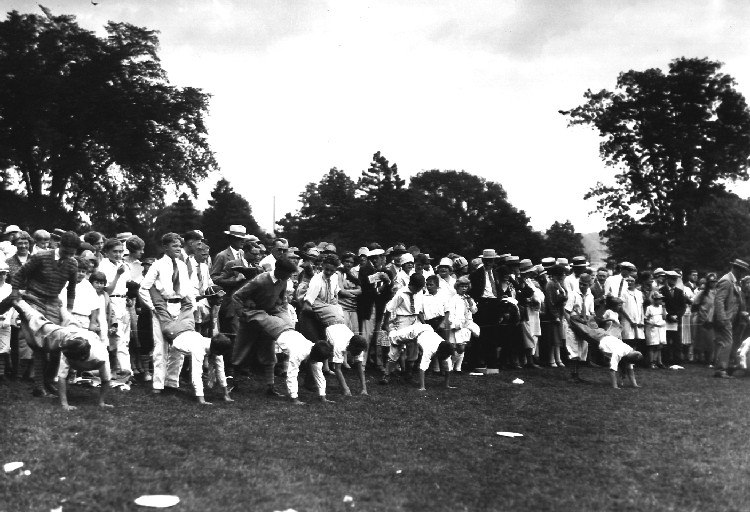
The Crowland Safe Guard Union and Port Robinson Presbyterian Sabbath Schools held a union picnic at the Falls on Aug. 15, and the occasion has been immortalized by the Crowland poet, as followeth : —
Wheelbarrow Race During Picnic in Queen Victoria Park, July 1927. Photo by Edwin Hodge Courtesy of the Niagara Parks Commission / Niagara Falls Public Library
Did you ever Pic-nic at the Falls ‡‡Upon a summer’s day ?
If not, I tell you, ’tis the place ‡‡To pass the time away.
Now first of all you name the day, ‡‡But then, if it should rain,
You fix upon another date, ‡‡And then perhaps again.
And next you must a chicken catch, ‡‡Be sure to take off its head,
Then fill it well with dressing ‡‡And roast it when it’s dead.
You fix a lot of other things ‡‡To fill the basket up ;
‘Tis well to take some dishes too, ‡‡A plate and spoon and cup.
The time comes round — you’re on the road, ‡‡Your best friend at your side,
And if you chose a pleasant day ‡‡You will enjoy the ride.
You can go by the Clifton hill, ‡‡Or down the old ravine,
No difference how you get there ‡‡Upon the park and green.
You meet your many neighbours there ‡‡Their friendship to renew,
Along perhaps with relatives ‡‡And strangers quite a few.
You’ll meet there Col. Gzowski ‡‡And he’ll not speak to you,
But gaze in blissful ignorance ‡‡Upon the sights to view.
And noon comes round, the tables spread ‡‡With pies and cakes and such
And some one at your elbow says, ‡‡“Take care, don’t eat too much.”
Now some drink water pure and bright, ‡‡But grannies have their tea,
For you can get hot water ‡‡Right at the park Q. V.
We sit along the bank awhile ‡‡And watch the Misty Maid ;
Some people will not ride on her ‡‡Because they are afraid.
The day is spent, we start for home ; ‡‡On two things we agree.
That we have had a pleasant time, ‡‡We’re tired as we can be.
Many thanks to Arden Phair for referring this poem to the Niagara Falls Poetry Project curator.
Source: Undated newspaper clipping (probably the Welland Tribune) found in The Diaries of Melvin Byron Misener, held at the Mayholme Foundation in St. Catharines. The clipping has the date “1900” handwritten in the margin of the previous page. Misener (1847-1936) was known as “The Crowland Poet.” Read more about Misener
Fairview Cemetery, Niagara Falls, Ontario Image courtesy of the City of Niagara Falls
I walk alone, eyes downcast
seeking paths of fallen leaves,
to disguise the sound
of breaking armour.
Cemeteries in the fall
are good places for disguise.
I can lie there,
surrounded by stone confessors,
and speak aloud
all that is in me.
Joy, sorrow,
goodness and sin.
There is no forgiveness,
or absolution offered.
They are not my pardoners.
They are just marks left for others,
who perhaps, like me,
spent troubled times there,
before making it their home.
Source: Shie Sirianni published this poem in Captured Essence: Niagara Poetry Anthology, vol. 11. St. Catharines: Canadian Authors Association, Niagara Branch, 1995
With thanks to Arden Phair who pointed out this poem by Shie Sirianni to the Niagara Falls Poetry Project curator.
The river carries me here
As a babe on its island’s shores I play
Palms and fingers squish soft sand, feet kick,
On my back, sun warmed laps of waves.
Currents change with the seasons
Moody green, then blue; milky, then grey
Factory polluted in a haphazard way.
In autumn steam rises after first frost
Buckhorn’s creek freezes over in white
Our skates’ steel cuts crust to granules of light
We hear the creak of the sheet unable
to bear our weight; it cracks, we lie on the ice
crawl to shore; imagine the classmate trapped
head under the lip of ice, face turned blue
frozen in his boots, red cap and jacket;
first of our generation to pay the price
like deer seeking to drink fresh water
stranded on ice floe; eyes wide in fear
headed for the Rapids, then the Falls.
Sooner or later the current carries us all.
Source: Kathy Gilbert, 2021
Award winning poet Kathy Gilbert grew up in Niagara Falls, NY, attending St John de La Salle, Prince of Peace, and 66th Street schools before moving to Grand Island. She currently resides in Northern California where she received an MFA in poetry from San Francisco State University. In 2020, she published a poetry collection, Aprils Three. Other poems have appeared in Transfer, Anomalous, Swampwriting, The Steel Toe Review, The Community of Writers, and,Vistas & Byways. She is currently working on a book about Niagara Falls.