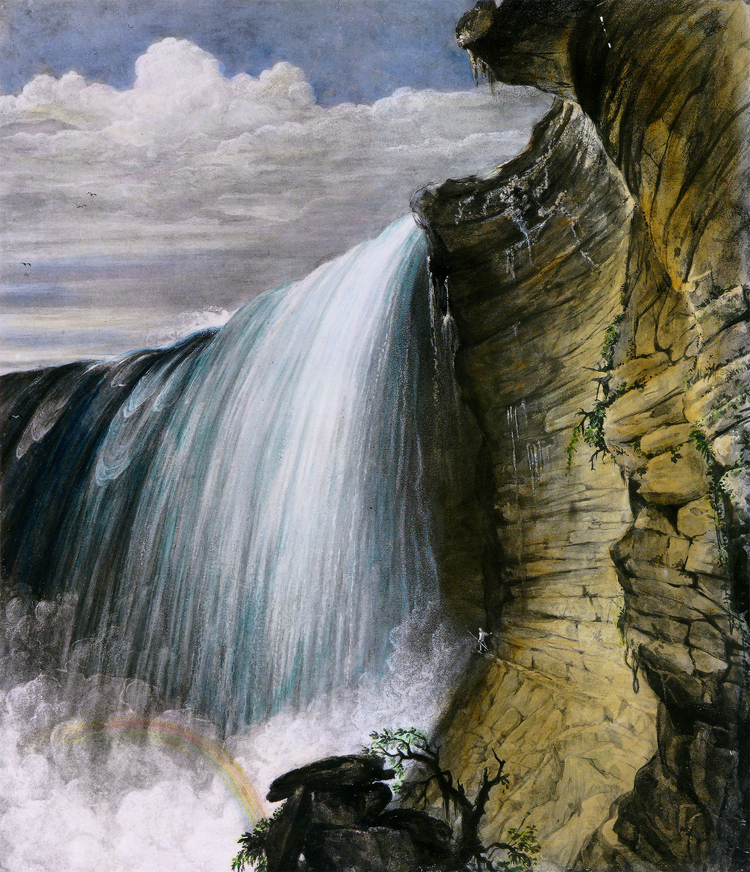
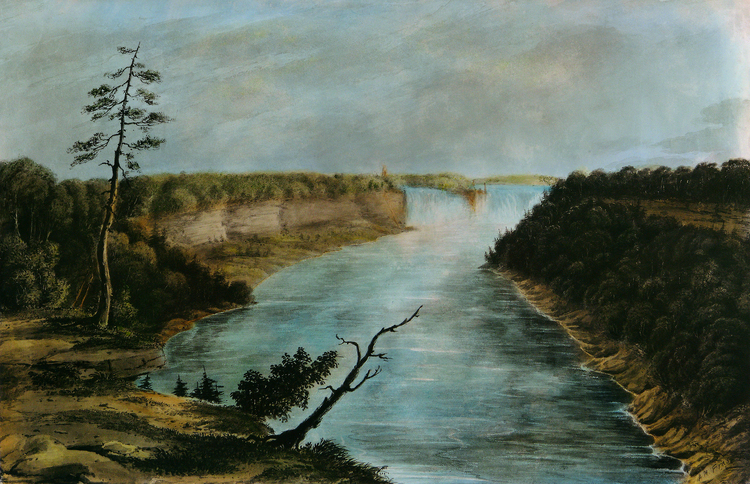
Horseshoe Falls and Table Rock, 1846. by Hanry Samuel Davis. Colour tint by Erna Jahnke Courtesy of Niagara Falls Public Library
Wonder of earth! I stand upon thy shore, ‡‡And, spirit-awed, behold thy em’rald wave;
I see thy rapids foam, and hear them roar,— ‡‡As frenzied, like the whirpool, waters rave, ‡‡‡‡Or wildly rush in reckless flight, ‡‡‡‡Far onward, gathering giant might, ‡‡‡‡And boldly leap thy rocky height, ‡‡‡‡‡‡Niagara!
Hath eye of mortal seen in other clime ‡‡Such sight as greets his view from Table Rock,
While on the rent and rugged edge sublime, ‡‡Entranced he witnesses the torrent’s shock? ‡‡‡‡Like peals of thunder rolling round, ‡‡‡‡Or cannon booming on the ground, ‡‡‡‡Such is thy overwhelming sound, ‡‡‡‡‡‡Niagara!
Millions of eyes have rested on thy wave, ‡‡Millions of hearts have throbb’d at thy dread sound;
Those millions now are mould’ring in the grave,— ‡‡Not e’en thy voice can break their sleep profound ‡‡‡‡And still thy waters downward dash, ‡‡‡‡And still thy ocean torrents splash, ‡‡‡‡Thy clouds of spray in sunlight flash, ‡‡‡‡‡‡Niagara!
The lonely Indian started at the sight, ‡‡When ages since he view’d thy rapid stream;
Chas’d is that Indian by the hand of might, ‡‡And his dark hist’ry seems but like a dream; ‡‡‡‡Now, here another people trace ‡‡‡‡What mortal hand cannot erase, ‡‡‡‡But thou defiest man’s vain race, ‡‡‡‡‡‡Niagara!
Kingdoms and nations have appeared and gone, ‡‡Thrones, people, empires, dynasties and all,
Yet still thou rollest on untired, alone, ‡‡And see’st the greatest like the meanest fall; ‡‡‡‡Forests have grown, and are no more, ‡‡‡‡Or wither’d lie beside thy shore, ‡‡‡‡But thou art changeless as before, ‡‡‡‡‡‡Niagara!
Beside thee giant works have worn away, ‡‡Their fragments disappear’d like grains of sand;
Beside thee all the things of life decay, ‡‡Yet still thou marchest over rock and land; ‡‡‡‡Ages with thee are but an hour, ‡‡‡‡Their ravages increase thy pow’r, ‡‡‡‡Eternity appears thy dow’r, ‡‡‡‡‡‡Niagara!
Flow on! flow on! thou mightiest of things; ‡‡On thee some lofty mission is impressed;
To me the voice of God in echo rings ‡‡From out thy tempest roar and foaming crest. ‡‡‡‡Oh! is it wrath or is it peace, ‡‡‡‡Our fears to waken or appease? ‡‡‡‡None, none shall know till time doth cease, ‡‡‡‡‡‡Niagara!
But when this world, and all its wonders dread, ‡‡Shall be destroyed by the same hand that made,
Thou, too, wilt be enrolled among the dead, ‡‡And thy hoarse torrent be for ever stay’d; ‡‡‡‡When man receives the doom divine, ‡‡‡‡And sun and stars have ceased to shine, ‡‡‡‡Annihilation will be thine, ‡‡‡‡‡‡Niagara!
Source: Henry G. Dalton. Tropical Lays and Other Poems. London: J. Evans, 1853.
Sweep on, thou mighty stream magestical,
Monarch of waters, broad, and still, and deep,
That, in the consciousness of strength, dost keep
As yet proud silence, and take from thy fall
Sublime voice mighty and poetical,
To tell the world, as headlong o’er the steep,
With foaming thunders, thou dost bound and leap,
That mightiest things are calmest still of all!
Then sink to sublime silence as before—
As if it cost thee nought to speak as though
Thou could’st outvoice the mighty Ocean’s roar,
Whene’er occasion called on thee to show
The power which thy silence in it bore,
Not lightly roused, but mightiest when so!
Source: Henry Ellison. The Poetry of Real Life: A New Edition Much Enlarged and Improved (First Series). London: G. Willis, 1844
Niagara Falls, c.1885. Attributed to George Barker. Courtesy of the Art Gallery of Ontario
Chaos of Beauty! — yet with horror blent,
Tremendous Chaos of One Element!
How in the triumph of thy mystery,
The power of all seems largely given to thee;
While still the astounding struggle, as we gaze,
Wakes more and more the wildered soul’s amaze;
Chaos of Beauty! — yet with horror blent,
Transcendant Chaos of One Element!
‘Tis Morning: all seems dazzling, — all divine;
How lustrously thy living waters shine:
The sun on thee hath blazed to second birth,
And Heaven, descending, sure hath touched the earth, —
Touched it, and bade its pride a Shadow be, —
Its motion, strength, and life, resigned to thee!
Chaos of Beauty! — yet with horror blent,
Majestic Chaos of One Element!
‘Tis Evening: have Her skies blushed more to find,
That on thine Earth-born forehead thou canst bind
A glory that shall win the astonished eye
From all their crowning Heavenly Pageantry?
Thou hast power to charm, too, from those Worlds of Light,
The great Celestial Mysteries of the old Night;
Chaos of Beauty! — yet with terrors blent,
Sublimer Chaos of One Element!
We greet thee with a burst of thoughts that roll
In wild responsive tumult through the Soul,
There eddying, the endless dreams in answer free,
Thrill, maddening with tempestuous sympathy.
What deep Niagaras have rushed and reigned
Through hosts of minds, — o’ermastering and unchained;
Chaos of Beauty! — yet with horror blent,
Tremendous Chaos of One Element!
Each differing Mind, — that broods o’er this dread scene, —
Or stern or mild, or fiery or serene,
Lends to thine awful mien and wonderous tone,
Its shadowy Semblance, faintly o’er thee thrown;
Winged souls, as with a crash of Thought, sweep down,
With thee, in passion, stormier than thine own! —
Chaos of Beauty! — yet with horror blent, —
Ungoverned Chaos of One Element!
There let us stand where thou wouldst seem to beat
Earth to a quivering foam beneath thy feet;
Thence upward look, where thou, midst vapoury shrouds,
Com’st like a flashing Ocean from the clouds!
A falling Firmament, — just wrenched away,
A falling Heaven, with stars dashed all to spray:
Chaos of Beauty! — yet with horror blent,
O’erpowering Chaos of One Element!
Yea! how thou seem’st through those white eddying shrouds,
To burst like some lashed Ocean from the Clouds!
Some loosened Firmament, midst storms of light,
Some down-driven Heaven of Stars, half-bared to sight;
Awe-struck we see these gathering terrors hurled! —
We gaze — Niagara seems made the World;
Chaos of Beauty! — yet with horror blent,
Stupendous Chaos of One Element!
Hast thou, indeed, with wild derision beat
Earth and her Empires under thy proud feet?
Art thou Unmaker of her strength and pride? —
Hast thou the unchecked Dominion far and wide? —
“Aha!” thou seem’st to shout, for evermore!
And what shall hurl reply to thy dread roar?
Chaos of Beauty! — yet with terrors blent,
Exulting Chaos of One Element!
Lo! be not thou a watery Sampson fierce;
Seize not the pillars old of the Universe!
Nor this fair Temple of grey Time destroy,
Smit with a sudden rage, and phrenzied joy.
Hast thou, blind Giant-Terror! thou this power?
No, surely not, till strikes the appointed hour!
Chaos of Beauty! — yet with horror blent,
Appalling Chaos of One Element!
Then, — then, — perchance, ‘midst all the gathering gloom,
The chasmy rending of each yawning Tomb,
Thou, with thy maddened waters yet mayst play
Disastrous part in all the vast dismay;
With seven-fold roar and shuddering hideous leap,
Thou to the centre mayst plunge down thy steep!
Chaos of Beauty! — though with terrors blent,
Terrific Chaos of One Element!
Or with sublime recoil, up-shooting high,
Mayst thou expire in spray along the sky;
Scattered through space, — yet thy moist clouds may float,
Showered o’er the face of some bright world remote,
Snatched to another atmosphere serene, —
So long thou sang’st of Heaven in Earth’s dim scene.
Chaos of Beauty! — yet with terrors blent,
Bewildering Chaos of One Element!
So long thy rolling Hallelujahs rang
To Heaven, from Earth where thou, glad-shouting sang,
And called vain Man to join thine echoing strain, —
That thus, perchance, thou’lt sing and shine again
In some fair Planet, thrilled with many a tone
Of thundering Hallelujahs, like thine own.
Chaos of Beauty! — yet with terror blent,
Transcendant Chaos of One Element!
One moment let me Heavenwards raise mine eyes,
Where flash through the empires of Night’s shuddering skies,
Niagaras of Fire!—urged on sublime,
Great Worlds driven hurrying down the Steep of Time;
Grandest Niagara of Nature! Stream, —
Where blazing Cataracts of Creations flame! —
Creations crowded to a Chaos, blent, —
Till theirs, — like thine, — seems One bright Element!
One moment Heavenwards, thus, I raise mine eyes,
Where flash through Night’s outstretched, imperial skies,
Niagaras of Flame, that roll and sweep,
Mysterious Time! — down thy great shadowy Steep,
Mightiest Niagara of Nature, gleam, —
Stream, blazing Cataracts of Creations, stream!
A Sea of Fire ye seem, thus heaved and blent, —
Resplendent Chaos of One Element!
Source: Emmeline Stuart-Wortley. On the Approaching Close of the Great Exhibition. London: W.N. Wright, 1851
View of Niagara Falls from the American Side, 1850. by A.M. Fraser. Colour tint by Jane Merryweather. Courtesy of Niagara Falls Public Library
Niagara! — that glorious voice of thine, ‡‡With never-ceasing, gathering power, seems still, ‡‡To charm each haunting sense of mortal ill;
It speaks but of the distant — the divine —
It lifts the soul to Nature’s holiest shrine, ‡‡It links the mind, with a surpassing skill, ‡‡To worlds that loftier destinies fulfil, —
Those worlds that scorn Creation’s boundary line. ‡‡Dread Fall! In beauty a crowned Sun of Light!
In action an Atlantic! — such thy force, ‡‡Ocean ‘gainst Ocean, battling in their might,
Were scarce more dreadful than thy raging course; — ‡‡While mounts thy glittering spray the Heavenly Height,
Tossed like the flashing mane of Death’s pale Horse!
Source: Emmeline Stuart-Wortley. On the Approaching Close of the Great Exhibition. London: W.N. Wright, 1851
“Before the writer is a delicate white Anemone, plucked from under the water-sheet at Niagara Falls. It was found quietly growing in a crevice of the limestone bed that, on one hand, flanks the perilous passage beneath the cataract.”
Hannah Flagg Gould
Flower of Niagara, — spirit-like flower! ‡‡High is the language thou speak’st to the soul ;
Grand is thy birthplace of splendor and power, — ‡‡Only “Omnipotence” traced on the whole.
Floods in the cataract curtained thy bed, ‡‡Awful, — stupendous, — high over thee hung ;
Damp from their sweep thy soft infancy fed, ‡‡Thunders eternal thy lullaby sung.
Rushing, and raging, with fierceness and foam, ‡‡Proud as the angels who fell from their bliss,
Plunged the bold waters, o’ershooting thy home, ‡‡Howling and wild, to their wrathful abyss.
Sure but a step was between him and death, ‡‡Who ventured forth to thy wondrous retreat :
Only one foot-slip, — one careless-drawn breath, — ‡‡Then but once more had his life-pulse to beat !
Yet, little tenderling, still didst thou bide ‡‡Lone in thy crevice, all fair and serene ;
Ever surveying its stormy outside, ‡‡Mild and unawed by the turbulent scene.
There wast thou safe as a pearl in its shell ‡‡‘Mid a whole ocean of tumult and sound; —
Calm as an anchoret bowed in his cell, ‡‡Whilst war and hurricane ravage the ground.
What was thy confidence, — who was thy stay, ‡‡When the loud waters swift o’er thee were driven,
Headlong to fall, throwing up the mad spray ‡‡Aimed like weak insults of rebels to Heaven ?
Still not a shock jarred thy root or thy stem, — ‡‡No heavy drop struck a petal of thine ;
Thou wast secure as a beautiful gem ‡‡Placed in the niche from a finger divine.
Say, sweet Anemone ! say, didst thou know ‡‡What the whole storm of the cataract spanned, —
O’er it, how God bent his glorious bow, ‡‡Guiding the flood by a sign of his hand ?
Then didst thou hear, in the distance remote, ‡‡How in its lines the strong element ran,
Tamed and assuaged, — on its bosom afloat ‡‡Bearing the treasures and life-boat of man?
Firm in thy measureless fortress of stone, ‡‡Leaning wast thou on the Deity’s will,
Meek as a spirit that kneels at his throne, ‡‡Waiting his holy design to fulfil.
Thence art thou come on thy mission to me, ‡‡Mild little angel in floral disguise !
Speaking with import profound as the sea, — ‡‡Bright as the stars, and sublime as the skies !
Who could thy home and thy structure behold, ‡‡His love and care ever present to doubt,
Whose viewless hand wrought thy delicate mould, ‡‡Nursed thee, and rolled the dread water-sheets out?
Think, weary soul whom earth’s trials assail, ‡‡When for thy faith comes the dubious hour, —
Lest o’er its strength the loud terrors prevail, — ‡‡Think of the tender Niagara Flower.
He who evoked the soft bud in the rock ‡‡Will not leave thee in the conflict alone !
He loseth never a lamb of his flock, — ‡‡Droppeth no jewel he marks as his own !
Source: Hannah Flagg Gould. New Poems by Miss Hannah F. Gould. Boston, F. J. Reynolds & Co., 1850