Conroy the Brave by Simeon Tucker Clark

Niagara Falls, June 1, 1874 
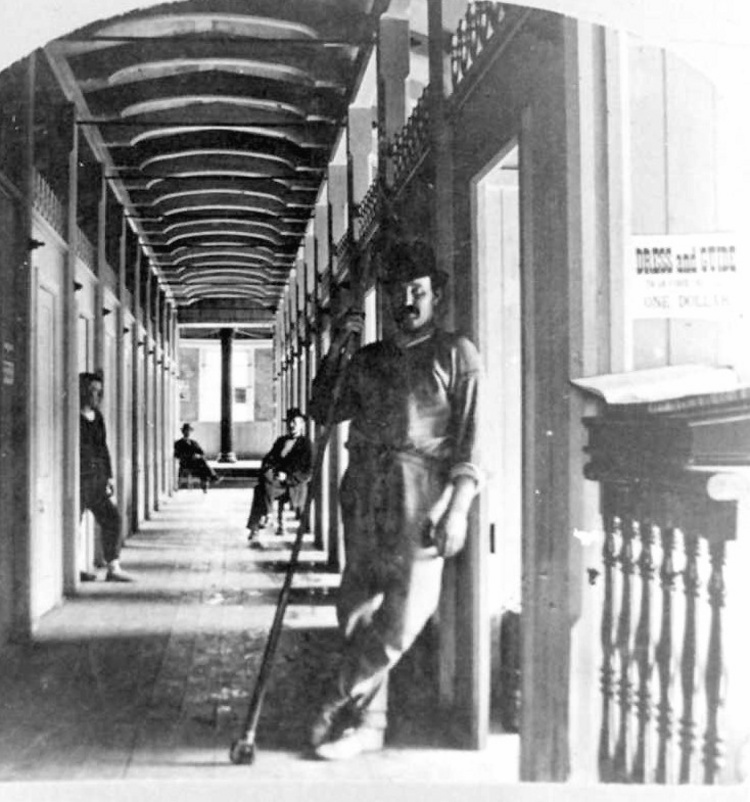
conroy

Guide Thomas Conroy Standing by the Dressing Room of the Shadow of the Rock Building. Photo by George Barker. Image courtesy of Niagara Falls Public Library

The sun looks out of a cloudless sky ;
‡‡The winds are drifting the apple-blows
That over the grass like snow-flakes lie ;
The oriole wooes his mate as they fly ;
‡‡And William McCullough to labor goes.

A prayer is warm in the old man’s heart,
‡‡A song is quivering on his tongue ;
As he busily plies his wonted art
He watches the arrowy rapids dart
‡‡Under his scaffolding, safely hung.

A moment more and under the tide
‡‡Of wrathful waters his form is lost !
The river fiends fasten on his every side —
They pluck at his beard, they gibber and chide !
‡‡He is blinded and deafened and pelted and tost !

Weary and wounded, all breathless and sore,
‡‡More than half dead he is hurried away,
Close to the brink where the great waters pour,
Heedless and headlong with terrible roar,
‡‡Into a vortex where never was day !

What can prevent him ? O Father Supreme !
‡‡Darkness like this thou alone can illume !
See !  What is that in the turbulent stream ?
It is a glimpse — a half-comforting gleam
‡‡Of floating grey hair mid the circling spume !

Yes ! he is clutching with half palsied hand
‡‡Yon God-given guerdon — a pillar of stone —
He whispers with Death and looks toward the land
Where he never again with his fellows may stand’
‡‡Who powerless must leave him to perish alone !

But lo ! who is coming with masterly stride,
‡‡Pride on his forehead and strength in his frame ?
Tom Conroy, the guide, who was never defied,
He laughs at the danger — and braving the tide
‡‡Is bound with a cord to the chariot of Fame.

Strong was the rope that was fast to the shore,
‡‡And under the coil was a heart big and brave —
Aye, braver to-day than ever before,
He reaches the rock — and like Perseus of yore —
‡‡He rescues his friend from the fiend of the wave !

When the names of our heroes are written or sung,
‡‡We will chant your name Conroy in musical stave
When palsied your arm and silent your tongue,
The child now unborn, shall hear how you flung
‡‡Yourself in the wave, a comrade to save !


Source: Niagara Gazette, June 10, 1874

Read an article on the rescue of William McCullough by Tom Conroy from the Buffalo Evening Courier & Republic, June 2, 1874

John Tyndall visited Niagara Falls, and in the chapter “Niagara” of his book Fragments of Science (1879) he tells of hiring Conroy as his guide. About a year after Tyndall’s visit, the rescue of  William McCullough took place. Tyndall wrote a postscript to the chapter:

A year or so after I had quitted the United States, a man sixty years of age, while engaged in painting one of the bridges which connect Goat Island with the Three Sisters, slipped through the rails of the bridge into the rapids, and was carried impetuously towards the Horse- shoe Fall. He was urged against a rock which rose above the water, and with the grasp of desperation he clung to it. The population of the village of Niagara Falls was soon upon the island, and ropes were brought, but there was none to use them. In the midst of the excitement, a tall powerful young fellow was observed making his way silently through the crowd. He reached a rope ; selected from the bystanders a number of men, and placed one end of the rope in their hands. The other end he fastened round himself, and choosing a point considerably above that to which the man clung, he plunged into the rapids. He was carried violently downwards, but he caught the rock, secured the old painter and saved him. Newspapers from all parts of the Union poured in upon me, describing this gallant act of my guide Conroy.

Sam Patch. Words and Music by Cornelius Eady


I’m the king of the Rochester Falls
Sam Patch has answered the call
This morning you’ll see it all.

The whirl of the water
That don’t bother me
Blood-thirsty crowd
That don’t bother me
Wind at my back
That don’t bother me
False friends cheering
That don’t bother me

cornelius
Poster Announcing Sam Patch’s Last Jump. Courtesy of Wikipedia

I’m the king of the Genesee
Every eye here is planted on me.
Roll up and see what you’ve
Never seen

The whirl of the water
That don’t bother me
Blood-thirsty crowd
That don’t bother me
Wind at my back
That don’t bother me
False friends cheering
That don’t bother me

Cho:
Fall and move on
Fall and move on
Fall and move on, boy,
Fall and move on
Fall and move on
Fall and move on,
Fall and move on, boy
Fall and move on.

The word has spread
The time has come
Come watch me leap
Into kingdom come
Come watch a day
That’s never been done.

The whirl of the water
That don’t bother me
Blood-thirsty crowd
That don’t bother me
Wind at my back
That don’t bother me
False friends cheering
That don’t bother me

The platform wobbles
Like a dancing bear
The foam and the spray
Rise like ghost in the air
Soon I will dance between
Here and there

The roar of the water
That don’t bother me
Blood-thirsty crowd
That don’t bother me
Wind at my back
That don’t bother me
False friends cheering
That don’t bother me

Will I fall and move on?


Cornelius Eady: Loops, and Vocals
Mitizie Collins: Hammered Dulcimer
Marvin Sewell: Electric Guitar
Emma Alabaster: Bass
Concetta Abbate: Violin

Source: The author.  First published in his music chapbook Book of Hooks, Kattywompus Press, 2013

About Cornelius Eady

Sam Patch jumped from a ladder at the base of Goat Island twice in the fall of 1829, and was killed later that year jumping at the Genessee Falls. Read more about Sam Patch.

Read Eady’s poem The Death of Sam Patch

Sam Patch in The Craftsman:

The Death of Sam Patch by Cornelius Eady

eady
Sam Patch’s Last Jump. By Internet Archive Book Images

No, there’s no mistaking Mr. Patch.
History will lead him to a watery grave
In my hometown of Rochester, NY.
He will disappear after he jumps
Only to return with the spring thaw.
There is so much in his brief fame
To ponder, that tugs at us.
Rochester, like any mill town
Is full of reckless death,
Yet the fate of Patch is on a par
With the local Native Americans, at least
When I attended grade school
We were taught the story
Of a man who made his living
Oddly, with a tame black bear
And calculation.
Any school child my age
Recalls his last moments on earth.
– Was there actually
A parade? A premonition?
Did he really waver at the top of the platform
Just before he jumped? Any contemporary of mine
Carries this, the language his body,
A wrong angle, recites
As it hits the gorge.
Here is the lesson of the
Tightrope walker, and of course,
A kid’s morbid curiosity –
A body, suspended in ice,
Worked over three months
By the elements –
What happens? One can only guess
How far away it must have seemed
From the energy of his last words,
No mistake in the way he brandished them
Against the spray.
William Carlos Williams
Will make much of the beginnings
Of our Icarus,
Who gets his start in Paterson, NJ,
To plunge headlong into my town’s
Settler past. What else have I learned
Besides the beauty of the dare?


Source: Prairie Schooner, Vol. 67, No. 3 (Fall 1993), pp. 12-13

About Cornelius Eady

Sam Patch jumped from a ladder at the base of Goat Island twice in the fall of 1829, and was killed later that year jumping at the Genessee Falls. Read more about Sam Patch.

Read the words and listen to a performance of Cornelius Eady singing his song Sam Patch.

A Legend of Niagara by Florio

florio
Upper Niagara River and Goat Island. Photograph by Andrew Porteus, 2004

An Indian, in the days of yore —
Of “fish and fur’s” abounding store —
Would cross Niagara’s stream —
Just where the river, smooth and wide,
Pours toward the gulf its treacherous tide,
Like some deceitful dream.

Near by, a bear was crossing, too :
Whose head no sooner rose to view,
Than straight the “Brave” urged his canoe
To grasp an easy prey ;
But Bruin fled not — glad to greet
A resting-place for weary feet,
He turned and swam his foe to meet,
Upon the watery way.

They met — the paddle’s blow was dealt ;
With paw received, or scarcely felt
By fur-protected bear.
Who, reaching up as for a bough,
Climbed gracefully into the prow
And sat serenely there.
The astonished “Brave” sought in his turn
The “ultima thule” of the stern,
And then sat down to stare.

And thus in armed neutrality
They sat in thoughtful “vis-à-vis,”
While the bark drifted silently
To meet the breakers white ;

But when the Indian seized an oar,
To stay his course, or seek the shore,
Admonished by an ominous roar,
He dropped it in affright :

For in those cavernous jaws he sees
Molars, incisors, cuspidés —
Enough a hero’s heart to freeze
Or dentist to delight.

More dreadful still, the angry Fall,
Like some huge monster seemed to call,
Impatient for its prey ;
And shows its breakers’ flashing teeth,
To welcome him to depths beneath ; —
And breathes its breath of spray.

Visions of fire and frying pan
Encompassed that bewildered man
(Tho’ watery fears oppressed)
And Shakspeare’s thought his bosom fills
“Better to bear our present ills
Than fly” — you know the rest.

Whether the Brave proved dainty fare,
And then the Fall devoured the bear,
Though unto them the “loss was sair”
To us is less ado :
But still, arrayed in fancy’s gleam,
Have floated down Tradition’s stream
The twain in that canoe —
And furnished to the faces pale,
The matter to “adorn a tale,”
And “point a moral,” too.

We float upon life’s lapsing tide
While toward some gulf the waters glide
With unremitting might ;
And some black bear holds us in awe,
Like the “black Care” which Horace saw
Behind the Roman knight.

We fain would seize an oar to reach
Some sylvan shore, some silvery beach ;
But still the moment miss —
For Pride, or Ease, or Care, or Fear,
Sits with o’erwhelming presence near ;
The saving hand we dare not lift,
And gently thus we drift, drift, drift,
Into the dread abyss.

Our land, which boasts that it prepares
Its morel and material wares,
Should make its legends, too :
And mixing one of native clay,
Let’s drop “a lion’s in the way,”
And in its stead hereafter say —
“A bear’s in the canoe.”


Source: The Crayon, vol. 8, no. 7, July 1861.

This poem is discussed in Episode 2 of the Niagara Falls History and Poetry podcast

Florio is possibly a pseudonym used by Clement Clarke Moore.  Two poems published in the New York Evening Post under the name of Florio later appeared in Moore’s 1844 book Poems, as outlined in the blog post Two Poems by Clement C. Moore, as First Published in the New York Evening Post


Niagara by William Wetmore Story

story
William Wetmore Story. From the Brady-Handy Collection in the Library of Congress

‡‡Like hell-hounds from their slumber waking,
And panting madly for their prey,
‡‡Their whitening manes in fury shaking,
And howling down their rocky way,
‡‡From Erie’s sleep, in rushing rapids breaking,
‡‡‡‡Storms down Niagara —
Wildly towards their dread abyss
Hurrying they rage, and foam, and hiss,
Over their shelving precipice ;
Yet pausing on those awful steeps,
‡‡Firm, solid, and compact,
With heavy plunge, and solemn anthem, sweeps
All — all — together in one emerald mass,
‡‡The thundering cataract ;
And evermore its solemn roar
Peals up the heavens, and down the shore —
While from the unremitting storm
‡‡Of seething foam below,
Rises the water’s ghostlike form,
‡‡In its shroud of foamy snow.

‡‡With thee the wrestling storm hath striven !
The wintry blast hath grasped thee by the mane !
And from the summer’s darkening heaven,
Plunging into thy breast its forked levin,
The thunder answered to thy call again ;
But undecaying in thy pauseless power,
Heedless of storm, and reckless of the hour,
Deep, deep, with everlasting trumpet-tone,
Thou soundest ever on !

‡‡A thousand harvests of the human race,
Hath Death’s keen sickle shorn,
Since thou wast in convulsions born ;
‡‡But like a passing mist across thy face,
Year follows year, and age succeeds to age,
And terrible as at thine hour of birth,
Thy hoary locks thou shakest wildly forth,
And scarless, in eternal youth, dost age.

‡‡Falling, falling, as if in huge despair,
Thy watery weight descends ;
‡‡Rising, rising, as Hope were even there,
To heaven again it tends ; —
And Faith her rainbow-bridge uprears
Upon the shattered spray of tears,
And o’er the roaring gulf its arch extends.

Strong as thou art, there is for thee an hour !
‡‡There is for thee a law !
Its limits an almighty power
‡‡Around thy strength can draw ;
Who forged the universe unto his will,
Can chain thy fury, bid thy storm be still ;
He who hath given paths unto the stars,
And meted to the universe its bound,
Who clothed thy being with the voice of wars,
Hath set thee thine appointed bound.
Thundering thou dashest on, with awful roar,
Yet bendest humbly to His stern decree ;
And thou unto His eye art nothing more
Than the frail swallows, that forever soar
Above thy terrors, by his law made free ;
Flames over thee, and all the fiery sword, —
Thou servest ! Thou art bondsman to the Lord !


Source: The Phi Beta Kappa Key, vol 3, no, 2 (January 1917)

Story, Harvard University Class of 1838, wrote this poem on July 6, 1843

Read about William Wetmore Story