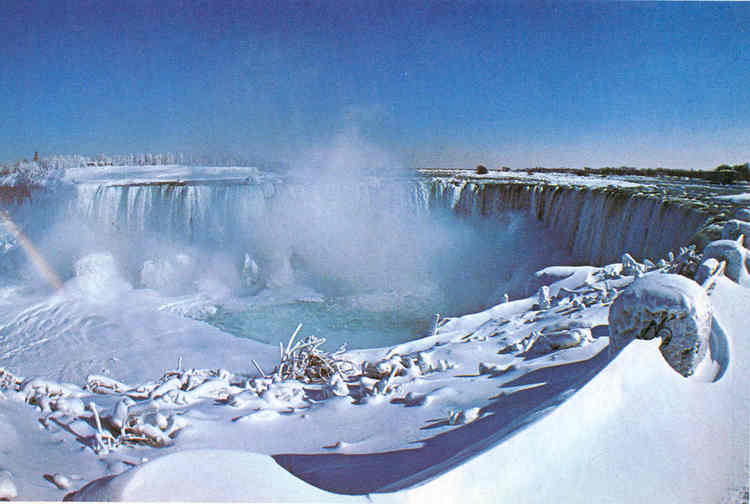
Niagara Falls, Where the Great Lakes Leap to the Sea. Travel by train by Fredric C. Madan, 1925 Image courtesy of The Library of Congress
Ye giant waves that from yon dizzy height,
So wildly plunge to seek th’ abyss below,
In whiring eddies raging as ye flow,
And reeling onwards in thy giddy flight,
How beauteous are ye in your majesty !
Dashing from rock to rock the foaming spray,
Waking eternal musick on your way!
And so thou’st done from all eternity ;
And yet, why dost such beauteous charms bestow
On scenes like these? so rude, so rough, so wild,
Where rocks on rocks together, careless piled,
Oppose your current as you wildly go.
Why seek ye not some smoother placid way,
Thro’ some sweet grove, or thro’ some flow’ry bed,
Who ‘d lead you on your pleasing path to tread,
To your far bourne, with milder, gentler sway ?
But ah! ye still go madly roaring on,
But never wearied with your stern delight,
So reckless, heedless, in your spirit’s might,
Ye give not ear unto my plaintive tone.
Source: The Craftsman, March 3, 1829
The poem is signed A.H.W. A.H.W. is believed to be Augustine Henry Wald, who is known to have written for The Craftsman.
The bulk freighter “CANADA MARQUIS” approaching the flight locks of the fourth Welland Canal at Thorold, 1984 (Just leaving St. Catharines) Painting by Anton (Tony) Akkerman. From the personal collection of Andrew Porteus.
Mi amor, mia domina, bon Santa Catarina:
I dreamt that you were skating
along the canal, gliding by
the cargo ships making way,
with dark hulls riding high,
ignoring the value of your presence,
as I have done these past many years.
I called out your name
but my words were naked,
lost and scattered to a cold wind,
as if now an empty voice, wishful,
in the stillness of your garden.
Mi amor, mia domina, joyeuse Santa Catarina:
I thought I saw you dancing
among a field of ripe berries,
the vines heavy with the yield,
unaware of your playful laughter,
as once I was when we were children.
A time when the world was distant
before I left behind the safe haven
of our friendship to the allure of a lion
bridge. But my life grew naked,
lost and scattered in a cold wind,
far from the stillness of your garden.
Mi amor, mia domina, chanteuse Santa Catarina:
I hoped to hear you singing again of the freedom,
we used to find on Geneva Street,
when everything was untouched by ego.
Where they championed civil rights
more profoundly than we did riches.
When long hair, loving, blossoms, hootenannies,
explained the culture of a generation,
a golden innocence easily naked,
lost and scattered by a cold wind,
far from the stillness of your garden.
Yet, mi amor, mia domina, bella Santa Catarina,
you have never changed.
Source: The author, 2025
I am a Canadian poet currently living in Chippawa. Over the years my poems have appeared in a number of anthologies and periodicals beginning with the anthology ‘Canadian Poets of 1969’.
The poem ‘On the Waterfront of Toronto’ earned the Monica Ladell Award 2012 for best poem presented by the Scarborough Arts Society.
I have participated in various poetry readings and venues held in Toronto, Scarborough, Welland, St. Catharines, Niagara-on-the-Lake, and Niagara Falls.
The Indian Heritage Council of Morristown, Tennessee, published a limited edition chapbook ‘The Pipe Maker and Other Poems’ in the millennial year 2000.
The Casket of George Stathakis, After His Fatal Attempt to go Over Niagara Falls in a Barrel, July 5, 1930. Photo courtesy of Niagara Falls Public Library
Jumpers and boaters and fame-hungry fools
end up in the gorge, in the eddies and pools,
or spattered on stone, or locked in the ice.
There’s no way to die here the sane would call nice.
Source: T. W. Kriner, 2025. First published in T.W. Kriner. The Red Pill and Other Poems. Buffalo: J & J Publishing, 2026.
T. W. Kriner is the author of Journeys to the Brink of Doom (1997), In the Mad Water (1999), Twelve Dozen Four-by-Fours (2025), and The Call of Tawiskaro (2025). He lives in a Western New York swamp with his wife and two cats.
Kriner says:
About three years ago I began writing what I call four-by-four poems: four lines with four beats per line, usually with a pair of rhyming couplets. The challenge for me was to do at least one or more of the following in each poem: tell a story; paint a picture; evoke or share a memory; express a political opinion; convey my view on a particular subject; do something else while trying to get a laugh. I’ve recently posted a fair number of them at All Poetry .com, if you’d care to sample.
Niagara Gorge From the Canadian Side Photo by Andrew Porteus, October 17, 2021
There was nowhere else for her to go. She looked to the depths, fighting vertigo. When she jumped, she took all her hopes and fears. Her bones weren’t discovered for many long years.
Source: T.W. Kriner, 2025. First published in T.W. Kriner. The Red Pill and Other Poems. Buffalo: J & J Publishing, 2026.
This one is loosely based on the death of my friend’s child.
T. W. Kriner is the author of Journeys to the Brink of Doom (1997), In the Mad Water (1999), Twelve Dozen Four-by-Fours (2025), and The Call of Tawiskaro (2025). He lives in a Western New York swamp with his wife and two cats.
Kriner says:
About three years ago I began writing what I call four-by-four poems: four lines with four beats per line, usually with a pair of rhyming couplets. The challenge for me was to do at least one or more of the following in each poem: tell a story; paint a picture; evoke or share a memory; express a political opinion; convey my view on a particular subject; do something else while trying to get a laugh. I’ve recently posted a fair number of them at All Poetry .com, if you’d care to sample.
Fisherman on Rock in Niagara River Just Above the Falls. Photo by Andrew Porteus, March 27, 2003
While trying to rescue his tackle box, he tripped into the current from his perch on the rocks. He floundered then foundered and, just like a stone, he went to the bottom. He died there alone.
Source: The author, 2025. First published in T.W. Kriner. The Red Pill and Other Poems. Buffalo: J & J Publishing, 2026.
T. W. Kriner is the author of Journeys to the Brink of Doom (1997), In the Mad Water (1999), Twelve Dozen Four-by-Fours (2025), and The Call of Tawiskaro (2025). He lives in a Western New York swamp with his wife and two cats.
The Late Fisherman in the Niagara Gorge is loosely based on an incident witnessed by Kriner’s son’s father-in-law.
Kriner says:
About three years ago I began writing what I call four-by-four poems: four lines with four beats per line, usually with a pair of rhyming couplets. The challenge for me was to do at least one or more of the following in each poem: tell a story; paint a picture; evoke or share a memory; express a political opinion; convey my view on a particular subject; do something else while trying to get a laugh. I’ve recently posted a fair number of them at All Poetry .com, if you’d care to sample.