Yehoash (Solomom Bloomgarten) Image courtesy of Wikipedia
A hundred cubits running wide,
Green and silver is the raiment
Of the Maiden of the Mists.
Rainbows strung along the edges,
Suns and snows and rows of foam,
Woven into plaits and braids.
Yo-ho!
Upon white cords,
Upon green bands,
Over stormy balustrades,
Leaps, besprinkles, the Maiden of the Mists,
Swims through glimmering bows of foam
The slender, slim and sinuous daughter of the mists.
[II]
Yearns the black forest,
Ten thousand years of lust,
Says the black, dense forest:
“Dance for me!
Fling open your green and silver raiments,
Tear apart the rainbows
And bare your form.
Mother-of-pearl thy breast,
White blossoms are thy loins.”
[III]
“Yo-ho, old forest,
I shall dance a dance for you;
Yo-ho, thou forest of black lusts,
I shall dance a dance for thee.”
On the green and gray stairway
Swings and sways the Maid of the Mists,
Chaste and laughing,
Nimble and pure,
Green and white,
Widely spread the trailings long,
All folds freely loosened,
All rainbows ablaze,
And leaps
To the deep roaring waters,
To the briskly roaring waters.
[IV]
“Yo-ho, old forest,
What of my thigh hast thou seen?”
“Yo-ho,
Whitest dust,
Snow and sun,
Pearls and crystals,
Veils and shawls—
Old forest of black lusts,
What of my loins hast thou seen?”
[V]
Whitest dust,
Sun and snow above
And an iris of rainbow
Dances the Mist Maiden
With the buoyant roaring waters,
With the sprightly roaring waters.
“Yo-ho, old forest,
What of my white thigh hast thou seen?”
Source: Jehiel B. Cooperman and Sarah H. Cooperman (selectors and translators). America in Yiddish Poetry: An Anthology. New York: Exposition Press, 1967.
An overgrown thicket
With locks flowing wild,
With steam from the mouth
Which envelops the face,
With the haste of a shot,
With the roar of a forest,
Springs into the vale from a mount,
As though to break the neck
And to sprain the feet—
Niagara, the giant.
And the winter caprice
With its icy yoke
As in chase for a beast
Niagara pursues.
Not in vain howls the wind,
Like a pack of dogs,
And with the snow shot in vain
Shoots the cloud, shoots again,
Desolated all around,
All around becomes stoned,
As though him not meant.
Never, at all, stops
Niagara’s gallop.
Source: Jehiel B. Cooperman and Sarah H. Cooperman (selectors and translators). America in Yiddish Poetry: An Anthology. New York: Exposition Press, 1967.
Dove Overlooking the American Falls Photo by Andrew Porteus
The tale of Niagara Falls
Long since has been white-bearded.
The elder would overtake you with noise—
Why be so gloomy, weary?
O eternity!
Just here my gaze is fixed
On things of every day.
Merely the tiny little day
Of a bit of joviality, of a dirge dash:
A reflective pane
Of an abandoned house
That mirrors
The sunset red
On a dove;
That hovers on wings
Of death,
And exhausts in the air
The mite of life that is destined her
On earth.
Source: Jehiel B. Cooperman and Sarah H. Cooperman (selectors and translators). America in Yiddish Poetry: An Anthology. New York: Exposition Press, 1967.
From mountain peak to mountain peak sprang a rider, an Indian
With a head high-feathered, a bird on mount,
And here a horseshoe silver lost on the ground.
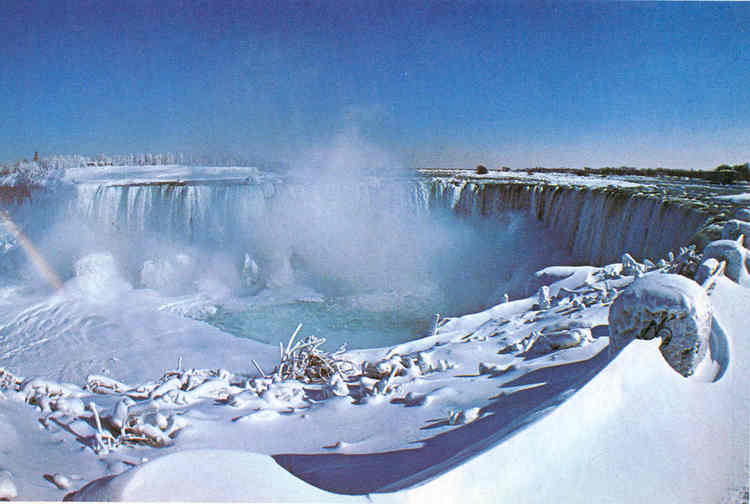
The horseshoe is the Niagara waterfall at America’s gladsome sill.
And over borders and valleys lies a bridge—for the stars a Milky Way:
A way for young couples in love twenty years
Who want their joy to hear in the waterfall’s noisy play.
The bottom rages, and from its boiling, which dazzles,
Fogs like veils of silk forth flit.
A cloud-break murky hangs ever low here,
And ever stands a rainbow; and the cloud-break splits
And round about the islands wooded, silent, covered under snow—
A forest in snow—ten thousand hanging candelabra, crystalline:
The sunshine in the Menorah branches glows
And in the water, mountains into silver dust ground fine.
And I raise my old sails too
And swim to your waters. I come to your stone-hewn steps.
Year in, year out, I come by pilgrimage to see you,
A glance to take upon your frothy crests.
My heart grows high when I see how too they grow—
Your billows, cradled on your stream—
With heads of lions and deer and buffalo
When they reach to the rocky edge of the abysm.
I become deafened with joy when your moaning I hear,
When birds fly away from you in blueness clear,
In the wink of an eye when into the abyss you spring,
You everlasting one, rainbowed and clouded.
You waterfall, brilliant and sunny-eyed,
At your sight I become again bold and young.
I am drawn to you, I fall with you, I am hurled down—
And rise on a cloud; with you akin
Splinter mountains and cities in the distances are found
Sealed in the mirror of your broad rivers within.
Your untamed power I sing in measured rhythm,
And in the mists of your diamoned dust
I see the thick beard and white locks of Walt Whitman,
Who sang to America an ode of praise glorious.
Your rainbow standing high over New York towers I view;
The wind dews my face with your pearly drops.
Always, always, thunder in my ears I hear you
And at night falls your waterfall my head atop.
And oftimes I see you, a woman, a stony giant, tall
And towering one formed of rocky blocks,
With knees, with breasts and face, built into the grounded wall,
And your back covered with your billowing locks.
And in the babel of New York’s glassy towers of time,
Where on the windows burn a setting sun like a desert with glowing dust,
In the windows burn out the desert storms meantime,
And cold electric shine engulfs the sea of panes.
I see from a cloud lowers a pale beam
That stands between earth and sky like a ladder with lunar treads.
And descend down the waves of the waterfall on him,
Winged with eagles’ heads, with lions’ heads, and with human beings’ heads.
Source: Jehiel B. Cooperman and Sarah H. Cooperman (selectors and translators). America in Yiddish Poetry: An Anthology. New York: Exposition Press, 1967.
Morris Rosenfeld From the book Sing, Stranger: A Century of American Yiddish Poetry
The Lord on high is mightier than the noise of many waters,
yea, than the mighty waves of the sea. (Psalms, 93:4)
A piece of the Works of Creation in the midst of Civilization; a vestige of
Chaos without form and void illuminated with electricity; a remote corner of
unfinished world; the ruin of God’s first abode—
Niagara Falls!
Eternal water capering down an eternal mountain, as if a sea committing
suicide; as if nature wanted to take her own life; as if the Devil learned to
swim; as if the World Architect confined here the unrest of all times—
Niagara Falls!
Is it the aftermath of Creation or a sampling of the dying of the World? Is
this how the World looked in its mother’s womb? How it will look in its
demise? Is this a stubborn primeval ore that wouldn’t be mastered? Did the
Ineffable Name fall in here?
Niagara Falls!
No, those must be the tears of sufferers who, unable to rest, hurl themselves
screaming into the valley, the Vale of Woes . . . Yes, this is the flood of tears
of the wretched, and here is the rainbow over the abyss . . . Here is the bow
whose colorful hues mirror the multicolored hopes for a future and the tears
roar; their uproar spreads with a million voices, drowning out the solid,
tough mountains all around . . .
Niagara Falls!
And maybe it is my own heart, trembling, boiling, seething, bustling,
overflowing like a sea in tower-waves, whose echo wakes God and man
and world—the sleeping trinity which must awaken? . . . Is it my poor soul
capering down the heights? The “divine part in me,” a divine waterfall on
earth—a Niagara Falls?
Niagara Falls!
Perhaps this is the curse of an Indian witch, a blind, old “squaw” for the
violated freedom of her race which once danced to the ghosts at the shores
of the abundant Lake Ontario—the big, strong lake which has gone mad
since the map turned it into a shameful partition between two nations with
one language? And perhaps this is the witch herself, the spit of the lost tribes
whose fiery horses were transformed into waves and kick and neigh and slap
with their water hooves the lashing eddy performing an exuberant concert
for the mountains, passing the “Great Gorge” that breathes miracles?
Niagara Falls!
Yes, those are ghosts, primeval spirits of an extinguished humanity, of
another “once upon a time,” with no chains, no grammar, no ethics,
no science, no morals, no law . . . From the whirlpool of this awesome
cataract, the ghosts wink at me and speak a long-forgotten tongue I think
I understand . . . From the silver foam of the pulverized water mountains
they emerge big and sublime like thoughts, and sing and dance and flutter
with their wet wings, dripping pearls as the lips of a prophet drip prophecy.
Now they paddle off into the moiling whirling torrent passing the rocky
walls, now they swim back like veiled nymphs astride the rainbow over
Niagara Falls.
Niagara Falls!
And overhead—the trains whistle, the factories hum, the bridges span and
seem to connect two countries . . . And the electrical wagons bustle and the
roar of the locomotives blends with the roar of the smashed water worlds,
and one wants to drown out the other: Civilization wants to scare Nature
and Nature—to shout louder than Technology. A war between Primeval
Spirit and the Spirit of the Time. And the stars look down pensively and,
winking their shining, celestial eyes, they hide in fear under the clouds. And
the mountains freeze in fear and shrug their mighty shoulders and their long,
giant shadows are swallowed in the mist.
Niagara Falls!
I stand bewildered and amazed, and ask: Who will triumph?
— I! shouts the Spirit of the Time—See, I harness the wild force to my
factories. Here are the reins and here is my whip!
— What God could not tame, I conquered. For “Now” is stronger than
“Was” and “Will Be” . . .
And the swoosh of the express train flew off in a silver smoke like a white
dove bathing in milk.
And the water falls and falls, as if it isn’t concerned. And it breaks down
from mountain to valley, and every drop is stamped with the seal of eternity,
bearing the secret of secrets: the cradle or the grave of the world.
Oh, Niagara Falls!
How long will it fall and fall, the screaming riddle with no solution? And my
question itself is drowned out in the thunder of crushing floods.
The Chaos “without form and void” and the “Let there be light” struggling
with each other, both surface from the abyss like two fighting serpents. One
twined around the other, they get entangled in the roaring water train that
rips on the reefs gazing out of the depths.
And ghosts and witches and thoughts and riddles and beliefs and languages
and races and gods and the “Red Jews” whirling in the Sambatyon of the
waves, and in the midst of this whirl-storm whirls my heart and my fantasy
and the deafening, monstrous chaos rises to the rainbow and higher, and
my questioning soul rises with it.
Source: Benjamin Harshav (ed). Sing, Stranger: A Century of American Yiddish Poetry. Stanford University Press, 2006
First published in the late 1800’s /early 1900s.
Many thanks to Sammy Hacker for drawing my attention to this poem.
Biography of Morris Rosenfeld (1862-1923) from Sing, Stranger.
“Born in the village of Boshka, Suvalk district, Jewish Lithuania, then in Russia close to the German border. His father was a tailor for the Russian army. Rosenfeld lived in the town of Suvalk, studied in heder. After his marriage, lived with his in-laws and studied Talmud.
Also learned German, Polish, read modern Hebrew literature and Yiddish poetry. From the age of fifteen, he wrote Yiddish poems. In 1882 visited America, returned to his parents, who had immigrated to London, where he worked as a tailor, lived in dire poverty, and was drawn to the anarchists. In 1886 settled in America, worked in New York tailor shops as a handworker and then as a presser. Began publishing socialist propaganda poetry that found an admiring audience among the Jewish workers. His poems were sung in shops and at assemblies.
From working as a presser, he became ill; tried to earn a living by singing his songs and selling his books. After his third book, 1897, he became famous. In 1898, Leo Wiener, professor of Slavic literature at Harvard, translated a book of Rosenfeld’s poems, Songs from the Ghetto, into English. Translations into other languages followed, including a book in German with Berthold Feiwel’s translations and Lilien’s illustrations and a book in English, Songs of Labor and Other Poems, translated by Rose Pastor Stokes and Helena Frank. Rosenfeld got a position as a journalist. In 1905 his only son died at the age of fifteen and Rosenfeld was paralyzed in half his body. His collected works were published in New York in six volumes, 1908–1910. In 1913 he was forced out of the daily Forverts and eventually became isolated from the new world of literature dominated by the aestheticians of the Young Generation (in Yiddish, di Yunge). His poems and collected writings were published in many editions in the United States and Europe, and several of his poems were set to music and gained wide popularity. Rosenfeld was received in Yiddish criticism as one of the fathers of Yiddish “Proletarian” poetry, but he also wrote many national and Zionist poems, as well as personal lyrics of love and nature and satirical verse on the human condition and the Jewish scene.”