“onitariio” ‡‡‡‡‡‡‡‡‡is Huron ‡‡‡‡‡‡‡‡‡‡it means ‡‡‡‡‡‡‡‡‡‡‡‡‡‡‡‡‡‡‡“beautiful lake” (and it is)
I was born ‡‡between Lakes Erie and Ontario (onitariio) ‡‡‡‡‡‡‡‡bracketed ‡‡‡‡‡‡‡‡‡‡‡‡‡‡‡‡‡‡‡north ‡‡‡‡‡‡‡‡‡‡‡‡‡‡‡‡‡‡‡and ‡‡‡‡‡‡‡‡‡‡‡‡‡‡‡‡‡‡‡south ‡‡‡‡‡‡‡‡‡‡‡‡‡‡‡‡‡‡‡‡‡‡‡‡‡by water
born in the winter, ‡‡‡‡‡‡‡‡‡‡‡‡‡‡‡‡‡‡‡I am child ‡‡‡‡‡‡‡‡‡‡‡‡‡‡‡‡‡‡‡‡‡‡‡‡‡‡‡‡‡of ice
but I find solace ‡‡‡‡‡‡‡‡‡‡‡‡‡‡‡and warmth ‡‡‡‡‡‡‡‡‡‡‡‡‡‡‡‡‡‡‡standing on their shores
I think that the water ‡‡‡‡‡‡‡makes a certain music ‡‡‡‡‡‡‡‡‡‡‡‡that calls out to me ‡‡‡‡‡‡‡‡‡‡‡‡‡‡‡‡‡‡and all who live here
Source: The author, 2019
atlantic was born and raised in Niagara Falls, where he still resides. A selection of his work is available on Instagram
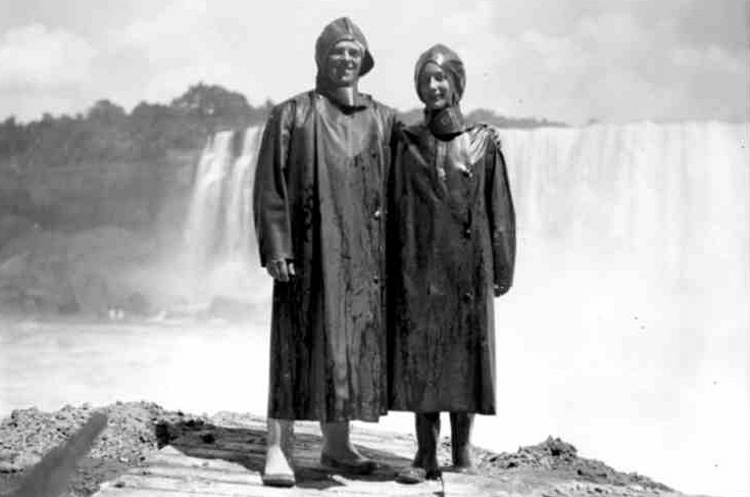
Mr. & Mrs. Harry Lewis At Table Rock Observation Platform, Horseshoe Falls In Background. Photographer unknown. Francis A. Petrie Collection. Courtesy of Niagara Falls Public Library
I visited Niagara Falls only once. I was sixteen
And with my family. The Customs Man
Came to know us after a few days.
But every time we crossed the bridge,
He asked us “Where were you born?”
Because he had to.
I spent much time on the Canadian side
Because it was exciting to be in another country.
I watched the trains that ran through the center of town.
Longest trains I’d ever seen, Canadian railroad.
I saw the bell tower where an unfaithful blonde
Was strangled by her husband in the movie Niagara. But the Falls? The three waterfalls,
Demonstrating the full force of water at top speed—
All I did was look at them.
My parents had been under them.
It had once been the fashion
For honeymooners to travel
To the Falls. For the maximum
In daring romance, they’d don clumsy raincoats
And clunky boots
And ride the boat Maid of the Mist
As it passed beneath the muscular shower,
Getting each marriage off
To a drenching start.
As if to say: “We are not wed
Until we’ve been soaked
And cleansed
In the spray of the Falls.”
I wonder if this magic might work in reverse.
If I were to go to Niagara now
And stand beneath the Falls
And let the water change me,
Make me ready
To receive
Love that streams
Like non-stop water.
It is not a question of where I was born
But rather a question of where I will revive.
Under the rainbow arc of water
Where love and courage have been tested
And children are conceived.
No age is too late for a honeymoon.
To stand beneath the Falls
Is an item on my list.
Lynne Bronstein is a poet, a journalist, a fiction writer, a songwriter, and a playwright. She has been published in magazines ranging from Chiron Review, Spectrum, and Lummox, to Playgirl and the newsletter of the U.S. Census Bureau. Bronstein has published five books of poetry, including her latest, Nasty Girls from Four Feathers Publishing. Her first crime story was published in 2017 in the anthology LAst Resort. Her adaptation of Shakespeare’s As You Like It was performed at two LA libraries. Her story “The Magic Candles” was performed on National Public Radio. She’s been nominated twice for the Pushcart Prize and four times for the Best of the Net awards.
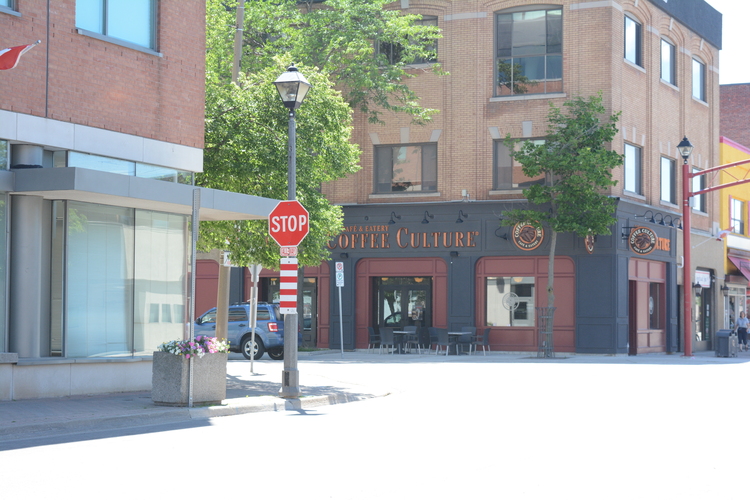
Coffee Culture – corner of Queen St. & Erie Ave., Niagara Falls, 2015. Photo by Alannah Mason. Courtesy of Niagara Falls Public Library
Sunday afternoons consisted of pressing five year old flesh against puzzle pieces, constructing a cardboard genome. Stuck in monosyllabic monotony to keep childhood ignorance distilled from ambiguity.
On Tuesdays, teen intimacies grew in the form of Queen Street coffee shops, hoisting shy ankles curled during untimely dates. Couples waited for conversations to climax, leaving sweat on lips to taste like warm milk.
Forget embarrassment and after parties where cold hands sunk into heads, pulling hair back behind the ears so stuttering saliva could cascade freely into Chippawa porta-potties. The guiltless eloquence of touch leaves a sensual lore sliding with voluptuous syncopation.
Ryan Racine earned his master’s of English language and literature from Brock University. He is currently working as a high school teacher and college instructor in Ontario. His poetry can be found in The Steel Chisel, Pauses/Words/Noises, The Brock University Anthology, Pictures & Portraits, Ekphrastic, Joypuke, Weekly Poems, and PACE Magazine.
See other poems by Ryan Racine on the Niagara Falls Poetry Project website: • Flow State • Worldly Wounds