Thoughts On Niagara by Michael McGuire


mcguire
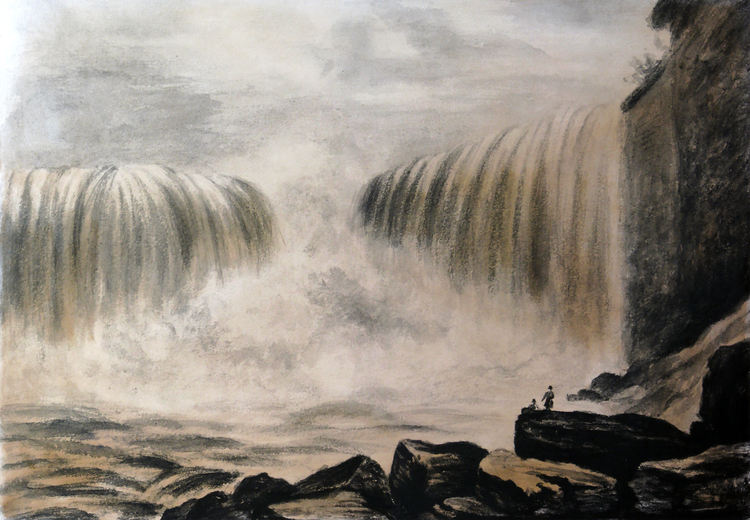
Niagara Falls: From the Canada Side.
Currier & Ives, 1856 (?). Image courtesy of the Library of Congress

I stood where swift Niagara pours its flood
Into the darksome caverns where it falls,
And heard its voice, as voice of God, proclaim
The power of Him, who let it on its course
Commence, with the green earth’s first creation ;
And I was where the atmosphere shed tears,
As giving back the drops the waters wept,
On reaching that great sepulchre of floods, —
Or bringing from above the bow of God,
To plant its beauties in the pearly spray.

And as I stood and heard, though seeing nought,
Sad thoughts took deep possession of my mind,
And rude imagination venturing forth,
Did toil to pencil, though in vain, that scene,
Which, in its every feature, spoke of God.
Oh, voice of nature ! full of strength and awe; —
Unceasing sermon, where Omnipotence
Is at once the theme and illustration.
O thou pervading sound !  o’erwhelming all
With vast conceptions of might infinite !
Hallow my inspirations, and subdue
Whatever in me jars with holy thought.
Let thy loud tones speak to my inmost soul,
And teach it ever to acknowledge God.

Full of thyself, great flood, how vain the task
To tell thy might, or adequately know
How vast thou art, — so very small are we !
If such the thoughts are which thy voice stirs up,
Then what the awe that would entrance the mind
At viewing thy dread strength, thy power sublime!
Or beauty that o’ertops the highest range
Of boldest fancy, whose most lofty flight
Would fall beneath thee far, and much abashed.
Oh place most sacred ! full of awe and God !
Where every sound, and all that’s seen, combine
To teach our minds to humbly trust in Him,
Whose fiat called, and who sustains the world.
O spot !  if any spot on earth can be
A temple, where Jehovah is felt most,
Raise my dejection, and enable me
To speak as may befit thee and myself ;
And teach me to address, in proper terms,
Him, for whose honor thou wast form’d to flow,
And talk forever of his power supreme.
O Thou, that givest all that we possess,
Whose might is infinite, and goodness, too,
Bend to my voice thy always ready ear,
And hearing grant, O grant my earnest prayer,
One which hypocrisy hath ne’er abused,
Nor has been by the drowsy formalist.
The verdant earth which thou hast made,
The sky through which the blazing sun doth ride,
And the moon with her large train make progress ;
These are thy works, which well assert thy might
And goodness, and addressing us, doth speak
Wherever culture rules or nature reigns.
Yet, sight of sky, of sea, or of the earth,
Of wild plant, or of cultivated flower,
Of quiet lake that sleeps in loveliness,
Wound in a belt of perfect solitude, —
Of streams that flow contented in their course,
And leave a legacy of flowers behind, —
Is not to me vouchsafed, — nor may I look
Upon the cataract’s unfetter’d rage,
That wildly hurries it to the abyss,
Which, like a gap in nature, waits the flood
Which, ever rolling, leaves it waiting still.
Of this, imagination tells alone !
Is forced to copy, oh, how faint transcribe,
Where all its paintings must be in itself,
Nature’s designer, and her artist, too.
For me, the world is black, and filled with gloom ;
Huge darkness sits recumbent on the air,
Oppressing it with universal night,
And making melancholy joys supplant,
Till cheerfulness removes from where gloom reigns,
Leaving the mind a prey to thoughts unblest.

And here, where Thou art ever felt to be,
Where nature loudly owns Thee as her God,
Whose praise is sounded by the cataract,
Hearken to me, and my petition hear,
As from each recess of my struggling soul,
The sighs of sickly hope, assembling fast,
Meet in a perfect flood of fervent prayer, —
Which all express’d is this, — Lord, give me sight: —
And that so long unheard, is unheard still.


Source:  Artman, Wm. and Hall, L.V.  Beauties and Achievements of the Blind.  Dansville, N.Y. : Published for the Authors, 1854

From Frank Severance’s Old Trails on the Niagara Frontier:

That Niagara’s supreme appeal to the emotions is not through the eye but through the ear, finds a striking illustration in “Thoughts on Niagara,” a poem of about eighty lines written prior to 1854 by Michael McGuire, a blind man. Here was one whose only impressions of the cataract came through senses other than that of sight. As is usual with the blind, he uses phrases that imply consciousness of light; yet to him as to other poets whose devotional natures respond to this exhibition of natural laws, all the phenomena merge in “the voice of God.”

The poem, which as a whole is far above commonplace, develops a pathetic prayer for sight; and employs much exalted imagery attuned to the central idea that here Omnipotence speaks without ceasing; here is
“A temple, where Jehovah is felt most.”

Niagara by William Wetmore Story

story
William Wetmore Story. From the Brady-Handy Collection in the Library of Congress

‡‡Like hell-hounds from their slumber waking,
And panting madly for their prey,
‡‡Their whitening manes in fury shaking,
And howling down their rocky way,
‡‡From Erie’s sleep, in rushing rapids breaking,
‡‡‡‡Storms down Niagara —
Wildly towards their dread abyss
Hurrying they rage, and foam, and hiss,
Over their shelving precipice ;
Yet pausing on those awful steeps,
‡‡Firm, solid, and compact,
With heavy plunge, and solemn anthem, sweeps
All — all — together in one emerald mass,
‡‡The thundering cataract ;
And evermore its solemn roar
Peals up the heavens, and down the shore —
While from the unremitting storm
‡‡Of seething foam below,
Rises the water’s ghostlike form,
‡‡In its shroud of foamy snow.

‡‡With thee the wrestling storm hath striven !
The wintry blast hath grasped thee by the mane !
And from the summer’s darkening heaven,
Plunging into thy breast its forked levin,
The thunder answered to thy call again ;
But undecaying in thy pauseless power,
Heedless of storm, and reckless of the hour,
Deep, deep, with everlasting trumpet-tone,
Thou soundest ever on !

‡‡A thousand harvests of the human race,
Hath Death’s keen sickle shorn,
Since thou wast in convulsions born ;
‡‡But like a passing mist across thy face,
Year follows year, and age succeeds to age,
And terrible as at thine hour of birth,
Thy hoary locks thou shakest wildly forth,
And scarless, in eternal youth, dost age.

‡‡Falling, falling, as if in huge despair,
Thy watery weight descends ;
‡‡Rising, rising, as Hope were even there,
To heaven again it tends ; —
And Faith her rainbow-bridge uprears
Upon the shattered spray of tears,
And o’er the roaring gulf its arch extends.

Strong as thou art, there is for thee an hour !
‡‡There is for thee a law !
Its limits an almighty power
‡‡Around thy strength can draw ;
Who forged the universe unto his will,
Can chain thy fury, bid thy storm be still ;
He who hath given paths unto the stars,
And meted to the universe its bound,
Who clothed thy being with the voice of wars,
Hath set thee thine appointed bound.
Thundering thou dashest on, with awful roar,
Yet bendest humbly to His stern decree ;
And thou unto His eye art nothing more
Than the frail swallows, that forever soar
Above thy terrors, by his law made free ;
Flames over thee, and all the fiery sword, —
Thou servest ! Thou art bondsman to the Lord !


Source: The Phi Beta Kappa Key, vol 3, no, 2 (January 1917)

Story, Harvard University Class of 1838, wrote this poem on July 6, 1843

Read about William Wetmore Story

Ode to Niagara by William Chambers Wilbor

wilbor
Panorama view of Niagara Falls, river and gorge, from Victoria Park, Canada, 1913, by David Ellis. Courtesy of the Library of Congress

From far-famed lofty Table Rock, in wide-
Extending vision, I behold, entranced,
The magnitude and symmetry of thy
Proportions. In one grand panoramic
Picture thou stretchest out before me — thy
Spacious overflowing gulf, thy distant
Falling flood, an avalanche of silver
Sheen, thy wooded islands’ intervening
Crags, and, near at hand, thy massive bending
Horseshoe : while far above the ascending
Rapids thy broad expanse of azure waves
Blend with the skies which frame the inspiring scene.

Long ages past, when the primeval woods
Sheltered thy banks, and fierce barbaric tribes
Threaded the forest trails to look on thee
And listen to thy voice, they felt in their
Untutored hearts the presence here of the
Great Spirit brooding o’er thy heights sublime
And foaming depths profound.

‡‡‡‡‡‡‡‡‡‡‡‡‡‡‡‡‡‡‡‡‡‡‡Fit temple art
Thou for the living God. Nature perpetual
Sabbath keeps within thy precincts, and man’s
Soul, awed by the thunder of thy deep tones,
Hushes the discords of a world of strife
And, low before the universe’s King,
In spirit worships and with him communes.

Cool breezes blow thy mists between thee and
Mine eyes, yet, by thy roar, I surely know
Thou rollest on in that uneven course through
Which thy way hast led long eons while the
Feet of those who on thee gaze forever
Vanish from thy side. Vapors are transient.
Soon the sun’s warm rays suspend before thy
Face serene a double rainbow. Lo, the
Zephyrs die, all clouds disperse, and thy clear
Sapphire-emerald blending hues gleam fresh and
Bright in the transparent air.

‡‡‡‡‡‡‡‡‡‡‡‡‡‡‡‡‡‡‡‡‡‡‡‡‡‡‡‡‡‡‡‡Upon the
Calm, still bosom of thy stream the gliding,
Flashing waters flow, with ever-quickening
Pace, to make the awful plunge of thy vast
Cataract; then, placid for a while, press
On impetuous downward through thy gorge, ‘twixt
Palisades of high-built walls of rock, like
Herds of wild unbridled steeds rearing and
Rushing on through eddying whirlpool’s mad
Uproarious waves, till they find rest at
Length in the smooth deeps of plains beyond,
And fall asleep in blue Ontario.

Poised in the path of thy swift-flowing surge
Enchanting isles divide thy fleet cascades
And hang suspended on the dizzy edge
Of towering precipice and beetling cliff.
Secluded dells, ‘neath grateful shade of trees
With many a winding way ‘mid fairy
Bowers, are decked with feathery foliage
Of silver birch and spruce. Festooning vines
Of the wild grape there diadem thy brows
With verdant chaplets twined with sylvan grace.

Within this paradise restored the mind
May think upon thy gentler, softer lines
As, far below, upon thy splendor and
Sublimity, it views the no less skillful
Handiwork of God, and lauds his boundless
Wisdom and love of all things beautiful.

Within thy drenched and gloomy Cave of Winds
I hear, appalled, the loud and dreadful crash
And uproar of thy frightful leap, and learn
Anew thy measureless and matchless power.
Like liquid veil thy crystal deluge falls
With headlong speed and far-resounding rage,
Dashing its weight of water on shattered
Trembling ledge of stone, escapes in glistening
Effervescent surf, and whirls along to
Join the fleeing billows which haste away
From the dread home of chaos and dispute.

The Rock of Ages rising at thy feet.
Where strike most furiously thy ponderous blows,
Bears all the swellings of thy tempest great
Unmoved. It braves the o’erwhelming shock
And stands for aye the symbol of that Rock
Which holds the Christian faith secure and strong
‘Mid ceaseless conflicts in a realm of doubt.

Thou hast for me a weird, unearthly charm
At midnight, when thy melody has lulled
To rest the multitudes who throng thy side
By day. Then the faint gleam of twinkling stars
And crescent moon their dim rays shed upon
Thy curved crest, and weave a halo soft,
Unknown to glaring light, which crowns thee with
A mystic glory and a shadowy glow.

There in the solitude and on the brink
Of thy unseen abyss, with darkness filled.
The sound of many waters and the ghostly
Sheet of foam about thee, are speech and forms
Of other worlds to me. Amazed, and with
‘Bated breath, I seem to stand, upon the
Verge of time, alone with thy Creator.

Thy strange caprice in winter I behold
With admiration and surprise as, of
Thy cloudlike spray frozen to Parian
Marble, thou carvest images grotesque,
And, drooping from laden branch of tree and
Shrub, thou hangest wreaths of ivory and
Coral white, and drap’st with purity all
That yield to the influence of thy magic spell.
While, at the foot of thy great waterfall,
There grows from day to day, an icy mount
Almost to level of thine altitude.
While, far beneath thy jagged bridge of ice,
Which spans thy hidden bed; thou hurriest on,
Resisting all constraint of frost and snow.

Eternity is symboled in thy strong,
Full, ceaseless life through an unmeasured flight
Of years. A hand omnipotent, from earth’s
Reservoirs exhaustless, pours within the
Brimming shores of thy swift, unresting waves
Floods ever full yet ever new supplied.
Thou teachest all who come to learn of thee
The endless length and breadth and depth and height
Of beauty, grandeur, and of power divine.

Thou runnest on unchanged by aught that e’er
Transpires among the races of the earth.
Kings rise to power and pass away. Armies
Are mustered in, and nations’ destinies
Are sealed upon the battlefields where they
Forever disappear. Generations
Come and go unheeded and unmarked by
Thee, as, ever moving on, defiant of
The lapse of time, thy rugged stream flows through
The long unnumbered centuries the same.


Source: William Chambers Wilbor.  Ode to Niagara. Buffalo: C.E. Brinkworth, 1907

Also published in his Ode to Niagara and Other Poems. New York: Eaton & Mains; Cincinnati: Jennings & Graham, 1911.
(Some punctuation differs in this edition)

Niagara by Benjamin Copeland

copeland
Niagara Falls, From International Bridge, c1905. Courtesy of Library of Congress

Majestic symbol of eternal power !
‡‡Dread oracle of eons all unknown !
Before thy presence Pomp and Passion cower, —
‡‡All men are equal at thy awful throne.

Abashed, the eager babble of the mart, —
‡‡To silence shamed, the vulgar greed for gain ;
No more ambition goads the weary heart,
‡‡And Toil forgets its unrequited pain.

Stern type of Truth’s inexorable law !
‡‡No room remains for envy or for pride ;
Here prince and pauper stand in common awe,
‡‡Swayed by the spell of thy resistless tide.

A rushing, seething Sinai, — thou dost pour
‡‡On sluggish consciences the solemn sense
Of justice infinite : — thy thunder’s roar
‡‡Declares to Wrong relentless recompense.

Against our arrogance thy strength doth plead ;
‡‡Deep unto deep Imperiously calls ;
Impartial annalist ! the nations read
‡‡Their transient glory on thy ageless walls.

Yet dost thou deign to dower the moment’s need, —
‡‡Our dreams exceeding by thy bounteous sway ;
With power unrivaled thy proud flood shall speed
‡‡The New World’s progress toward Time’s perfect day.

O mighty monitor ! O seer sublime !
‡‡The soul’s surpassing grandeur thou dost show ; —
The fountains of thy immemorial prime
‡‡Through man’s immortal being freely flow.


Source:  Benjamin Copeland.  Niagara, and Other Poems. Buffalo: The Matthews-Northrup Works, 1904

Dr. Benjamin Copeland (1854-1940) was a Methodist minister in Buffalo, New York. He founded three Methodist churches in that city and was the author of four volumes of poetry.

Read about Copeland here

Niagara Falls by Thomas Frederick Young

young
Horseshoe Fall, Niagara, Seen From Below on the Canadian Side by an unknown artist. Colour tint by Erna Jahnke. Courtesy of the Niagara Falls Public Library

Niagara, thou mighty flood,
I’ve seen thee fall, I’ve heard thee roar,
And on the frightful verges stood,
That overhang thy rocky shore.

I’ve sailed o’er surging waves below,
And view’d the rainbow’s colour’d light,
And felt the spray, thy waters throw,
When leaping, with resistless might.

I’ve seen the rapids in their course,
Like madden’d, living things rush on,
With wild, unhesitating force,
To where thy mighty chasms yawn.

And there to take the awful leap,
And fall, with hoarse and sullen roar,
Into th’ unfathomable deep,
Which rolleth on, from shore to shore.

Niagara, thou’rt mighty, grand,
Thou fill’st human souls with awe,
For thee, and for that mighty Hand,
Which maketh thee, by nature’s law.

Thou’rt great, thou mighty, foaming mass
Of water, plunging, roaring down,
But so are we, yea, we surpass
Thee, and we wear a nobler crown.

Thy mighty head is crowned with foam,
And rainbows wreathe thy robes of blue ;
Our earthly forms — our present home —
Are insignificant to you.

But look, thou mighty thund’rer, thou,
Tho’ puny be our forms to thine,
These forms possess, yea, even now,
A spark, a ray of life divine.

Rush on, O waters ! proudly hurl
Thyself to roaring depths below,
And let the mists of ages curl,
And generations come and go.

But know, stupendous wonder, know,
Thy rocks would crumble, at the nod
Of Him, who lets thy waters flow ;
Thy Maker, but our Friend and God.

Thy rocks shall crumble, fall they must ;
Thy waters, then, shall plunge no more,
But we shall rise, e’en from the dust,
To live upon another shore.


Source: T.F. Young.  Canada, and Other PoemsToronto: Hunter, Rose & Co., Printers, 1887