Niagara: A Poem by Rev. C.H.A. Bulkley

Bulkley ‘s poem is 132 pages long, followed by copious notes about religious references and history and descriptions of the events described in the poem. The full text of the poem can be found on the Hathi Trust site:


From Charles Mason Dow’s Anthology and Bibliography of Niagara Falls (p. 742-743):

The author tells us that these 3,600 lines are an attempt to answer the demand for a ” poem of more than ordinary length, truly American in its character ” on Niagara Falls. He says that his ” object has been not so much to describe at length the scenery of Niagara, in order to excite emotions in the reader similar to those of the beholder, for this would be vain endeavor, as to give a transcript of what passes through the mind of one who is supposed to witness so grand an achievement of nature.” The poem is tedious, with commonplace intervals, although it occasionally rises to the heights of true poetry. The analysis which follows gives an idea of the ambition and scope of the undertaking.


Analysis

Introductory apostrophe — themes proposed. Apostrophe to the Fall as a vast form of life. The presence-chamber of God. A knight-errant. Restless spirits. The streams — their lament — its uselessness. The Torrent like Time. A mourner over men and nations. The Indian — his chase — his death-song — his fall. Apostrophe to the Cataract as a Destroyer — an Historian — a warning Prophet — an oracle of Truth — a Chronicler undying — a tireless Laborer — and unswayed by man. The islands — refuge-spots — so are some hearts. Winter — the Fall ice-imprisoned. Spring — with a song of Liberty. Apostrophe to Niagara River — passage down its banks. The Cliffs — Death of Hungerford. The Cave of the Winds. The Pinnacle-Rock. The Whirlpool. Apostrophe to the Fall respecting its origin and early life. The Fall’s Invocation to the Creative Spirit for the Seasons. Evening and Night. The Hermit of the Fall — his birth-place and character — his strain — his melancholy and aspirations — his strife, disappointment, doom, fearful deed, remorse, and death. The Fall a witness of Redemption. Sunrise — typical of Genius. Hymn of Praise. Noon. The Flood’s Invocation. Poet. Musician. The Table- Rock. Beneath the Sheet. The Cataract’s hymn to the Creator. Proof of Deity. The Doom of Time, with the Flood’s death-dirge and fall. The Farewell to the Cataract.


A selection from the poem by Bulkley chosen by Dow:

Spirit of the Fall

What towering form erects its figure here,
To check the footsteps of inquiring man,
As if it were a sentry at his post,
To guard with faithfulness the narrow pass?
It is the Rock of Manitou, the Pinnacle
On which the gloomy spirit of the Fall,
Sits brooding o’er the tide below, that shows
His fearful frowns reflected in its wave,
Or feels the movements of his busy hand
Searching its depths and torturing its course,
Till its full currents reel in conscious pain!

How high the Water-God his altar rears
With jagged summits from a liquid base!
How green the moss that decks its time-worn crown,
Like youthful forms that cluster round old age !
From yonder cliff, impending o’er the stream
With shadowy fringes of the evergreen,
This massive pile, like an inverted cone,
Seems hurled in other years with giant hand,
Upon the kindred masses dashed below!


Source: Rev. C.H.A. Bulkley.  Niagara. A Poem. New York: Leavitt, Trow & Co., 1848

Spirit of the Fall is also published in Rhine, Alice HynemanNiagara Park illustrated : original and selected, descriptions, poems and adventures. New York: Niagara Pub. Co., 1885; New York: William T. Hunter, 1888
To Niagara by G.D. Canale

canale
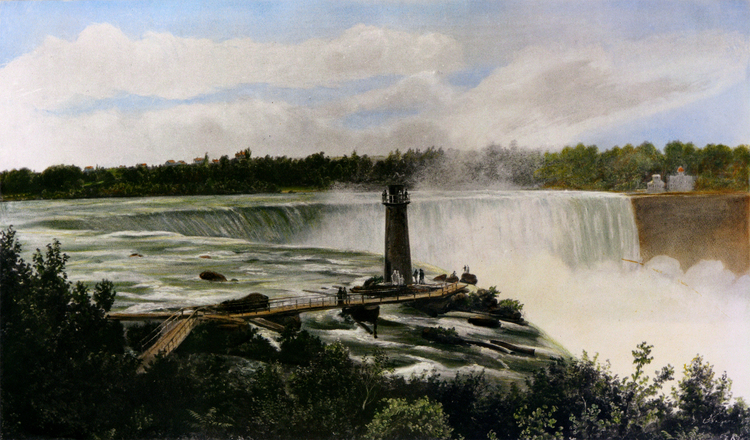
Terrapin Point by Ferdinand Richardt, c1856. Courtesy of Niagara Falls Public Library

Niagara! As I look upon thy ever-foaming
‡‡and ever-rushing waters, my heart is filled
‡‡with awe and admiration.
Thou standest as a wonder of Ages, to which
‡‡man may look and discern the overruling
‡‡power of Him who governs the Universe.
When the steamer, from the pure and clear waters
‡‡of the Ægean sea bore me to Patmos,
There I beheld the very spot where John heard
‡‡the voice of God, as the “sound of many
‡‡waters ;”
And now, as I hear  “the sound of many waters,”
‡‡I am amazed and trembled ! Thy
‡‡voice, O Niagara, is Jehovah’s voice!
I heard many seas roaring, and powerfully beating
‡‡our frail bark.
I heard the mighty waves of the Ocean in their
‡‡greatest fury dash and roar.
But thy thunder-like voice surpasses all. Unrivalled
‡‡stands thy majestic tone!
Let me admire thee, 0 monument of unsurpassed
‡‡greatness, let me drink of thy crystal
‡‡waters.
Many sad and pleasant recollections cluster
‡‡around thy watery grave! Who ever thought
‡‡that I would look upon thy mighty cataracts ?
That I would see the tri-colored-diadem which
‡‡the sun daily lays upon thy imperial brow!,
But alas ! I must leave thee! Other places
‡‡invite me, farewell ! thy voice, O Niagara !
‡‡shall for ever ring in my ears.
May thy waters roll on for ever, to charm others,
‡‡and enchant them with a view of thee,
‡‡which so many desire to see.
And if I return to my native land, and visit
‡‡again Athens and the shores of fair Pallas,
There amidst those classic scenes, I shall remember,
‡‡O Niagara, with undying affection,
‡‡the pleasant moments I spent upon thy eternal banks!


Canale first published this poem in the Boston Journal, July 10, 1858

Source: Robert S. Littell (ed.)  The Living Age August 28, 1858 (vol. 58)

From The Boston Journal:

NIAGARA FALLS IN HELLENIC BALLAD

Mr. Canale, a Greek gentleman residing in this city, has kindly furnished to us a literal translation of a Greek lyric poem which he wrote while viewing “Niagara Falls.” The poem is marked for its simplicity and beauty, and although the translation presents but a very faint picture of the original, depriving it of the harmony and the onomatopoetic structure upon which so much of the beauty of lyric poetry depends, still we publish it with pleasure, being the first time, so far as we know, that Niagara the “wonder of the world,” has been immortalized in the language of Pindar.

The original poem, we understand , has been forwarded to be published in one of the Athenian Magazines.

Niagara Falls by Ezekiel Bacon

“Labitur—labitur—et semper labetur.” 

bacon
Niagara Falls, 1845. Courtesy of the Library of Congress

WHEN from the realms of chaos dark
‡‡God chased the shades of night,
And on creation’s midnight void
‡‡Poured floods of living light;

Then o’er the darkness of the deep
‡‡The Almighty spirit stood,
Gave to the eternal hills their place,
‡‡Its bounds the unfathomed flood.

Long rolled that angry, sullen wave
‡‡In its imprisoned bed,
In Erie’s wild and watery waste,
‡‡By mighty torrents fed.

Till bursting from its ramparts high
‡‡Niagara’s current flowed,
And o’er the mountain and the glen
‡‡Its fearful surges rode.

Through long lost generations since
‡‡Thy ceaseless round hast run;
For generations yet to come
‡‡Thy race is but begun.

Roll on to thy deep ocean bed,
‡‡Thou wild, mysterious stream !
When ages yet unborn are passed
‡‡As fades a baseless dream.

Faint emblem of eternity !
‡‡Thy teaching sure is given
To point the enraptured wonderer through
‡‡Life’s narrow strait, to heaven !


Source: Ezekiel Bacon. Ægri Somnia: Recreations of a Sick Room.  New York : John Allen, 1843

Biography of Ezekiel Bacon

Niagara Falls by Rev. Charles Burroughs

Composed there, August 10, 1846.


burroughs
The Rev. Charles Burroughs, DD, painted by Gilbert Stuart, Princeton University Art Museum. 

HARK ! what sounds of mighty thunders !
O’er those cliffs an ocean pours !
Mark its foaming furious surges,
Booming on the rocky shores.

Why is all this awful tempest
Of Niagara’s flood so vast ?
Why these hurricanes of waters,
Seeming like destruction’s blast ?

Hear the story of these wonders ;
This decree did God proclaim :
‘Let the waters here be gather’d
To adore my glorious name.’

Lakes immense, and icebergs melted
From the stormy northern pole,
Babbling brooks, and countless rivers
To Niagara’s temple roll.

To that glorious altar move they
Not with slow reluctant pace,
But with eager speed and transport
Rush they to that sacred place.

All their garments beam with splendor ;
Some are whiter than the snow ;
These display a crimson lustre ;
Those, like brightest emeralds glow.

Some are graced with tints of azure ;
Those with amber ; these with green ;
Boundless wreaths of glittering diamonds
O’er Niagara’s robes are seen.

Thus the stream, all clothed with glory
To its God with rapture sings,
And the heavenly vaults re-echo
With its awful thunderings.

Then ascend thick clouds of incense,
Which is borne on angels’ wings,
And o’er earth the richest blessings
With unbounded mercy flings.

Then did Christ our blessed Saviour,
For those harmonies so loud,
Paint the rainbow’s radiant beauties
On the fleecy incense cloud.

There I saw the bow of promise
As it came from God’s right hand,
And it spread its arch transcendent
On our own and Britain’s land.

Here a Church has Christ erected,
All these sounds are praise to Him ;
All this stream ‘s a font baptismal,
And its drops are seraphim.

These grand cliffs are altars sacred
To that God who reigns above ;
All this rush and deafening roaring
Are but songs of holy love.

All these foaming crystal surges
Hath a Saviour’s mercy hurl’d
O’er those craggy heights, to christen
And redeem a fallen world.

It is wise that erring mortals
Should frequent these wondrous scenes,
Here to see the God of Nature,
And to learn what worship means.

‘T is not strange that red men always
View this spot, as God’s dread home,
And their pipes and beaded wampums
Humbly offer on the foam.

‘T is not strange that unbelievers
Here betray remorse and shame,
And confess our Lord’s dominion
Over cataract and flame.

‘Tis not strange that Christian pilgrims
Here the richest blessings know ;
Here ‘s the hem of Christ’s bright garment,
Which, when touch’d, will grace bestow.

These dread scenes portend the judgment,
When in triumph Christ shall come,
With a voice, like mighty waters,
To pronounce earth’s endless doom.

Then, O God, in mercy save me
From thine everlasting frown,
That in bliss my ears may hear Thee,
And my eyes behold thy crown.


Source: Burroughs, Charles, Rev.  The Poetry of Religion, and Other Poems. Boston, Ticknor, Reed & Fields, 1851.

NOTES [from the text by Charles Burroughs].

Note 1. — Allusion is made in the fourth verse to the waters which flow over Niagara Falls. They come from those mighty Lakes, or as they may be more rightly termed, inland Seas, Lakes Erie, St. Clair, Huron, Michigan, Superior, and many others. Lake Superior is four hundred and fifty miles long, one hundred wide, and nine hundred feet deep. It receives constant contributions from about forty rivers. The most distant source, that supplies Niagara, is probably the river St. Louis, which rises twelve hundred and fifiy miles north-west of the Lakes, and one hundred and fifty miles north-west of Lake Superior. Now these immense lakes, with their hundreds of rivers, great and small, all of which flow over Niagara Falls, cover a surface of one hundred and fifty thousand square miles, and contain nearly half the fresh water on the face of the globe. It is computed that one hundred millions of tons per hour, and thirty thousand tons per second, pass over the Falls. Hence old Father Hennapin, who visited the Falls in 1678, said, ‘I could not conceive how it came to pass, that such mighty lakes and numerous rivers should discharge themselves at Niagara Falls, and yet not drown a good part of America.

Note 2. — In verse seventh I speak of some of the robes of the Falls as covered with glittering diamonds.’ As you stand at a place, called the Platform, on the American shore, near the ferry-ways, the Falls at your side are thrown over the precipice for a long distance beyond you, in perpetual showers of huge drops, which continue as drops till they enter into the river below, and which, when seen about an hour before sunset, seem like a miraculous and perpetual shower of millions on millions of diamonds and other most brilliant gems.

Note 3.- In the 8th verse I speak of the ‘thunderings of the cataract. It is supposed that this circumstance led to its name. Niagara in the Iroquois dialect signifies the ‘thunder of waters.’ They produce not only a concussion of the air, but a constant trembling of all the adjacent country. So writes a beautiful Poet, —

‘Niagara, as thy dark waters pour,
An everlasting earthquake rocks thy lofty shore.’

Note 4.-In verse thirteen I have called the cliffs of Niagara “a sacred altar.’ Since writing that passage I have seen the same idea applied to the Falls by another writer. He calls them the everlasting altar, on whose cloud-capt base the elements pay homage to Omnipotence.’

Note 5. — The fourteenth verse associates the Falls with our redemption. So some other writer has well said,

“A Pavilion it seem’d, with a Deity grac’d,
And justice and mercy met there and embraced.’

Note 6. — The homage of Indians at the Falls is no fiction. Whenever they first see this wonder of our world, they offer at the cataract to the Great Spirit whatever they have valuable about them ; as mentioned in verse sixteenth.

Note 7.— I speak of God in the seventeenth verse as ‘over cataracts and flame.’ Beside the unsurpassed wonder of the Falls, there is near them a burning spring, an everlasting lamp of flame, which is kindled by the breath of Omnipotence.

Note from Charles Mason Dow’s Anthology and Bibliography of Niagara Falls

“Composed at Niagara August 10, 1846. To the clergyman author [ Burroughs ] the rush of water was a song of rapture to God, the clouds of spray were incense, the rainbow was a reminder of redemption by Christ, the cliffs were altars, and the whole Falls an inspiration to worship.”

Niagara by J.N. M’Jilton

mcjilton
Rev. John Nelson McJilton
From a portrait provided to the Edgar Allen Poe Society of Baltimore by Thomas F. Upson, a great-great-grandson of McJilton

Roll on resistless flood ; in mystery roll
The restless waters from thy lofty brow ;
No earthly arm the billows may control
That play upon thy summit ; there they bow,
And battle with the winds that through them plow,
Till from thy mountain forehead, down they pour ;
And as in centuries past, so they are now,
The firm base shaking of thy rocky shore,
And drowning echo in the eternal roar ;
Nor may the tempest shout as loud as thou.

Roll everlasting torrent ; on thy front
The Almighty’s signet rests ; the brilliant bow
Belts thy broad bosom yet, as it was wont
To arch it o’er a thousand years ago ; —
Girding the waves to watch them as they flow,
And gathering from the spray, in glorious thrall,
The rays prismatic as they richly glow,
Trembling amid the fires that on them fall,
In fadeless beauty from the sunlit hall,
Where floods of light their deathless radiance throw.

Up from thy emerald shores in beauty still,
A bright memorial of the deed, it springs,
That buried guilty nations at the will
Of Him who rides upon the tempest’s wings ; —
Dread warnings from the mighty past it brings,
And gazing on its splendors, man may feel
The inspiration which around him flings
The past and future ; and the high appeal
Of Revelation, on his heart may steal,
While to the blessed bow his vision clings.

Thou mightiest of waters ; God hath stood
Thee, a stern sentinel on the brow of time,
That as the years, with thy eternal flood,
Pass swiftly onward to the unknown clime,
Thou mightst forever, in thy thunder chime,
Peal their tremendous requiem ; years have rolled
On from the dark and unexplored abyme,
Like thee for centuries; the ages told,
Upon eternal pages are enrolled
With all their deeds of worthiness and crime.

Amid thy restless waters ; many a star.
Hath gazed upon its shadow, and the blue —
The brilliant heaven, hath in thy depths afar,
Bathed its bright countenance and shone anew.
Thou wearest in thy billows every hue,
The changing aether wears; clouds flit o’er thee,
Throwing the gloom or glory now they threw,
When in their anger fierce, or in their glee,
In ages of the past, as fresh as free.
Above thy crown, upon the winds they flew.

The lovely moon hath kissed thee : queen of night,
She rose on dark Ontario, ere day was gone ;
And from her throne of silver, threw her light
Through twilight shadows, on thy waters dun ;
A snowy radiance as her course she run,
Mantled the shores where rippling eddies play,
Like laughing children in the evening’s sun,
Chasing each other in the mimic fray ;
Pale traveller ! she gazed as glad as they,
And moved in peace her lonely journey on.

The sun hath glassed his glories on thy head.
And clad it like his heavens, in robes of gold ;
Among thy hoary locks his beams were shed,
Eternal youth entwining with each fold ; —
With all thy years upon thee, as of old
Thou yet art glowing ; neither age nor time,
Nor the ten thousand changes time has told,
Hath taken from thy brow its morning prime ;
Thy hoary honors are thy crown sublime,
And all thy early freshness thou dost hold.

Winds claim thy wild companionship, and on
Thy surface sport; they with thy dark green waves,
Wrestle but for a moment and are gone.
The tempest walks thy waters, when it raves,
They toss in tumult and expose the caves,
Which in the hour of peace beneath them hide :
And winds like human passions, are the slaves
Of impulse, dashing in their strength and pride ;
And on, in their destructive madness ride,
Regardless that they sweep o’er men or graves.

Storms tremble ‘mid thy terrors ; lightnings throw
Their lurid fires from cloud to cloud on high ;
Deep in thy waves the vivid shadows glow,
Fierce as the flames athwart the angry sky,
That flash and in majestic grandeur fly ;
Upon thy lofty forehead thunders break,
And dreadful whirlwinds dash their dangers by ;
But Nature’s war, thy purpose cannot shake,
The deep Inundations of the earth must quake,
Before thy mountain rocks in ruin lie.

Roll on unrivalled queen of rivers, crowned
By heaven’s immortal King ; thy coronal
The rays that burn his glorious throne around,
And on thy glowing summit richly fall ;
Thy girdle is the light ; its beams enthrall
The throne of pearl, reared on the mount of snow,
That foams above thine own eternal wall
Of rushing waters, where earth’s ocean all
Have trembled into drops and plunged below,
Forever rolling through the rocky hall.


Source: J.N. M’Jilton.  Poems.  Boston: Otis, Broaders & Co., 1840

N.B. The book has his last name as M’Jilton; other sources cite McJilton.

Biography of Rev. John Nelson McJilton from the Edgar Allen Poe Society of Baltimore

Search for this book by M’Jilton, or McJilton on AbeBooks

Search:


Title:

Author: