Lines in a Young Lady’s Album by Peter A. Porter

peter
Col. Peter Augustus Porter (1827-1864)
Image courtesy of Wikipedia Commons


An artist, underneath his sign, (a masterpiece, of course),
Had written, to prevent mistakes, ‘This represents a horse’;
So ere I send my Album Sketch, lest connoisseurs should err,
I think it well my Pen should be my Art’s interpreter.

A chieftain of the Iroquois, clad in a bison’s skin,
Had led two travelers through the wood, La Salle and Hennepin.
He points, and there they, standing, gaze upon the ceaseless flow
Of waters falling as they fell two hundred years ago.

Those three are gone, and little heed our worldly gain or loss—
The Chief, the Soldier of the Sword, the Soldier of the Cross.
One died in battle, one in bed, and one by secret foe;
But the waters fall as once they fell two hundred years ago.

Ah, me! what myriads of men, since then, have come and gone;
What states have risen and decayed, what prizes lost and won;
What varied tricks the juggler, Time, has played with all below:
But the waters fall as once they fell two hundred years ago.

What troops of tourists have encamped upon the river’s brink;
What poets shed from countless quills, Niagaras of ink;
What artist armies tried to fix the evanescent bow
Of the waters falling as they fell two hundred years ago.

And stately inns feed scores of guests from well replenished larder,
And hackmen drive their horses hard, but drive a bargain harder;
And screaming locomotives rush in anguish to and fro:
But the waters fall as once they fell two hundred years ago.

And brides of every age and clime frequent the island’s bower,
And gaze from off the stone-built perch—hence called the Bridal Tower—
And many a lunar belle goes forth to meet a lunar beau,
By the waters falling as they fell two hundred years ago.

And bridges bind thy breast, O, stream! and buzzing mill-wheels turn,
To show, like Samson, thou art forced thy daily bread to earn;
And steamers splash thy milk-white waves, exulting as they go,
But the waters fall as once they fell two hundred years ago.

Thy banks no longer are the same that early travelers found them,
But break and crumble now and then like other banks around them;
And on their verge our life sweeps on—alternate joy and woe:
But the waters fall as once they fell two hundred years ago.

Thus phantoms of a by-gone age have melted like the spray,
And in our turn we too shall pass, the phantoms of to-day:
But the armies of the coming time shall watch the ceaseless flow
Of waters falling as they fell two hundred years ago.


Source:  Johnson, Richard L. (ed).  Niagara: Its History, Incidents and Poetry. Washington, Walter Neale General Book Publisher, 1898

Also published in Holley, G. W., ed. Niagara: Its History and Geology, Incidents and Poetry. Toronto,  Hunter, Rose and Company, 1872

Also Published in Holley, George W., ed.  The Falls of Niagara and Other Famous Cataracts.  Baltimore: A.C. Armstrong & Son, 1883

Holley says of this poem: “The most graceful verses on Niagara ever written by a resident are the following by the late Colonel Porter, who was an artist both with the pencil and the pen. They were written for a young relative in playful explanation of a sketch he had drawn at the top of a page in her album, representing the Falls in the distance, and an Indian chief and two Europeans in the foreground.”

Read The Poetry of Peter A. Porter by Michelle Ann Kratts

Read about Colonel Peter A. Porter 

The Winds of Niagara by Ada Elizabeth Fuller

winds
Niagara Mornings, February 15, 2007. Winds Blowing Mist
Photo by Andrew Porteus

Blow strong from the River, O Breeze,
‡‡For hot are my passions to-day.
Breathe soft from your feathery trees
‡‡And blow all my sorrows away.
Oh make my heart buoyant and glad,
‡‡As gay and as free as thou art;
For my soul is so weary and sad,
‡‡I would have its dark visions depart.

Oh breezes that ripple and curl
‡‡The waves on the great river’s breast,
The banners of morning unfurl
‡‡Their gleams on each foaming wave’s crest!
So lull my wild passions to rest
‡‡As you airilv dance to the sea,
And the thoughts that are wholesome and best
‡‡Will scatter their blessings on me!


Source:  Ada Elizabeth Fuller.  Sunshine and Shadow: Poems by Ada Elizabeth Fuller.  Niagara Falls, Ont.: Ada Elizabeth Fuller, 1919


See  the Niagara Mornings photographs by Andrew Porteus on YouTube

Chimes of De Veaux by Ada Elizabeth Fuller

deveaux
Ambrose Chapel at De Veaux College, where the bells were housed
Photo courtesy Big Daddy Dave blog


Fling out your silver peals,
‡‡Over the river’s breast.
Speak to the waters, peace,
‡‡Bid the wild Rapids rest.
Peal sweetly, high and low,
‡‡Chimes of De Veaux.

Chime to the flaming woods,
‡‡Gay in the morning sun.
Chime to the solemn pines
‡‡After the day is done.
Peal sweetly, high and low,
‡‡Chimes of De Veaux.

Ring out your silver strains,
‡‡Over Niagara’s breast.
Bid the wild waters roll,
‡‡On to their ocean-rest.
Peal sweetly, high and low,
‡‡Chimes of De Veaux.


Source:  Ada Elizabeth Fuller.  Sunshine and Shadow: Poems by Ada Elizabeth Fuller.  Niagara Falls, Ont. Ada Elizabeth Fuller, 1919


The site of DeVeaux College is now owned by the New York State Office of Parks, Recreation, and Historic Preservation, and is now the DeVeaux Woods State Park. According to the TowerBells.org DeVeaux School had a 10-bell chime installed by Meneely/Troy in 1913, which was sold to Verdin in November 1994.  The remaining structure on the site have also been demolished.


From The Living Church, vol. 50, January 3, 1914

New Chimes at De Veaux College

On New Year’s Eve, at midnight, the new chimes at De Veaux College, Niagara Falls, N.Y. (the Rev. William Stanley Barrows, headmaster), were rung for the first time. The bells, ten in number, were made by the Meneely Company of Troy, and are known as their F Tenor chime. They are a duplicate of those recently given to Christ Church, Greenwich, Conn, and are the gift of Mr. Albert H. Lewis of Bridgeport, Conn., who attended De Veaux College from 1857 to 1862. The inscription on the great bell reads: “Fortiter, Fideliter, Feliciter.  In honor of Samuel De Veaux and as a memorial to those trustees, masters, boys, and patrons who have faithfully served and fostered De Veaux College, this chime is presented by Albert Henry Lewis, ’57-’62, Founder’s Day, A. D. 1913, the fifty-sixth anniversary of the opening of De Veaux College. Glory to God in the highest and on earth peace good will toward men.” The inscription of the other bells is: “Fortiter, Fideliter, Feliciter. De Veaux College, ex dono Albert Henry Lewis, Founder’s Day, A. D. 1913.”


View the song Thy Bells Deveaux by Thomas Vincent Welch and J. Ernest Rieger

Read more about the DeVeaux College Chimes

Visit the Big Daddy Dave blog post about DeVeaux School

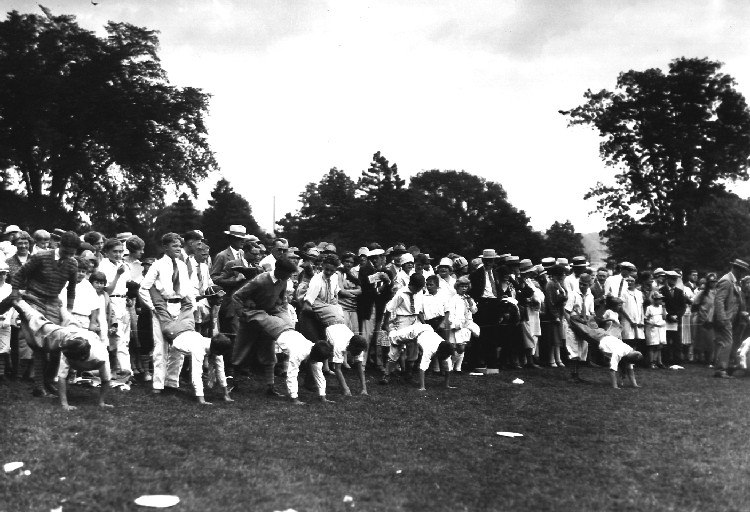
A Pic-Nic at the Falls by Melvin Byron Misener

The Crowland Safe Guard Union and Port Robinson Presbyterian Sabbath Schools held a union picnic at the Falls on Aug. 15, and the occasion has been immortalized by the Crowland poet, as followeth : —

misener
Wheelbarrow Race During Picnic in Queen Victoria Park, July 1927.
Photo by Edwin Hodge
Courtesy of the Niagara Parks Commission / Niagara Falls Public Library

Did you ever Pic-nic at the Falls
‡‡Upon a summer’s day ?
If not, I tell you, ’tis the place
‡‡To pass the time away.

Now first of all you name the day,
‡‡But then, if it should rain,
You fix upon another date,
‡‡And then perhaps again.

And next you must a chicken catch,
‡‡Be sure to take off its head,
Then fill it well with dressing
‡‡And roast it when it’s dead.

You fix a lot of other things
‡‡To fill the basket up ;
‘Tis well to take some dishes too,
‡‡A plate and spoon and cup.

The time comes round — you’re on the road,
‡‡Your best friend at your side,
And if you chose a pleasant day
‡‡You will enjoy the ride.

You can go by the Clifton hill,
‡‡Or down the old ravine,
No difference how you get there
‡‡Upon the park and green.

You meet your many neighbours there
‡‡Their friendship to renew,
Along perhaps with relatives
‡‡And strangers quite a few.

You’ll meet there Col. Gzowski
‡‡And he’ll not speak to you,
But gaze in blissful ignorance
‡‡Upon the sights to view.

And noon comes round, the tables spread
‡‡With pies and cakes and such
And some one at your elbow says,
‡‡“Take care, don’t eat too much.”

Now some drink water pure and bright,
‡‡But grannies have their tea,
For you can get hot water
‡‡Right at the park Q. V.

We sit along the bank awhile
‡‡And watch the Misty Maid ;
Some people will not ride on her
‡‡Because they are afraid.

The day is spent, we start for home ;
‡‡On two things we agree.
That we have had a pleasant time,
‡‡We’re tired as we can be.


Many thanks to Arden Phair for referring this poem to the Niagara Falls Poetry Project curator.

Source: Undated newspaper clipping (probably the Welland Tribune) found in The Diaries of Melvin Byron Misener, held at the Mayholme Foundation in St. Catharines.  The clipping has the date “1900” handwritten in the margin of the previous page. Misener (1847-1936) was known as “The Crowland Poet.”  Read more about Misener


Fairview Cemetery by Shie Sirianni

sirianni
Fairview Cemetery, Niagara Falls, Ontario
Image courtesy of the City of Niagara Falls

I walk alone, eyes downcast
seeking paths of fallen leaves,
to disguise the sound
of breaking armour.
Cemeteries in the fall
are good places for disguise.
I can lie there,
surrounded by stone confessors,
and speak aloud
all that is in me.
Joy, sorrow,
goodness and sin.
There is no forgiveness,
or absolution offered.

They are not my pardoners.

They are just marks left for others,
who perhaps, like me,
spent troubled times there,
before making it their home.


Source:  Shie Sirianni published this poem in Captured Essence: Niagara Poetry Anthology, vol. 11. St. Catharines: Canadian Authors Association, Niagara Branch, 1995

With thanks to Arden Phair who pointed out this poem by Shie Sirianni to the Niagara Falls Poetry Project curator.