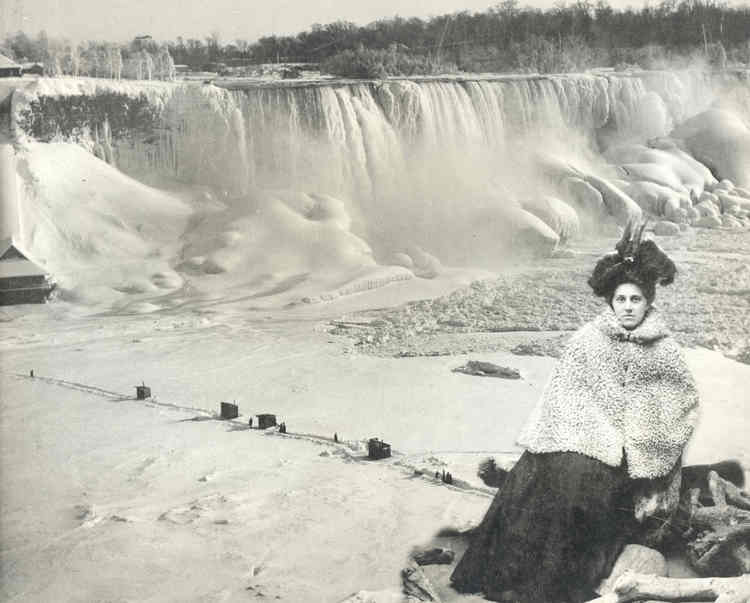
An Unknown Lady. A typical studio portrait using a backdrop of a view of Niagara Falls. Image Courtesy of Niagara Falls Public Library
My great-grandparents are both twenty-one.
This is their honeymoon. They sit in front
of a pasteboard screen of Niagara Falls
painted in aniline blues and greens.
Unnecessary props—plaster columns, draperies
and wax flowers—have been pushed aside.
He leans his elbow on the false balustrade,
restless in his dark suit, one leg extended,
One hand hidden behind her back.
Both of them frown at the camera.
He has not even taken off his hat
to balance it on his knee. Perhaps
he is already thinking of leaving.
Inverted in the viewing glass her white dress
wavers in and out of focus. The photographer
bends above his box and pleated bellows,
a black cloth over his head.
He tends the image carefully, as if
it is a lantern he is trying to keep
alight. This far north the sun sets early.
Beyond the glass wall of the studio
it is already night. The photographer lifts
his hand to bid them to be still. He lights
the touch paper. The shutter clicks.
Magnesium flashes with the power of
twelve hundred candles. As the column
of white smoke settles, the room fills
with a fine metallic powder. Their faces are
both silvered over. This is the only photograph
of them together. They do not move or speak.
Outside each second nine thousand tons of water
fall through the full dark of the last century.
Source: The New Republic, vol 218, issue 13, March 30, 1998
During the so-called war of 1812-14 between England and the United States, Laura Secord, the wife of a crippled British veteran, saved the British forces from surprise and possible destruction by the heroic action narrated in the ballad. Her home lay near the celebrated Queenston Heights, a few miles from the Falls of Niagara.
Amidst those scenes of wonder do I stand,
Though not in bodily presence, but in thought ;
Stupendous works of the Almighty’s hand,
By artist’s skill before my vision brought.
The deep, strong floods, that downward ever pour,
The mists, that from their bosom ever rise,
I see, and almost seem to hear the roar
Of many waters sounding to the skies.
The littleness of man, the power of God,
Doth to the sight as visible appear !
So felt the Indian, as these scenes he trod ;
‘Twas the Great Spirit’s voice he seemed to hear,
That the deep silence of the forests broke,
And to his children in its thunders spoke.
Source: Jones Very. Poems and Essays. Complete and revised ed. Boston: Houghton Mifflin, 1886
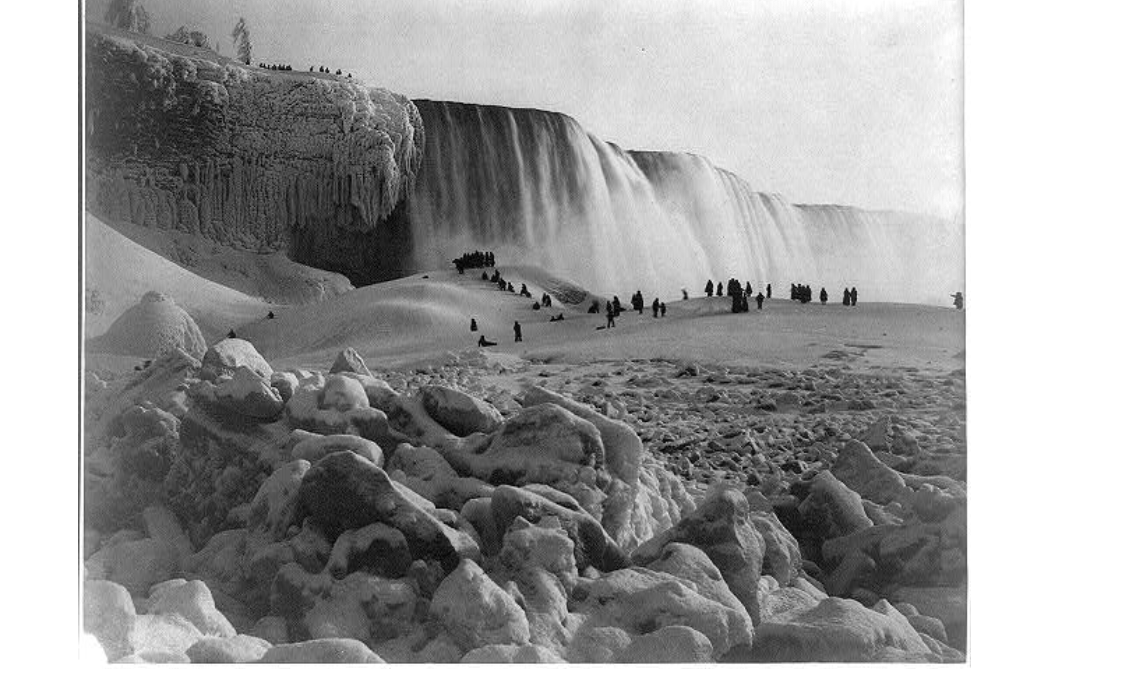
People Walking on the Ice Bridge at Niagara Falls, 1883. Photograph by George Barker Image Courtesy of the Library of Congress
One day in March ‡‡‡‡‡‡‡a century or so ago
Niagara Falls couldn’t or wouldn’t
Why there was no flow ‡‡‡‡‡‡‡was a puzzle.
Why didn’t the water show?
Beached creatures needed to know.
The day before it fell pell-mell. ‡‡‡‡‡‡‡Now, nothing gushing, dry as…
Well, when Niagara Falls fails ‡‡‡‡‡‡‡fears assail faces.
Something’s very wrong in high places
when the mighty Falls just stops its drops.
What befell the Falls, ‡‡‡‡‡‡‡caused the pause?
People walked the riverbed, ‡‡‡‡‡‡‡dismayed, began to pray.
Boaters removed crags that had been snags.
Finally word from Buffalo, hours away,
conveyed that storm winds chunked ice up
and that ice jam became an ice dam, ‡‡‡‡‡‡‡blocking Niagara River to a sliver.
For forty hours no Falls at all, still it was, till
the dam broke, bursting waters spoke
from a rumble to a thundering roar,
as Niagara’s breadth unfurled
its Falls in power once more ‡‡‡‡‡‡‡to a grateful lark-winged world.
Lines suggested by a glance at the visitor’s Album, kept at the Museum, Niagara Falls.
Give up, ye would-be bards, your rhymes to tag here so,
In vain you rack your brains to paint Niagara.
A theme which even Milton’s muse might beggar, you
Had better let alone when at Niagara.
About Lodore right well could Southey swagger, tho’
‘Twould take ten thousand such to match Niagara.
To all who can stand boasting fit to stagger me,
I’d recommend a visit to Niagara.
Hear yon sleek slaver—not a bit in waggery—
Toasting the “Flag of Freedom” at Niagara!
“You Canucks,” quoth he, “need the starry flag o’er you
To make you worth your salt benorth Niagara!
You can’t too quickly have that British rag o’er you
To disappear entirely from Niagara!
He calculates some day to blast a crag or two
And drain Lake Erie all up from Niagara.
He speculates, just as myself I drag away,
How Ætna’s throat would like to gulp Niagara!
Oh, cousins, cousins! what a set for brag are you!
When will you learn mere froth is not Niagara?
But I must cease, lest they should lynch or dagger me;
Already they have fleeced me at Niagara.
Source: Evan MacColl. The English Poetical Works of Evan MacColl. 2nd Canadian edition. Toronto: Hunter, Rose & Co., 1885