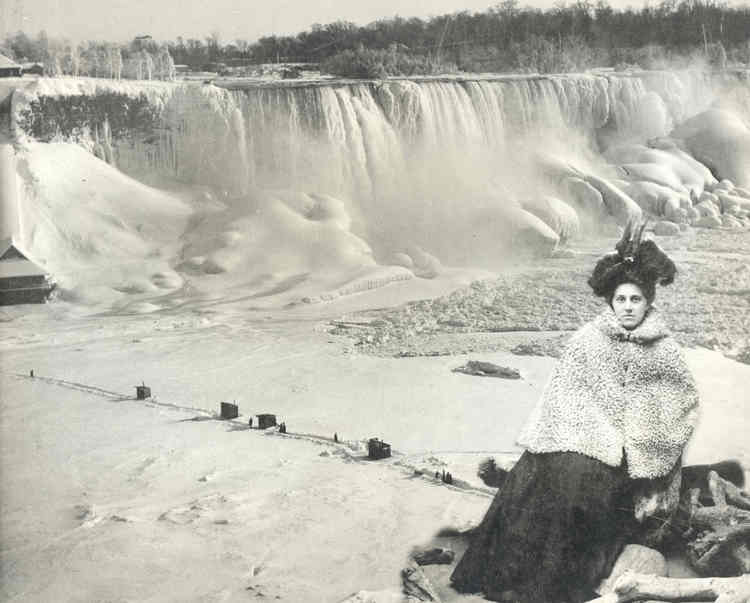
An Unknown Lady. A typical studio portrait using a backdrop of a view of Niagara Falls. Image Courtesy of Niagara Falls Public Library
My great-grandparents are both twenty-one.
This is their honeymoon. They sit in front
of a pasteboard screen of Niagara Falls
painted in aniline blues and greens.
Unnecessary props—plaster columns, draperies
and wax flowers—have been pushed aside.
He leans his elbow on the false balustrade,
restless in his dark suit, one leg extended,
One hand hidden behind her back.
Both of them frown at the camera.
He has not even taken off his hat
to balance it on his knee. Perhaps
he is already thinking of leaving.
Inverted in the viewing glass her white dress
wavers in and out of focus. The photographer
bends above his box and pleated bellows,
a black cloth over his head.
He tends the image carefully, as if
it is a lantern he is trying to keep
alight. This far north the sun sets early.
Beyond the glass wall of the studio
it is already night. The photographer lifts
his hand to bid them to be still. He lights
the touch paper. The shutter clicks.
Magnesium flashes with the power of
twelve hundred candles. As the column
of white smoke settles, the room fills
with a fine metallic powder. Their faces are
both silvered over. This is the only photograph
of them together. They do not move or speak.
Outside each second nine thousand tons of water
fall through the full dark of the last century.
Source: The New Republic, vol 218, issue 13, March 30, 1998
During the so-called war of 1812-14 between England and the United States, Laura Secord, the wife of a crippled British veteran, saved the British forces from surprise and possible destruction by the heroic action narrated in the ballad. Her home lay near the celebrated Queenston Heights, a few miles from the Falls of Niagara.
Amidst those scenes of wonder do I stand,
Though not in bodily presence, but in thought ;
Stupendous works of the Almighty’s hand,
By artist’s skill before my vision brought.
The deep, strong floods, that downward ever pour,
The mists, that from their bosom ever rise,
I see, and almost seem to hear the roar
Of many waters sounding to the skies.
The littleness of man, the power of God,
Doth to the sight as visible appear !
So felt the Indian, as these scenes he trod ;
‘Twas the Great Spirit’s voice he seemed to hear,
That the deep silence of the forests broke,
And to his children in its thunders spoke.
Source: Jones Very. Poems and Essays. Complete and revised ed. Boston: Houghton Mifflin, 1886
Lines suggested by a glance at the visitor’s Album, kept at the Museum, Niagara Falls.
Give up, ye would-be bards, your rhymes to tag here so,
In vain you rack your brains to paint Niagara.
A theme which even Milton’s muse might beggar, you
Had better let alone when at Niagara.
About Lodore right well could Southey swagger, tho’
‘Twould take ten thousand such to match Niagara.
To all who can stand boasting fit to stagger me,
I’d recommend a visit to Niagara.
Hear yon sleek slaver—not a bit in waggery—
Toasting the “Flag of Freedom” at Niagara!
“You Canucks,” quoth he, “need the starry flag o’er you
To make you worth your salt benorth Niagara!
You can’t too quickly have that British rag o’er you
To disappear entirely from Niagara!
He calculates some day to blast a crag or two
And drain Lake Erie all up from Niagara.
He speculates, just as myself I drag away,
How Ætna’s throat would like to gulp Niagara!
Oh, cousins, cousins! what a set for brag are you!
When will you learn mere froth is not Niagara?
But I must cease, lest they should lynch or dagger me;
Already they have fleeced me at Niagara.
Source: Evan MacColl. The English Poetical Works of Evan MacColl. 2nd Canadian edition. Toronto: Hunter, Rose & Co., 1885
Edward Hartley Dewart 1828-1856 Courtesy of Wikimedia Commons
ERE yet I saw the wild magnificence,
Which Nature here with peerless pomp unveils,
A solemn sound—a stern and sullen roar—
By which the earth was tremulously thrilled—
Kindled a flush of deep, expectant joy,
Quickening the pulses of my throbbing heart,
And tingling through my veins like fire. But now,
While standing on this rocky ledge, above
The vast abyss, which yawns beneath my feet,
In silent awe and rapture, face to face
With this bright vision of unearthly glory,
Which dwarfs all human pageantry and power,
This spot to me is Nature’s holiest temple.
The sordid cares, the jarring strifes, and vain
Delights of earth are stilled. The hopes and joys
That gladden selfish hearts, seem nothing here.
The massy rocks that sternly tower aloft,
And stem the fury of the wrathful tide—
The impetuous leap of the resistless flood,
An avalanche of foaming, curbless rage—
The silent hills, God’s tireless sentinels—
The wild and wondrous beauty of thy face,
Which foam and spray forever shroud, as if
Like thy Creator, God, thy glorious face
No mortal eye may see unveiled and live—
Are earthly signatures of power divine.
O! what are grandest works of mortal art,
Column, or arch, or vast cathedral dome,
To these majestic foot-prints of our God!
Unique in majesty and radiant might,
Earth has no emblems to portray thy splendor.
Not loftiest lay of earth-born bard could sing,
All that thy grandeur whispers to the heart
That feels thy power. No words of mortal lips
Can fitly speak the wonder, reverence, joy—
The wild imaginings, thrilling and rare,
Which now, like spirits from some higher sphere,
For whom no earthly tongue has name or type,
Sweep through my soul in waves of surging thought.
My reason wrestles with a vague desire
To plunge into thy boiling foam, and blend
My being with thy wild sublimity.
As thy majestic beauty sublimates
My soul, I am ennobled while I gaze—
Warm tears of pensive joy gush from my eyes,
And grateful praise and worship silent swell,
Unbidden, from my thrilled and ravished breast;
Henceforth this beauteous vision shall be mine—
Daguerreotyped forever on my heart.
Stupendous power! thy thunder’s solemn hymn
Whose tones rebuke the shallow unbeliefs
Of men, is still immutably the same.
Ages ere mortal eyes beheld thy glory,
Thy waves made music for the listening stars,
And angels paused in wonder as they passed,
To gaze upon thy weird and awful beauty,
Amazed to see such grandeur this side heaven.
Thousands, who once have here enraptured stood,
Forgotten, lie in death’s lone pulseless sleep;
And when each beating heart on earth is stilled,
Thy tide shall roll, unchanged by flight of years,
Bright with the beauty of eternal youth.
Thy face, half-veiled in rainbows, mist, and foam,
Awakens thoughts of all the beautiful
And grand of earth, which stand through time and change
As witnesses of God’s omnipotence.
The misty mountain, stern in regal pride,
The birth-place of the avalanche of death—
The grand old forests, through whose solemn aisles
The wintry winds their mournful requiems chant—
The mighty rivers rushing to the sea—
The thunder’s peal—the lightning’s awful glare—
The deep, wide sea, whose melancholy dirge,
From age to age yields melody divine—
The star-lit heavens, magnificent and vast,
Where suns and worlds in quenchless splendor blaze—
All terrible and beauteous things create
Are linked in holy brotherhood with thee,
And speak in tones above the din of earth
Of Him unseen, whose word created all.
God of Niagara! Fountain of life!
At whose omnific word the universe
Arose; whose love upholds all worlds, and guides
Each orb in its mysterious path through space;
Around whose throne the Morning-stars of light
Bend low in wondering adoration, or
With lofty hymns of love and joy proclaim
Thy power and grace, boundless—immutable!
I, a poor erring worm of earth, a child
Of sin, am all unworthy to behold
This faint reflection of thy glorious power:
How, then, can I approach thy glorious throne,
Or dare to breathe in thine offended ear
The wants and woes of my polluted heart?
Father of mercy! hear my trembling prayer!
To me let love and light divine be given,
To guide my erring feet in paths of truth,
And purify my dark and sin-stained heart;
That while I muse upon thy glorious works,
And mark the tokens of thy presence here,
I may behold Thyself, and find in Thee
My strength, my light, my everlasting Friend.
Source: Edward Hartley Dewart. Songs of Life: A Collection of Poems. Toronto: Dudley & Burns, Printers, 1869