Durfboger-LaCasse Wedding at Niagara Falls James Photography Studio, September 19, 1959 Image courtesy of Niagara Falls Public Library
I’VE seen them come, I’ve seen them go, ‡‡Too numerous to mention,
And I put on a mighty show ‡‡To capture their attention.
I hurl me boldly down the cliff ‡‡And thrash myself to spray,
Yet none of them would notice if ‡‡I ran the other way.
I think it’s very rude to me ‡‡That any groom and bride
Should come this distance just to be ‡‡So darned preoccupied !
Source: Saturday Evening Post, May 22, 1948
Biographical sketch of Norman R. Jaffray. Saturday Evening Post, March 28, 1942:
Jaffray, Just Jaffray
NORMAN JAFFRAY first appeared in Post Scripts sixteen years ago and he’s been appearing there with regularity ever since. You’ll even find him there this week, with WHODUNIT? Acceding to a deluge of requests from four readers (Hansel, Ole, Sergi and Tong Lee Jaffray), we are this week shaking down the fruit of Mr. Jaffray’s persistence.
Here he is:
“Yes, here I am—but guess which? Not the one in uniform—no-o. Not the one in the middle — no-o, but you’re getting warmer. . . . The scene is Santa Barbara, where I live, the friends. Flying Officer Robert French, RAF, and Mrs. Shreve Ballard, and the background is the blue Pacific (advt.).
“Where to start? Born? Yes. In Brooklyn, N. Y., and came to this country as a small boy.That was in 1904. Roosevelt was President—he still is; horse and buggy were the popular mode of transportation—nothing has changed.
” I went to Yale and then to Trinity College, Cambridge, and in 1926 I came out West. The country was filling up, and men sought new lands where they could start life afresh. I picked on Los Angeles, and it was there that Ted Cook, of the Examiner, printed my first piece in Cook-Coos. I’ve been freelancing ever since. I’m not even married.
” The other day I went to Los Angeles again, this time for a rendezvous with some fellow contributors to Post Scripts. Local No. 138 of the Curtis chain gang, comprising Ethel Jacobson, Kay Hosking and your correspondent, met and passed several resolutions, which were quickly tabled. Just to give you an idea of what shop talk among writers is like:
ETHEL: I liked that Christmas poem of yours—the one with the bad scansion.
KAY: Done anything lately, yourself?
ETHEL: Yes, something for Easter.
NORMAN (apprehensively): Nothing long, I hope?
ETHEL: Whole column.
KAY: Don’t you ever get sick or anything?
ETHEL; Do you like Y?
KAY AND NORMAN; Like that. (Gesture of cutting throat)
KAY: How about Z?
ETHEL AND NORMAN: Well, Z’s stuff is pretty good. Of course, it doesn’t rhyme and . . .
NORMAN; Well, I’ve got to drive back to Santa Barbara. (Goes to door, feeling for knife in shoulder blades.) And please . . . please don’t talk about me when I’m gone! (He goes. They do.)”
St. Mark’s Church, Niagara-on-the-Lake from The Centennial Poem
Hail ! all hail ! dear old St. Mark’s ! We greet thee joyfully, and well Upward thy praise. As sky-larks Sing, o’er field and wooded dell, Far up in heaven’s own blue, We, too, would sing thy fame, And tell abroad thy name Of worth and, honor true. Ring ! ring ! loud and merry bell ! And thou, great organ, thunder too ! Wide open every swell ! Join every voice anew, Out on the morning air, to tell Thy story true and well, On this thy day Centennial !
‡‡‡‡‡‡‡‡‡‡‡‡‡‡‡‡I.
O SACRED PILE ! thine age thou bearest well !
Over Niagara’s harbor, at Ontario’s head,
Between Forts George and Mississaugua dread,
Through a full century thou hast stood sentinel.
Where, standing still, as beacon on a hill,
Far out from haven, thy square tower we view ;
Above whose summit, higher rising still,
Waves in the breeze our flag — Red, White and Blue —
For churchmen true are loyal everywhere ;
Who to the State gave being, ever bear
Upon their hearts its interests with a will.
Nor can be loyalty, if in thy precincts fair
It be not found : to king and country true,
Our sires, than power, or fame, or glittering gold,
Honor esteemed, which must to country hold
Their sons and thine, and other loves dispel,
By ties of living and the bonds of dead.
‡‡‡‡‡‡‡‡‡‡‡‡‡‡‡‡II.
Grand old St. Mark’s ! he treads on hallowed ground,
Who over thy gates’ threshold sets his foot ;
For all around thy witnesses, though mute,
By life and death its sacredness profound
Proclaim. Blended in thee is found the dust
Of soldier brave and sailor bold, the wise,
Poet and patriot, priest and humbler just,
Waiting the day and call again to rise.
Rest they together in a peace most true,
In hidden spot or place more clear to view ;
‘Neath Christian sign, or heathen urn or crust
Of marble pale, which tastes of times devise,
That yet a coming time could never suit.
But yet what matters such, when loves entwine,
And rise beyond the shade of earthly sign,
And but the clay lies resting in the ground ?
‡‡‡‡‡‡‡‡‡‡‡‡‡‡‡‡III.
If there be place within our earth’s confines
Than other place more sacred, sweet and pure
(No other’s more of love and honor sure,
How far soever we may stretch the lines),
It is this place, where, from turmoil secure,
Our simple praises rise an upward stream,
Till glows the heart as when the captives dream
Of lands where freedom’s sun forever shines ;
And when the heavenly mysteries are spread,
Age by the aged to God’s board is led —
Most saintly men, whose earthly duty done,
Look towards the land of never-setting sun —
In verity, it makes thee sweetly seem
The gate of heaven and pathway to our Head ;
While all around us lie, in peaceful sleep,
Our best beloved, who used with us to keep
Sad vigil and the joyful holy-day,
Whose souls o’er Jordan winged from us away,
That they some foretaste of that joy might reap,
Which we with them to share both hope and pray,
Sweetness itself thou art ! Thy life in Him
We prove in prayer, in praise, and rite ; though dim
Our view, our faith is clear, and brighter love.
Our prayer thus joined to solemn chant and hymn
In thee below, we rise to things above :
Our treasure there, though still our hearts are here ;
Yet our affection is as sure on high ;
For love of thee foreshadows as we move,
The coming love, for which we often sigh,
Which shall be ours, when we have victory won ;
And from each face Himself shall wipe last tear —
The God so distant, yet in Christ more nigh
Than even thou, the fabric held so dear !
‡‡‡‡‡‡‡‡‡‡‡‡‡‡‡‡IV.
High on the bank, ‘mid beauteous setting
Of feathery willow, chestnut-tree and pine,
By which the river flows, as if forgetting
Its leap sublime ; its seething, swirling, fretting ;
Its rush and roar, adown the steep decline,
Into the massy goblet, never quaffed,
Held in His hidden hand. Who made and lined
It of a russet hue, with gold unfined ;
And yet around which demons must have laughed,
If helpless victim drawn adown its shaft
To them give joy, whose depths we cannot sound ;
Within whose lips the water, bright blue-green,
With foam-flecked surface, as each age has seen,
Must wind and whirl, as demons had their spoon
Deep plunged therein, and stirred in turn from e’en
Till midnight, then to morn, anon to noon,
And yet to night again — repeating round
And round within its awful circle’s bound.
Anon in sober majesty to flow,
In stately grandeur now its way to find
Into Ontario’s arms, which round it twine
As if, at length, embrace of mother sweet,
Returning child, after adventurous feat,
With welcome eager happily did greet ;
Of both the love and life— so it appears—
To make complete, and back on thee to throw
Their happiness, in such bright golden glow
As rests on faces which have done with tears,
Thou hast been placed Centurion of years.
‡‡‡‡‡‡‡‡‡‡‡‡‡‡‡‡V.
Away down yonder, at thy feet below,
Where breezes raise the swell, and onward waft
Beyond the bar, where danger’s stealthiest
Steps are taken to rob live’s wealthiest,
On the lake’s heaving bosom may be seen,
As if the folds of flowing robe between,
All hidden now, again each one appears.
Well manned by such as nothing know of fears —
The humblest ever are the healthiest —
The fisher-boats ; beyond which farther far,
Curling from funnel of some steaming craft,
A feather wide diffused hangs far abaft
Where it ascends, to spread away behind
Horizonward, where now it melts to sheen,
A long grey streamer floating on the wind ;
Or sailing ship, whose lance-like spar
The well-filled sail vibrating gladness bears —
“Heave, lads, ye ho!” shouts lustily each tar,
As on they speed the harbor sweet to find ;
And thou dost watch them near and far away,
As still thou standest this Centennial Day.
‡‡‡‡‡‡‡‡‡‡‡‡‡‡‡‡VI.
These on the water. On the sandy beach,
With unprotected feet and pail and spade,
And dresses above knees to readier wade,
Near by and all the sandy shore along,
Their little ships securely held to sail,
The children play ; while fishers mend their net
And reel it up, with whistling and gay song
To help. Where find more happy, gleeful throng ?
Their cheeks like roses of a brownish shade,
Laid on a groundwork soft as peach’s bloom,
And eyes like jewels in some setting pale,
Outflashing joy without a shade of gloom —
Roses and eyes are they, a prize to get !
And now their shouts and laughter our ears reach,
Of innocence, the joyful sound and speech ;
In their sweet hearts for guile is yet no room ;
A hundred years here passing, looking yet,
Continued, still is going on thy tale.
‡‡‡‡‡‡‡‡‡‡‡‡‡VII.
But landward look ! See lying all around,
As with their fragrance all the air is fraught,
So sweet and peaceful on enchanted ground,
Peach-tree and vine, quince, plum and apricot,
Pear-tree and apple, all everywhere abound.
The early violet, late forget-me-not,
June rose and autumn, too ; laburnum’s gold,
Accacia purply fair, and other blow
Follow along, until the spring is old,
Of deeper hue or white as driven snow,
Bringing such thoughts as prove though it be cold,
Love ever lives, and needs but cherishing.
Amidst which standing, thou time-honored pile,
Thy life sublime still by them nourishing,
The pride of which to our cheeks brings a glow ;
Inanimate indeed, yet living all the while,
As to and fro, in group and single file,
Men come and go, or swiftly or but slow ;
And whither ? Who can tell us ? Who can know ?
Living to-day — to-morrow perishing !
Yet still thou watchest the great river’s flow !
‡‡‡‡‡‡‡‡‡‡‡‡‡‡‡‡VIII.
Still standest thou, and nigh as fresh and fair
As those who, blushing, came to thee as brides
Long years ago ; and still thy grace we laud,
Though faded theirs. Scene of many a story
Within thy sacred precincts has been viewed :
In days of peace, from worship nought divides
From thy true use ; yet did presumptuous dare
In day of war, in other nation’s name,
To claim thy shelter, and to change thy use,
And desecrate surrounding tombs, nor shame
To feel. Fragrant thine aisles of flowers there strewed,
‘Neath mourners’ feet and feet of those who glory
Bore — a throng of youth, mature and hoary —
Who came, who went, who yet return no more,
Though ears in listening attitude have waited,
Are waiting still, to hear them as of yore,
Hoping they homeward travel though belated,
Again to get the greeting of fond love —
The greeting sweet to give them in return ;
And eyes, too, strain out to the distance dim,
While prayer goes upward to the throne above ;
For while life lasts the holy fire will burn
On love’s high altar, and desire shall hymn
Each day its fondness forth, then upward turn,
In hopeful prayer, unto the ear of Him,
Who heareth ever, Whose best name is Love,
In Whom, though severed yet are all related.
Even now thy sacred walls and well-trod floor —
Holy to us because of those who trod
Thereon, who rest in peace to-day with God —
Re-echo still each footstep to our ear ;
Re-echo, too, in tones the while subdued,
The lessons taught of truth and fortitude,
.Which make the burdens that we still must bear
The easier borne ; re-echo, too, the prayer
Common to us as to them in their day,
Whose influence lives, though they have passed away ;
And principles, by which our sires imbued —
Like them to be, we well may hope and pray —
Made them, what now they ever shall appear,
Men that were MEN, whose bright, unsullied fame
Makes it our gladness to extol their name !
Yes, here they lived, and moved, and were endued
By that which only can be power — the fear
Of God — which them to Him, this land, their king,
As truth itself made true ; whose honor ring
The future ages shall, and whose high praise,
So long as men have voice, the true shall sing ;
Long as the sun on man shall shed his rays,
For them thy sons to God thanksgiving raise !
‡‡‡‡‡‡‡‡‡‡‡‡‡‡‡‡IX.
Thy holy priests— quaint Addison, sweet Creen ;
McMurray honored sees thy present day —
Surrounded were, as stars in heaven are seen,
By lesser lights along the Milky-way.
Bravely they labored for the common good,
Nor unreproached of such as should sustain —
Saints live not here alone on angels’ food ;
On rougher fare is fed their nobler name.
The path of virtue is a path of pain ;
Nor true is virtue where is never blame ;
For blame is fostered by the vicious rude ;
Nor lived the man who might no weakness claim,
Whatever height in grace he did attain.
My soul with theirs be joined, when, to the clay,
My body has been laid, like theirs, to rest !
Our dust, redeemed, at length shall waken blest,
And all made pure, as Christ doth make the heart,
To soul rejoin, as part to fitted part.
Death of this life, is but the crucial test —
The final proof of our triumphal faith
In Him, god-soul, Whose own thou surely art,
Who serve in life, and better prove in death.
They having proved His love’s length, height ; its breadth
And depth ; the beatific vision seen ;
Ended, and well, their holy ministry —
So well, thou art their monument, I ween !
‡‡‡‡‡‡‡‡‡‡‡‡‡‡‡‡X.
Thy youth renew, surrounded, as thou art,
By such a host as round thee sleeping lie !
Live still ! connecting link for ages be,
Of those who live, those from the body free.
Alas ! poor mortals, we in turn must die !
To-day lives none who saw thy welcome birth ;
And who shall live thy final day to see ?
End of thy work and all complete thy worth ?
Live ! teaching still to all that better part
In Him, Whose witness still thou dost abide ;
And comfort sweet yet give to many a heart
Before it cross death’s dark and narrow firth !
Continue, then, no matter what betide
The ministers who serve, in course, in thee !
Live on ! for hearts their truest earthly home,
Until to heavenly home at length they come !
Chime thy sweet influence afar and nigh,
From thy pure centre, ‘neath the heavenly dome !
Live, though men die — a standing proof still be
Of Catholic faith and Christian liberty !
Out to the world God’s love in Christ still ring,
Until it echo from each mountain side !
Live, love and lift to every holy thing,
And ever prove the PALACE of the KING !
Source: The Rev. J.C. Garrett. The Centennial: A Poem Written on the Centenary of St. Mark’s Church, Niagara, Ont. (1792-1892). 1892
Written on the Opening of the Eastern Section of the Great Western Railroad, 1st November, 1853
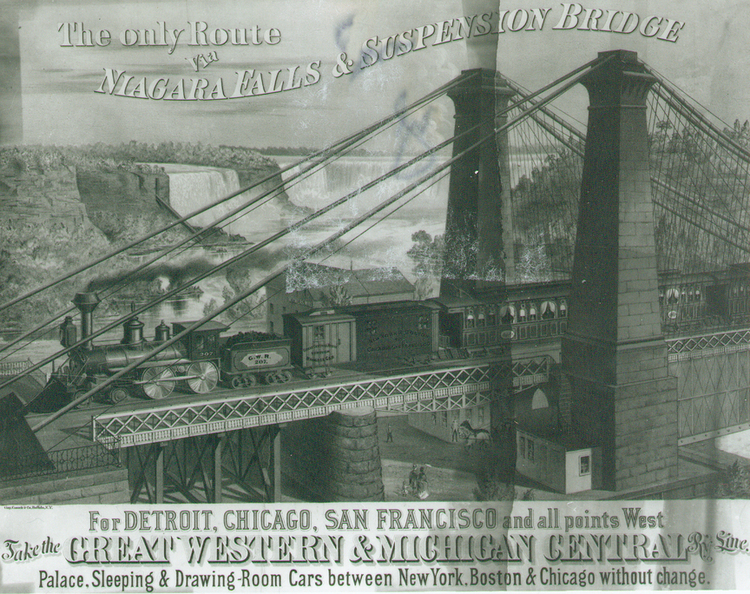
Advertising poster for the Great Western and Michigan Central Railroad, late 1850s Artistic licence places the bridge much closer to the Falls as is the case. Construction of the bridge was completed in 1855 Image courtesy of Niagara Falls Public Library
Hurrah, for the straight, hard iron road ! ‡‡For the fire-horse swift and strong !
Hurrah for the pond’rous chariot-train ‡‡That fleetly speeds along !
Through wood and wold—through hill and dale, ‡‡Past hamlet, hut, and hall,
The snorting fire-horse flys apace, ‡‡With a swift adieu to all.
Trees, rocks, and streams seem darting past ‡‡Like shadows on the wind—
The earth itself is rushing on, ‡‡To recede fast, fast, behind !
Away ! away bounds the mighty steed, ‡‡While wondering crowds admire
And, breathless, gaze on the fearful force ‡‡Of iron moved by fire.
The horse—the horse of our grandsire’s days, ‡‡With bones and muscles strong—
And the camel tall, and the elephant, ‡‡Could drag huge loads along ;
But the iron-horse, from the hand of man, ‡‡Impelled by mind and steam,
Whirls mountain chariots through the air ‡‡With the swiftness of a dream !
Speed on, strong horse ! with thy tidings glad, ‡‡Through wood and wild, speed on—
Thou bear’st abroad in triumphs now, ‡‡The conquest Mind has won ! —
The marvels, mysteries, magic, spells ‡‡Of a darker, bygone day,
Before the fact of the iron-horse ‡‡Must quickly pass away—
And fleet and far o’er the iron road ‡‡Strong thoughts shall soon be borne,
To burst the bondsman’s irksome chain, ‡‡And blast the tyrant’s scorn :
Intelligence, and power, and peace, ‡‡As the Maker, God, designed,
Like a rainbow wreath shall gird the earth, ‡‡As the heritage of Mind.
Land of the wood, and ocean lakes— ‡‡Of the wild beasts’ dark abodes !
Lands where the shirtless savage raved ‡‡Wild mummeries to his gods !—
Land of the savage now no more ! ‡‡Blest, peaceful, prosp’rous land !
Thy wealth and freedom are secured ‡‡By a massive iron band !
The red man’s rude and murderous bow— ‡‡His flimsy bark canoe—
His frantic worship—war-whoop wild— ‡‡And nostrums not a few—
From Art and Commerce fled away, ‡‡Yielded to mental force :
And Science now, on her iron road, ‡‡Sends forth her iron-horse.
Hail, Canada ! Thy fame, in part, ‡‡Is shadowed here to-day,
When sounds the steam-car’s whistle loud ‡‡Round our commercial Bay,
And hark ! the whistle sounds again ; ‡‡Crowds press, with keen desire,
To witness Mind’s stupendous power ‡‡In iron and in fire.
Source: St. Catharines Journal, November 17, 1853. p. 1
From Holt, William J. (ed) Niagara Falls, Canada: A History of the City and the World Famous Beauty Spot; an Anthology. Niagara Falls: Kiwanis Club of Stamford, 1967, p. 62 :
“The coming of the Great Western Railway in 1853 brought boom times to the village of Elgin, Canada West.* Hundreds of jobs were created in construction and railroading in Elgin, resulting in a startling population increase from 100 in 1853 to 2000 in 1857. The Great Western, in 1845, took over a charter granted in 1834 to the London and Gore Railroad, which gave it authority to build from any point on the Niagara River to the Detroit River. The construction of the Suspension Bridge at Elgin and its charter provision for a top deck for railroad traffic made Elgin the obvious choice.
Samuel Zimmerman had the contract to construct the portion of the line between Hamilton and Niagara Falls. Construction began in 1851 and the first run to Niagara Falls, with a steam engine and six passenger cars, took place in November, 1853. A gala party was planned at Zimmerman’s Clifton Hotel to mark the arrival of the first train and even though the last few miles of the trip were made by road, after the locomotive broke down, the party was held.”
It is possible that this poem was read at the gala.
*Elgin was a small village where the present day Via/Go railway station and the Niagara Falls bus terminal are located, a few blocks from Niagara Falls City Hall. It amalgamated with the village of Clifton in 1856, and in 1881 was renamed the Town of Niagara Falls. In 1904 the Town of Niagara Falls and the Village of Niagara Falls (formerly Drummondville) were amalgamated to form the City of Niagara Falls.
Lydia Huntley Sigourney 1791-1865 by Augustus Washington, 1855
Flow on for ever, in thy glorious robe
Of terror and of beauty ! God hath set
His rainbow on thy forehead, and the cloud
Mantled around thy feet. And he doth give
The voice of thunder power to speak of Him
Eternally — bidding the lip of man
Keep silence, and upon thy rocky altar pour
Incense of awe-struck praise.
‡‡‡‡‡‡‡‡‡‡‡And who can dare
To lift the insect trump of earthly Hope,
Or Love, or Sorrow, — ‘mid the peal sublime
Of thy tremendous hymn? — E’en Ocean shrinks
Back from thy brotherhood, and his wild waves
Retire abashed. — For he doth sometimes seem
To sleep like a spent laborer, and recall
His wearied billows from their vexing play,
And lull them in a cradle calm : — but thou,
With everlasting, undecaying tide,
Dost rest not, night or day.
‡‡‡‡‡‡‡‡‡‡‡The morning stars,
When first they sang o‘er young Creation‘s birth,
Heard thy deep anthem — and those wrecking fires
That wait th’ Archangel‘s signal to dissolve
The solid Earth, shall find Jehovah‘s name
Graven, as with a thousand diamond spears,
On thine unfathomed page. Each leafy bough,
That lifts itself within thy proud domain,
Doth gather greenness from thy living spray,
And tremble at the baptism. Lo! yon birds
Do venture boldly near, bathing their wing
Amid thy foam and mist. — ‘Tis meet for them
To touch thy garment‘s hem, — or lightly stir
The snowy leaflets of thy vapour wreath, —
Who sport unharmed upon the fleecy cloud,
And listen at the echoing gate of Heaven,
Without reproof. But, as for us, — it seems
Scarce lawful with our broken tones, to speak
Familiarly of thee. Methinks, to tint
Thy glorious features with our pencil‘s point,
Or woo thee to the tablet of a song,
Were profanation.
‡‡‡‡‡‡‡‡‡Thou dost make the soul
A wandering witness of thy majesty ;
And while it rushes with delirious joy
To tread thy vestibule, dost chain its step,
And check its rapture, with the humbling view
Of its own nothingness — bidding it stand
In the dread presence of th’ Invisible,
As if to answer to its God through thee.
Signed L.H.S., Hartford, Conn.
Source: Parsons, Horatio A. A Guide to Travelers Visiting the Falls of Niagara. 2nd ed., greatly enlarged. Buffalo: O.G. Steele, 1835
Page from Sangster’s “Our Land Illustrated in Art & Song”
Also published in Tunis’s Topographical and Pictorial Guide to Niagara. Niagara Falls. W.E. Tunis, Publisher, 1855 under the title Apostrophe to Niagara
The first stanza was also published in Sangster, Charles, ed. Our Land Illustrated in Art & Song. Toronto: Toronto Willard Tract Depository, 1887.
Also published in: Holley, George W., ed. The Falls of Niagara. Baltimore: A.C. Armstrong & Son, 1883
Also published in Johnson, Richard L. (ed). Niagara: Its History, Incidents and Poetry. Washington: Walter Neale General Book Publisher, 1898
Source: Tunis, W.E. Tunis’s Topographical and Pictorial Guide to Niagara. Niagara Falls, NY: W.E. Tunis, Publisher, 1855
The Pagoda that Almira refers to was at Point View, which “is a sudden elevation of the bank a few rods below the ferry-house Until five or six years ago, the adjacent grounds were tastefully arranged into a pleasure-garden and bowling-green. Upon this spot stood a Chinese Pagoda, surmounted by a camera-obscura. A few rods to the east of this stood the cabin of Francis Abbott. Apropos of the place, we subjoin Stanzas….”
From George Drought Warburton’s Hochelaga; or. England in the New World, 1846 edition, p 129-130:
Now, the neighborhood of this great wonder is overrun with every species of abominable fungus — the growth of rank bad taste; with equal luxuriance on the English and American sides, Chinese pagoda, menagerie, camera obscura, museum, watch-tower, wooden monument, sea gardens, “old curiosity shops.” A boy handed me a slip of paper, on which were printed some stanzas of astounding magnificence signed ” Almira, ” much in the favorite style of the poet laureate to ” Moses and Son. ” I cannot refrain from giving a short quotation:
Note that the lines Andfromtheunfinishedstructuregazeabroad, / AndwonderatthepowerofGod; before the line To the Pagoda’s utmost height ascend, in the original poem by Almira, have been omitted.