Laura Secord by Agnes Maule Machar

During the so-called war of 1812-14 between England and the United States, Laura Secord, the wife of a crippled British veteran, saved the British forces from surprise and possible destruction by the heroic action narrated in the ballad. Her home lay near the celebrated Queenston Heights, a few miles from the Falls of Niagara.

machar
Laura Secord  Monument
 Drummond Hill Cemetery, Niagara Falls.
Image courtesy of Niagara Falls Public Library

Softly the spell of moonlight fell
‡‡On the swift river’s flow,
On the gray crags of Queenston Heights,
‡‡And the green waves below.

Alone the whip-poor-will’s sad cry
‡‡Blent with the murmuring pines,
Save where the sentry paced his rounds
‡‡Along th’ invading lines.

But in one lowly cottage home
‡‡Were trouble and dismay ;
Two anxious watchers could not sleep
‡‡For tidings heard that day ;

Brave James Secord, with troubled heart,
‡‡And weary crippled frame,
That bore the scars of Queenston Heights,
‡‡Back to his cottage came ;

For he had learned a dark design
‡‡Fitzgibbon to surprise,
As with a handful of brave men
‡‡At Beaver Dam he lies.

‘And Boerstler, with eight hundred men,
‡‡Is moving from the shore
To steal upon our outpost there,
‡‡Guarded by scarce two score !

‘Then, wiping out, as well he may,
‡‡That gallant little band,
The foe will sweep his onward way
‡‡O’er the defenceless land.

‘Then noble Brock had died in vain—
‡‡If but Fitzgibbon knew !’—
And the poor cripple’s heart is fain
‡‡To press the journey through.

But Laura, bending o’er her babes,
‡‡Said, smiling through her tears :
‘These are not times for brave men’s wives
‡‡To yield to craven fears.

‘You cannot go to warn our men,
‡‡Or slip the outposts through ;
But if perchance they let me pass,
‡‡This errand I will do.’

She soothed his anxious doubts and fears :
‡‡She knew the forest way ;
She put her trust in Him who hears
‡‡His children when they pray !

Soon as the rosy flush of dawn
‡‡Glowed through the purple air,
She rose to household tasks—and kissed
‡‡Her babes with whispered prayer.

To milk her grazing cow she went ;
‡‡The sentry at the lines
Forgot to watch, as both were lost
‡‡Amid the sheltering pines.

The rising sun’s first golden rays
‡‡Gleamed through the forest dim,
And through its leafy arches rang
‡‡The birds’ sweet morning hymn.

The fragrant odour of the pines,
‡‡The carols gay and sweet,
Gave courage to the fluttering heart,
‡‡And strength to faltering feet.

And on she pressed, with steadfast tread,
‡‡Her solitary way,
O’er tangled brake and sodden swamp
‡‡Through all the sultry day.

Though, for the morning songs of birds
‡‡She heard the wolf’s hoarse cry,
And saw the rattlesnake glide forth,
‡‡As swift she hurried by.

Nor dark morass nor rushing stream
‡‡Could balk the steadfast will,
Nor pleading voice of anxious friends
‡‡Where stood St. David’s Mill.

The British sentry heard her tale,
‡‡And cheered her on her way ;
But bade her ‘ware the Indian scouts
‡‡Who in the covert lay.

Anon, as cracked a rotten bough
‡‡Beneath her wary feet,
She heard their war-whoop through the gloom,
‡‡Their steps advancing fleet ;

But quickly to the questioning chief
‡‡She told her errand grave
How she had walked the livelong day
‡‡Fitzgibbon’s men to save !

The redskin heard, and kindly gazed
‡‡Upon the pale-faced squaw ;
Her faithful courage touched his heart,
‡‡Her weary look he saw.

‘Me go with you’ was all he said,
‡‡And through the forest gray
He led her safe to Beaver Dam,
‡‡Where brave Fitzgibbon lay.

With throbbing heart she told her tale ;
‡‡They heard with anxious heed,
Who knew how grave the crisis was.
‡‡How urgent was the need !

Then there was riding far and near,
‡‡And mustering to and fro
Of troops and Indians from the rear
‡‡To meet the coming foe ;

And such the bold, determined stand
‡‡Those few brave soldiers made—
So fiercely fought the Indian band
‡‡From forest ambuscade,—

That Boerstler in the first surprise
‡‡Surrendered in despair,
To force so small it scarce could serve
‡‡To keep the prisoners there !

While the brave weary messenger
‡‡In dreamless slumber lay,
And woke to find her gallant friends
‡‡Were masters of the fray.

∗                   ∗               ∗             ∗             ∗

If e’er Canadian courage fail,
‡‡Or loyalty grow cold,
Or nerveless grow Canadian hearts,
‡‡Then be the story told—

How British gallantry and skill
‡‡There played their noblest part,
Yet scarce had won if there had failed
‡‡One woman’s dauntless heart !


Source:  Agnes Maule Machar.  Lays of the ‘True North’ and Other Canadian Poems.  2nd enlarged ed. London: E. Stock, 1902

Click here to see an earlier version of this poem, published in 1880, under the title Mary Secord and using Machar’s pen name ‘Fidelis’

Read about the life of Machar

Read about the Battle of Beaverdams

Read more poems about the War of 1812


On Viewing the Falls of Niagara, as Photographed by George Barker by Jones Very

barker
Photograph of Ice Bridge, Ice Mound, and American Fall, Niagara by George Barker.
Image Courtesy of the Library of Congress

Amidst those scenes of wonder do I stand,
Though not in bodily presence, but in thought ;
Stupendous works of the Almighty’s hand,
By artist’s skill before my vision brought.
The deep, strong floods, that downward ever pour,
The mists, that from their bosom ever rise,
I see, and almost seem to hear the roar
Of many waters sounding to the skies.
The littleness of man, the power of God,
Doth to the sight as visible appear !
So felt the Indian, as these scenes he trod ;
‘Twas the Great Spirit’s voice he seemed to hear,
That the deep silence of the forests broke,
And to his children in its thunders spoke.


Source: Jones Very. Poems and Essays. Complete and revised ed. Boston: Houghton Mifflin, 1886

Very wrote this poem in September, 1875

Read about Very here

Read about George Barker here


From the Sublime to the Ridiculous by Evan MacColl

maccoll
Evan MacColl
from the frontispiece


Lines suggested by a glance at the visitor’s Album, kept at the Museum, Niagara Falls.

Give up, ye would-be bards, your rhymes to tag here so,
In vain you rack your brains to paint Niagara.
A theme which even Milton’s muse might beggar, you
Had better let alone when at Niagara.
About Lodore right well could Southey swagger, tho’
‘Twould take ten thousand such to match Niagara.
To all who can stand boasting fit to stagger me,
I’d recommend a visit to Niagara.
Hear yon sleek slaver—not a bit in waggery—
Toasting the “Flag of Freedom” at Niagara!
“You Canucks,” quoth he, “need the starry flag o’er you
To make you worth your salt benorth Niagara!
You can’t too quickly have that British rag o’er you
To disappear entirely from Niagara!
He calculates some day to blast a crag or two
And drain Lake Erie all up from Niagara.
He speculates, just as myself I drag away,
How Ætna’s throat would like to gulp Niagara!
Oh, cousins, cousins! what a set for brag are you!
When will you learn mere froth is not Niagara?
But I must cease, lest they should lynch or dagger me;
Already they have fleeced me at Niagara.


Source: Evan MacColl.  The English Poetical Works of Evan MacColl.  2nd Canadian edition.  Toronto: Hunter, Rose & Co., 1885

Click here to see a biography of Evan MacColl

The Falls of Niagara by Edward Hartley Dewart

dewart
Edward Hartley Dewart
1828-1856
Courtesy of Wikimedia Commons

ERE yet I saw the wild magnificence,
Which Nature here with peerless pomp unveils,
A solemn sound—a stern and sullen roar—
By which the earth was tremulously thrilled—
Kindled a flush of deep, expectant joy,
Quickening the pulses of my throbbing heart,
And tingling through my veins like fire. But now,
While standing on this rocky ledge, above
The vast abyss, which yawns beneath my feet,
In silent awe and rapture, face to face
With this bright vision of unearthly glory,
Which dwarfs all human pageantry and power,
This spot to me is Nature’s holiest temple.
The sordid cares, the jarring strifes, and vain
Delights of earth are stilled. The hopes and joys
That gladden selfish hearts, seem nothing here.

The massy rocks that sternly tower aloft,
And stem the fury of the wrathful tide—
The impetuous leap of the resistless flood,
An avalanche of foaming, curbless rage—
The silent hills, God’s tireless sentinels—
The wild and wondrous beauty of thy face,
Which foam and spray forever shroud, as if
Like thy Creator, God, thy glorious face
No mortal eye may see unveiled and live—
Are earthly signatures of power divine.
O! what are grandest works of mortal art,
Column, or arch, or vast cathedral dome,
To these majestic foot-prints of our God!

Unique in majesty and radiant might,
Earth has no emblems to portray thy splendor.
Not loftiest lay of earth-born bard could sing,
All that thy grandeur whispers to the heart
That feels thy power. No words of mortal lips
Can fitly speak the wonder, reverence, joy—
The wild imaginings, thrilling and rare,
Which now, like spirits from some higher sphere,
For whom no earthly tongue has name or type,
Sweep through my soul in waves of surging thought.
My reason wrestles with a vague desire
To plunge into thy boiling foam, and blend
My being with thy wild sublimity.
As thy majestic beauty sublimates
My soul, I am ennobled while I gaze—
Warm tears of pensive joy gush from my eyes,
And grateful praise and worship silent swell,
Unbidden, from my thrilled and ravished breast;
Henceforth this beauteous vision shall be mine—
Daguerreotyped forever on my heart.

Stupendous power! thy thunder’s solemn hymn
Whose tones rebuke the shallow unbeliefs
Of men, is still immutably the same.
Ages ere mortal eyes beheld thy glory,
Thy waves made music for the listening stars,
And angels paused in wonder as they passed,
To gaze upon thy weird and awful beauty,
Amazed to see such grandeur this side heaven.
Thousands, who once have here enraptured stood,
Forgotten, lie in death’s lone pulseless sleep;
And when each beating heart on earth is stilled,
Thy tide shall roll, unchanged by flight of years,
Bright with the beauty of eternal youth.

Thy face, half-veiled in rainbows, mist, and foam,
Awakens thoughts of all the beautiful
And grand of earth, which stand through time and change
As witnesses of God’s omnipotence.
The misty mountain, stern in regal pride,
The birth-place of the avalanche of death—
The grand old forests, through whose solemn aisles
The wintry winds their mournful requiems chant—
The mighty rivers rushing to the sea—
The thunder’s peal—the lightning’s awful glare—
The deep, wide sea, whose melancholy dirge,
From age to age yields melody divine—
The star-lit heavens, magnificent and vast,
Where suns and worlds in quenchless splendor blaze—
All terrible and beauteous things create
Are linked in holy brotherhood with thee,
And speak in tones above the din of earth
Of Him unseen, whose word created all.

God of Niagara! Fountain of life!
At whose omnific word the universe
Arose; whose love upholds all worlds, and guides
Each orb in its mysterious path through space;
Around whose throne the Morning-stars of light
Bend low in wondering adoration, or
With lofty hymns of love and joy proclaim
Thy power and grace, boundless—immutable!
I, a poor erring worm of earth, a child
Of sin, am all unworthy to behold
This faint reflection of thy glorious power:
How, then, can I approach thy glorious throne,
Or dare to breathe in thine offended ear
The wants and woes of my polluted heart?

Father of mercy! hear my trembling prayer!
To me let love and light divine be given,
To guide my erring feet in paths of truth,
And purify my dark and sin-stained heart;
That while I muse upon thy glorious works,
And mark the tokens of thy presence here,
I may behold Thyself, and find in Thee
My strength, my light, my everlasting Friend.


Source:  Edward Hartley Dewart.  Songs of Life: A Collection of Poems.  Toronto: Dudley & Burns, Printers, 1869

Biography of Dewart

Dewart

Lines Written After Seeing the Falls of Niagara by Henry G. Dalton

dalton
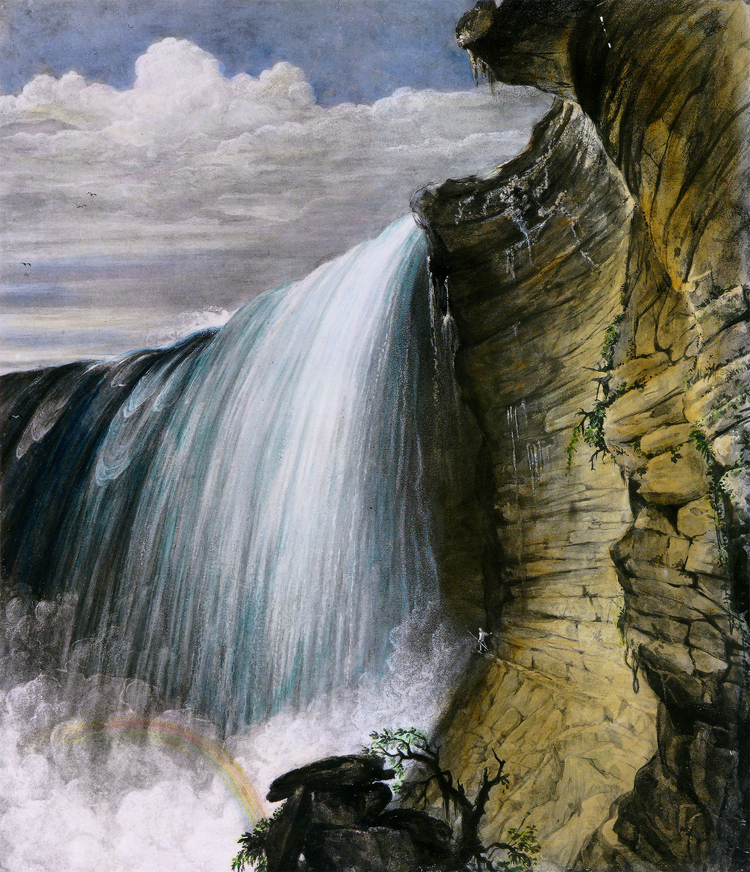
Horseshoe Falls and Table Rock, 1846. by Hanry Samuel Davis. Colour tint by Erna Jahnke
Courtesy of Niagara Falls Public Library

Wonder of earth! I stand upon thy shore,
‡‡And, spirit-awed, behold thy em’rald wave;
I see thy rapids foam, and hear them roar,—
‡‡As frenzied, like the whirpool, waters rave,
‡‡‡‡Or wildly rush in reckless flight,
‡‡‡‡Far onward, gathering giant might,
‡‡‡‡And boldly leap thy rocky height,
‡‡‡‡‡‡Niagara!

Hath eye of mortal seen in other clime
‡‡Such sight as greets his view from Table Rock,
While on the rent and rugged edge sublime,
‡‡Entranced he witnesses the torrent’s shock?
‡‡‡‡Like peals of thunder rolling round,
‡‡‡‡Or cannon booming on the ground,
‡‡‡‡Such is thy overwhelming sound,
‡‡‡‡‡‡Niagara!

Millions of eyes have rested on thy wave,
‡‡Millions of hearts have throbb’d at thy dread sound;
Those millions now are mould’ring in the grave,—
‡‡Not e’en thy voice can break their sleep profound
‡‡‡‡And still thy waters downward dash,
‡‡‡‡And still thy ocean torrents splash,
‡‡‡‡Thy clouds of spray in sunlight flash,
‡‡‡‡‡‡Niagara!

The lonely Indian started at the sight,
‡‡When ages since he view’d thy rapid stream;
Chas’d is that Indian by the hand of might,
‡‡And his dark hist’ry seems but like a dream;
‡‡‡‡Now, here another people trace
‡‡‡‡What mortal hand cannot erase,
‡‡‡‡But thou defiest man’s vain race,
‡‡‡‡‡‡Niagara!

Kingdoms and nations have appeared and gone,
‡‡Thrones, people, empires, dynasties and all,
Yet still thou rollest on untired, alone,
‡‡And see’st the greatest like the meanest fall;
‡‡‡‡Forests have grown, and are no more,
‡‡‡‡Or wither’d lie beside thy shore,
‡‡‡‡But thou art changeless as before,
‡‡‡‡‡‡Niagara!

Beside thee giant works have worn away,
‡‡Their fragments disappear’d like grains of sand;
Beside thee all the things of life decay,
‡‡Yet still thou marchest over rock and land;
‡‡‡‡Ages with thee are but an hour,
‡‡‡‡Their ravages increase thy pow’r,
‡‡‡‡Eternity appears thy dow’r,
‡‡‡‡‡‡Niagara!

Flow on! flow on! thou mightiest of things;
‡‡On thee some lofty mission is impressed;
To me the voice of God in echo rings
‡‡From out thy tempest roar and foaming crest.
‡‡‡‡Oh! is it wrath or is it peace,
‡‡‡‡Our fears to waken or appease?
‡‡‡‡None, none shall know till time doth cease,
‡‡‡‡‡‡Niagara!

But when this world, and all its wonders dread,
‡‡Shall be destroyed by the same hand that made,
Thou, too, wilt be enrolled among the dead,
‡‡And thy hoarse torrent be for ever stay’d;
‡‡‡‡When man receives the doom divine,
‡‡‡‡And sun and stars have ceased to shine,
‡‡‡‡Annihilation will be thine,
‡‡‡‡‡‡Niagara!


Source:  Henry G. Dalton.  Tropical Lays and Other Poems.  London: J. Evans, 1853.