I’m surrounded by apples. The buckets are heavy laden, spotting the front and sides of the barn with mounds of red rounds. David’s saws settle in behind the bounty. He points to tomato vines weaving a fence on a heap of boards, to other cauldrons blooming his brother’s favoured seeds. The air is full of saw dust and skunk and Jonamac must and the sugar of warm raspberries. David shows me the jigsaw and what he is making. He hacked down the dying walnut tree himself, clawed it from the dirt with his hands and his tools, and here it is, transformed into chess: a raw rook, a crooked king, near perfect pawns. David built the barn we are in, figured out how to fit the pieces together and raise them with his own two ruddy hands and instructions from his Dad and his granddad. He is 20. He has a slow grin and a sharp twinkle behind his glasses. When he was two, he padded over to me with an orange extension cord wound expertly around one arm, pressed the other end to my neck and made animated noises. Started digging holes and mixing cement that same summer, in his floppy yellow boots. He never cried, not until two decades had fallen away and he and I were standing together at the foot of a hospice bed, saying goodbye to my father. Dad, I said, the barn. If you could only see this kid’s barn! He never would. He never walked again. We buried him. But in the midsummer sunset, the rooster weathervane raised to that roof brands the night in his blood.
Source: The author. This prose poem first appeared in Verse and Voice (Hong Kong)
Lorette in North Africa with her camel friend.
Lorette C. Luzajic was born in Niagara Falls and lives in Toronto. She has a degree in journalism from Ryerson University, but has been a lifelong student of art history and poetry. She is the founding editor of The Ekphrastic Review, a journal devoted to literature inspired by visual art. She writes prose poems and small fictions that merge personal experiences and observations and the contemplation of visual art. Her works were selected as Best Small Fictions 2023 and 2024, and have also been nominated several times each for Best of the Net, the Pushcart Prize, and Best Microfictions, as well as seven times for Best American Food Writing for her column on food and art in Good Food Revolution. Lorette is also an award-winning mixed-media artist who has collectors in over forty countries so far. Visit her at www.mixedupmedia.ca
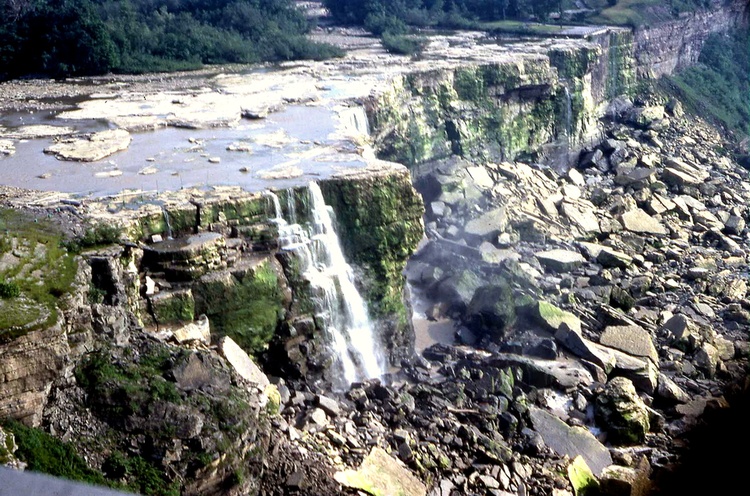
Dewatered American Falls From Prospect Point Observation Tower; Showing Rock Build-Up at Base, 1969 Photo by Albert Knobloch Image courtesy of Niagara Falls Public Library
Back in ‘69
was decided to divert
mighty river
to dry falls.
Why, you might ask
For the Army Corp
to remove large rocks,
great majesty to fall
further into depths
at the base, Maid to see
splendor from the mist
but did they expect
remains to be found,
those fallen and drowned
forever lost in those rocks?
Spectators traveled far
and even those near sought
to see the dry falls, huge
drop sans thunderous water;
I was among those there
young teen at the railing,
hundreds lined up, a turn
to witness such an event,
dried up river bed, dry falls
never seen again since,
burned into my closed eyes,
even photographs cannot
diminish that great memory.
Julie A. Dickson
This poem was written in 2024 and is previously unpublished.
Julie A. Dickson is originally from Buffalo, NY. Her father’s family was from Guelph and Vineland Station, Ontario, Canada in the late 1800’s, they founded the Culverhouse Canning Factory there. Dickson lived near Lake Erie and Niagara Falls until her early teens, when her family relocated to Massachusetts. Always the lakes-girls, her poems often reflect in memories of Lakes Ontario and Erie, and visiting the falls. Her poems appears in many journals including Ekphrastic Review, Misfit, Open Door and others; full length works on Amazon. Dickson has been a guest editor, past poetry board member, is an advocate for captive elephants and shares her home with two rescued cats.
Julie A. Dickson was the guest editor of the Ekphrastic Review challenge to write a poem inspired by Frederic Edwin Church’s painting Niagara, 1857. See a page about ekphrastic poetry of Niagara, including the poems from the Ekphrastic Review
Cave of the Winds, Niagara Falls NY Two separate touring parties, one approaching and the other leaving Hurricane Deck . In foreground is Wildcat Stream. In background at right, Bridal Veil Falls and at left, American Falls
The rubber boots
were too large
for my child-sized feet
We stood in line
my brother and me
between slicker-ed parents
Slowly we walked down
metal stairs into a cave –
rush of water loud in my ears
damp, moldy smelling walls,
water trickling down, looked
at the floor to ensure firm footing
until we reached the look-out. Cave of the Winds, they said,
strange to a child of seven
whistling and howling winds
blew through, spraying my face,
a fine sheen of water soaking me
Peered out from behind a sheet
of water, thundering past cave
opening to the rocks below
I squeezed mother’s hand
feeling the power it yielded,
yellow slicker enveloped me
Julie A. Dickson
Julie A. Dickson is originally from Buffalo, NY. Her father’s family was from Guelph and Vineland Station, Ontario, Canada in the late 1800’s, they founded the Culverhouse Canning Factory there. Dickson lived near Lake Erie and Niagara Falls until her early teens, when her family relocated to Massachusetts. Always the lakes-girls, her poems often reflect in memories of Lakes Ontario and Erie, and visiting the falls. Her poems appears in many journals including Ekphrastic Review, Misfit, Open Door and others; full length works on Amazon. Dickson has been a guest editor, past poetry board member, is an advocate for captive elephants and shares her home with two rescued cats.
Julie A. Dickson was the guest editor of the Ekphrastic Review challenge to write a poem inspired by Frederic Edwin Church’s painting Niagara, 1857. See a page about ekphrastic poetry of Niagara, including the poems from the Ekphrastic Review
The path is worn.
A scar scorched through the forest by an untold number of travelers.
The sky is gray.
What leaves remain on the trees are at rest.
Silent.
Still.
Looking down, a pair of legs are moving forward but no steps are heard.
How long have they been walking?
Looking up, the path, with long snow kissed grass skirting the sides stretches on without end.
To the left an unseen cliff, to the right a spacious field filled with unremarkable flora.
The pace quickens to combat an incessant chill.
How much longer to go?
His legs ache. A glance backwards reveals nothing as the path melts away into black. The further he walks the more darkness gathers behind.
With eyes now forward on the perennial view, he feels a weakening resolve and for the first time, a shortening stride.
Ahead, a soft bend is revealed.
A new breeze arouses the leaves while the mute footsteps become perceptible.
Rounding the bend.
The once impenetrable clouds disperse to reveal a warming sun, a distinct tune from a bird and a flower in bloom.
Entranced by the surprising change he carelessly slows to a saunter while the bend hardens in front of him.
Warm turns to hot turns to blazing.
The song turns to noise turns to a cry.
The grass thickens and encroaches on the path with sharpened blades.
A wince.
As he shields his eyes from the light he kicks towards the intruding growth and launches into a blind run.
The color flushes away and the noise fades to a hum, to a dead calm.
Defeated, he opens his eyes and fixes them back on the straightened path.
Silent.
Still.
Myles Calvert
Source: Myles Calvert, 2023. Written in May, 2021.
The location of “the path” is heavily influenced by a hiking trail at Decew Falls / Morningstar Mill. As you walk along away from the waterfall there is a cliff on your left and at times an open field to your right.
Those who have walked it before may know it well and recognize the descriptions (although the waterfall is not mentioned in The Path).
Cover of “Dear Martin” by Nic Stone, the book that inspired this poem
I am from a bad neighborhood with just me and my mom From learning to go right rather than wrong I am from learning to trust even if their skin is white From learning to fight with words for my rights
I am from playing video games with my best friend Manny From debating with SJ and going to Blake’s terrible parties I am from being on and off with Melo And from me and Jared sharing only a small “hello”
I am from almost always listening to my Mama And from getting caught up with Jared and Blake’s drama. From trying to make it to the top, even when Trey always feels the need to tell me, “Mr. Smarty Pants”, to stop
I am from always knowing I can go up to Doc And from realizing showing compassion is just one drop From realizing no matter how hard I try, I won’t be able to let those cold metal handcuffs fly I am from learning Castillo’s dead, but it never mattered From the cold metal cuffs still being felt by me in the shower
I am from understanding, there will always be jerks And from learning it doesn’t matter and not to assume the worst From late-night conversations with SJ when there’s no need to pretend And from making mistakes I can learn from in the end
I am from asking Martin for some guidance And from not letting my voice rest in the silence I am from learning to say my words and fight with peace From understanding my life isn’t missing a puzzle piece
I am from figuring out, they aren’t trying to be insensitive; based on where they came from, it just comes out. I am from learning to forgive just like Martin would From making it clear that, “it’s aight we good” I am from believing no one should be alone From everyone should have somewhere to call home
I am from finding out that compassion will win again and again, opinions aside I am from learning, just like Martin said, we should all be kind and look for what’s on the inside I am from trying always to look at people and understand From trying to answer the big question, “are all men really created equal in the end?”
Source: Hardi Patel, 2023. First submitted as a student project in English class, and then published in the African American Registry, Fall 2022. Also published on the I Am Fromwebsite in 2022
My name is Hardi Patel and I am the author of the “I Am From – Justyce’s Perspective” poem.
This poem is based on Nic Stone’s Dear Martin novel. I am a first-generation Canadian from India. I am currently a student at AN Myer Secondary School in Niagara Falls, Ontario. I am heading into Grade 11 this September; however, this poem was written by me when I was in Grade 9.
This poem began as a portion of my culminating assignment given to me by my Grade 9 teacher, Tina Chivers. My English class studied many writing pieces throughout the semester. Our novel was Dear Martin by Nic Stone. Throughout the semester, we studied the question, “Are all men created equal?”
For my course culminating assignment, I was given many media options and had to choose one to represent my understanding of Dear Martin. I chose the poem option. However, I was faced with a barrier: I didn’t know how to write another poem other than the “I Am From” poem. So, after looking at different poetry forms, I decided to write an “I Am From” poem. However, I wrote it from the perspective of the main character in the book, Justyce McAllister. The “I Am From” poem was something my Grade 9 class did at the beginning of the semester (https://iamfromproject.com/?s=tina+chivers). When I asked Mrs. Chivers what she thought of my idea, she said, “Amazing” and continued with, “That’s an awesome idea! I’m excited to see it!”
Dear Martin was impactful to my class, largely because the main characters in the book were the same age as we were. We could visualize ourselves in their shoes but felt thankful for a safe and accepting community. I found it easy to see these characters as your friends. Ms. Stone’s writing made it easy for me to understand Justyce’s intentions. I also understood how he felt about everything that was transpiring in his life. Although this is a fictional story, all details are relevant to modern life.
Through my poem, I attempted to convey Justyce’s thirst to be an excellent person even with all of the challenges he faced. I attempted to write about how Justyce didn’t change because of the negatives, but rather, he kept trying because of the positives. I wanted my poem to be a summary of the novel, and reinforce the main ideas of the book for Dear Martin’s readers.
This poem was never meant to reach a large audience.
I sent my poem to Ms. Stone, and she showed me lots of love. Mrs. Chivers encouraged me to send it to the “I Am From” project; I got a lot of appreciation from them as well. I’m thankful for these people. Julie Landsman, one of the women who run the I Am From Project reached out to me about adding my poem to the 2022 Fall issue of the African American Registry which is an initiative that she is also a part of. This offer elated me! Additionally, Mrs. Chivers contacted a local library (The Niagara Falls Public Library) and helped put my poem in their local writer’s section! After that, Paul Forsythe published an article in the Niagara This Week newspaper about my poetry. He interviewed Mrs. Chivers and me about how it came to be. As well, the mayor of Niagara Falls, Mayor Jim Diodati, sent me a handwritten note congratulating me on my achievements!
This has certainly been a memorable experience for me. This simple poem with a message I wrote has had an extraordinary impact on my life. I am extremely grateful for the support I have received from so many individuals. When I sent it to Ms. Stone and Ms. Landsman, I simply took a chance, and I received a great deal of support from them. This is an example of how positive results can be achieved if you try or take something a step further.